Half of 2021 data center Ethernet switches to be 25GbE or 100GbE: Crehan Research
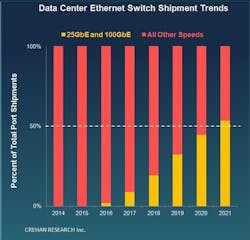
According to Crehan Research Inc.'s new "Data Center Switch Long-Range Forecast Report," sales of Ethernet switches for data center network applications will exceed $15 billion by 2021. Half of that total will come from a combination of 25 Gigabit Ethernet (GbE) and 100GbE platforms.
"25GbE and 100GbE data center switch adoption is already experiencing exponential growth, with port shipments currently in the hundred-of-thousands per quarter," explains Seamus Crehan, president of Crehan Research. "Volumes would likely be even higher if it weren't for pockets of supply constraints in certain areas, such as the optical transceivers that uplink and connect many of these switches."
Several factors will account for the popularity of such switches, according to the market research firm. These include cost structures that represent little or no price premium versus comparable 10 and 40 Gigabit Ethernet switches, the growth in bandwidth per lane, compatibility with existing data center fiber-optic cables, and pent-up demand from hyper-scale cloud providers.
As 25GbE and 100GbE switches increase in popularity, SFP-based 10GbE and QSFP-based 40GbE data center switch shipments will decline in 2017, the company says in the new report. However, Crehan expects 10GBASE-T data center switching to continue on a strong growth path for some time.
For related articles, visit the Business Topic Center.
For more information on high-speed transmission systems and suppliers, visit the Lightwave Buyer's Guide.