U.S. lags far behind in FTTH deployment
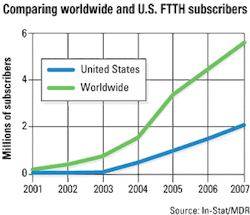
While fiber-to-the-home (FTTH) is beginning to make significant strides in high-speed broadband access in some parts of the world, the United States lags far behind in such deployments, according to a new report by In-Stat/MDR (Scottsdale, AZ). Korea, Sweden, Japan, and Italy—where strong residential FTTH deployments are already underway—have a head start on the United States, thanks to the encouragement of the telecommunications ministries in those countries.
Manufacturers like Alcatel and Optical Solutions are striving to make fiber a reality by developing equipment that will connect each resident to the high-speed Internet via a fiber connection. In-Stat/MDR contends that FTTH will be where DSL and cable are today in about 10 years.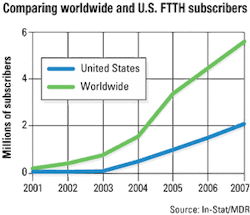
In the United States, FTTH is a small percentage of the total broadband business market, registering under 1%. North America accounts for roughly 50,000 subscribers, while Asia-Pacific and Europe account for 390,000 subscribers.
While the cost of deploying fiber will continue to decrease over the next five years, so too will the monthly charge to subscribers. Currently, the monthly cost of getting high-speed voice, video, and data access over fiber is around $130. In the future, the subscriber will be able to purchase the entire package for less than $100, which is what most customers are paying now for high-speed Internet access, voice, and video.
For more information about the report, "Fiber at the Speed of Light: Coming to a Neighborhood Near You," call 480-609-4533 or visit www.instat.com.