VeEX awarded a U.S. patent for analyzing downstream QAM environments

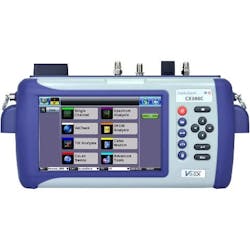
VeEX announced that the United States Patent and Trademark Office has issued U.S. Patent No. 11,848,789, “System Testers for Analyzing Downstream QAM Environments,” for its VeGrade® proprietary measurement feature.
While traditional techniques that use metrics like modulation error ratio (MER), bit error rate (BER), and power level often provide only basic assessments of signal quality, they lack the necessary details to empower field technicians to take appropriate action for improving signal quality.
VeEX's VeGrade assesses the quality of an individual Digital QAM channel and is available on the vendor’s CX310 and CX380C field test meters.
The CX380C features fast 1.8 GHz Spectrum Analysis and Sweep, DOCSIS 3.1 OFDM, Full SLM, V-Test Speedtest, OPM and TDR/DMM.
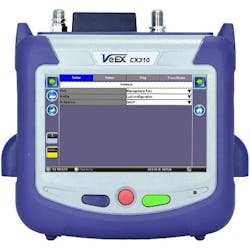
Designed to accommodate DOCSIS 3.1 migrations, the CX310 can help overcome the technical hurdles while not straining capital budgets.
By utilizing various metrics, VeGrade provides a Digital Grade ranging from A+ to F, enabling the identification of channels impacting service and requiring additional troubleshooting measures.
The VeGrade feature continuously and rapidly monitors the quality of the Digital Channel and provides a metric that the field technician quickly understands. This rapid monitoring capability allows the meter to capture bursty intermittent issues that may otherwise be overlooked by traditional measurements such as MER, BER, and Signal.
“With Analog channels slowly diminishing and Digital QAM channels taking their place in the CATV lineup, Cable TV operators are constantly monitoring and maintaining the quality of their digital signals,” said Mike Collins, product manager, CATV at VeEX. “Our patented VeGrade feature utilizes a user-friendly grading approach, providing an additional tool for troubleshooting and effectively resolving hard-to-detect impairments with Digital QAM channels.”
For related articles, visit the Network Design Topic Center.
For more information on high-speed transmission systems and suppliers, visit the Lightwave Buyer’s Guide.
To stay abreast of fiber network deployments, subscribe to Lightwave’s Service Providers and Datacom/Data Center newsletters.
About the Author
 Sean Buckley
Sean Buckley
Sean is the Editor-in-Chief of Lightwave. He establishes and executes Lightwave's editorial strategy across its website, email newsletters, events, and other information products. Before coming to Lightwave in July 2023, he served as editor of Broadband Communities. Earlier, he served as senior editor of FierceTelecom and the editor of the former Telecommunications Magazine. He got his start in the optical industry in 1998 when he became the editor of enterprise and optical networks at Information Gatekeepers. He has a BA in English from the University of Massachusetts, Boston, and lives in Dracut, Mass, with his wife, two sons, and his cat, Dove.