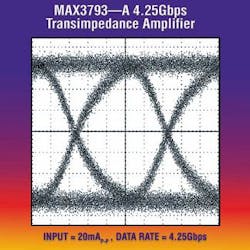
4.25-Gbit/sec TIA ideal for multi-rate transceivers
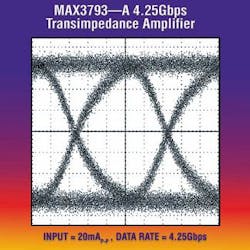
November 22, 2004 Sunnyvale, CA -- Maxim Integrated Products today introduced the MAX3793, a +3.3V, 4.25-Gbit/sec transimpedance amplifier (TIA) for multi-rate Fibre Channel and Gigabit Ethernet transceivers. The MAX3793 operates in 1X, 2X, and 4X Fibre Channel receivers without requiring a rate-select input. It is ideal for meeting 4.25-Gbit/sec performance without losing sensitivity at 1Gbit and 2-Gbit operation.
The MAX3793 has an RSSI output to indicate the module's received power. The MAX3793 TIA, the MAX3794 limiting amplifier, and the MAX3795 VCSEL driver comprise a chipset that provides an easy upgrade to 4-Gbit/sec Fibre Channel designs.
Operating from a single 3.3-V supply, the MAX3793 TIA has 2.9-GHz bandwidth and provides 3.5 kilohms of differential gain, while consuming only 105 mW of power. The device has an input overload of 2m A and generates only 370 nA root-mean-square of input referred noise. The MAX3793 has a low, 30-kHz low-frequency cut-off and generates only 6ps of deterministic jitter at 4.25 Gbit/sec.
The MAX3793 is available as 1.27-mm x 0.76-mm dice and operates over the industrial temperature range (-40 ° Celsius to +85 ° Celsius). Prices start at $1.25 in 1000-unit quantities. Evaluation kits are available to speed designs.