AI data centers will drive $583B IT, networking and energy opportunities by 2030
Data centers that support AI will drive new business opportunities, such as IT, networking, and energy businesses.
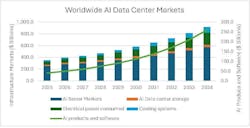
According to a new CIR study, Networks and Power Requirements for AI Data Centers: A Ten Year Market Forecast and Technology Assessment, AI will drive $583 billion in opportunities.
The research firm said that by 2030, AI data centers from firms such as Google, Microsoft, and OpenAI will spend $420 billion on networking, storage, and server products based on new technologies such as Ultra-Fast Ethernet, Co-packaged Optics (CPO), and Silicon Photonics.
Energy will also continue to play a key role during this forecast period. CIR forecasts that another $162 billion will be spent on providing electrical power and data center cooling. Within a few years, much of the power for AI data centers will come from Small Modular (nuclear) Reactors, and the cooling will switch from industrial A/C to liquid cooling.
Despite the potential in these industry segments, CIR's President, Lawrence Gasman, cautions that latency remains a key issue.
"Whether AI data centers realize their full revenue potential depends on if latency can be held in check," he said.
Gasman added that edge networking, high-bandwidth technologies, and locating the data centers close to large users can all reduce latency. "If we can cut through latency," said Gasman, IT, networking, and energy-related revenues from AI data centers will reach $915 billion by 2034.
For related articles, visit the Data Center Topic Center.
For more information on high-speed transmission systems and suppliers, visit the Lightwave Buyer’s Guide.
To stay abreast of fiber network deployments, subscribe to Lightwave’s Service Providers and Datacom/Data Center newsletters.
About the Author
 Sean Buckley
Sean Buckley
Sean is the Editor-in-Chief of Lightwave. He establishes and executes Lightwave's editorial strategy across its website, email newsletters, events, and other information products. Before coming to Lightwave in July 2023, he served as editor of Broadband Communities. Earlier, he served as senior editor of FierceTelecom and the editor of the former Telecommunications Magazine. He got his start in the optical industry in 1998 when he became the editor of enterprise and optical networks at Information Gatekeepers. He has a BA in English from the University of Massachusetts, Boston, and lives in Dracut, Mass, with his wife, two sons, and his cat, Dove.