Energia Communications tests G.fast, TWDM-PON in Japan
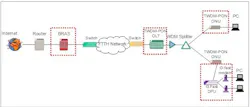
Energia Communications and Alcatel-Lucent (Euronext Paris and NYSE: ALU) have partnered to work out the systems vendor's G.fast and TWDM-PON technologies for possible use in Japan, the companies say. The trials aim to position Energia to eventually provide such bandwidth-intensive services as 8K television when the first such broadcasts begin in Japan in 2016.
The trial sees Energia using TWDM-PON for both fiber to the home (FTTH) as well as to feed G.fast distribution point units (DPUs; see illustration above). Energia envisions using G.fast to support up to 1-Gbps data rates to subscribers not easily reached via fiber, such as subscribers in multiple-dwelling units (MDUs). Other Alcatel-Lucent trial partners have expressed interest in similar applications for G.fast (see "First G.fast customer connected by Telekom Austria's A1 as part of trial").
TWDM-PON's four wavelengths are architected to run alongside existing PON wavelengths on the same fiber; the trial so far has proved this is the case, the two parties say. The Energia's current FTTH infrastructure runs EPON.
In addition to the TWDM-PON and G.fast gear, Energia is using Alcatel-Lucent's IP/MPLS 7750 Service Router to backhaul traffic from the access aggregation network to the core.
Alcatel-Lucent announced TWDM-PON capabilities last fall (see "Alcatel-Lucent unveils TWDM-PON"). It unveiled its first G.fast offerings in the same time frame (see "G.fast ONT available early next year says Alcatel-Lucent").
For more information on FTTx equipment and suppliers, visit the Lightwave Buyer's Guide.
About the Author
Lightwave Staff
Through our integrated media portfolio, Lightwave’s editorial staff delivers content focused on broadband, fiber optics and optoelectronics, the technologies that enable the growth, integration and improved performance of voice, data and video communications networks and services. Our experienced editorial team provides trusted technology, application and market insights to corporate executives, department heads, project managers, network engineers and technical managers at equipment suppliers, service providers and major end-user organizations.