Ocean Networks Selects Prysmian and IT International Telecom for Hawaiian Islands Fiber Link (HIFL) cable project
Key Highlights
- Ocean Networks has selected Prysmian and submarine cable engineering and installation specialist International Telecom (IT) for the Hawaiian Islands Fiber Link (HIFL) project.
- The Hawaiian Islands Fiber Link (HIFL) is a new infrastructure project to expand high-speed internet across Hawaiʻi.
- HIFL will be a carrier-neutral cable system allowing interconnections from any provider.
- HIFL will serve as the middle mile component of the State of Hawaiʻi’s “Connect Kākou” broadband initiative

What is the Hawaiian Islands Fiber Link (HIFL)?
The Hawaiian Islands Fiber Link (HIFL) is a new infrastructure project to expand high-speed internet across Hawaiʻi. As part of the project, an underwater fiber cable system is being installed connecting the islands of Oʻahu, Hawaiʻi, Maui, Kauaʻi, Lānaʻi, and Molokaʻi. The system will have 24 fiber pairs with a design life of 25 years and is expected to be ready for service in late 2026.
Ocean Networks (ONI), which is responsible for the supply, construction, operations, and maintenance of the Hawaiian Islands Fiber Link (HIFL) interisland cable system, has selected Prysmian and submarine cable engineering and installation specialist International Telecom (IT) for the project.
The project is being overseen by the University of Hawai'i System Office for Information Technology with support from the Research Corporation of the University of Hawaiʻi. A grant from the U.S. Treasury Department’s Capital Projects Fund (CPF) is funding part of the system, with the remaining costs covered by private funding secured by ONI.
Under the agreement, Prysmian will supply approximately 740 kilometers of submarine cable, while IT will provide essential engineering and installation services for the HIFL system.
Ocean Networks said this collaboration marks progress in the development of Hawaiʻi’s open-access, carrier-neutral inter-island fiber infrastructure, designed to improve and expand high-speed broadband internet throughout the state. Designed to last 25 years, HIFL will be a carrier-neutral cable system allowing interconnections from any provider.
“Securing these contracts represents a major step forward in the construction timeline for the HIFL project, bringing us closer to fulfilling the promise of improved connectivity for all of Hawaiʻi’s residents, businesses, education, and government entities,” said David Blau, COO of Ocean Networks.
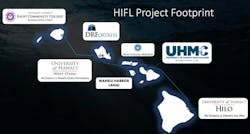
A hybrid build
Each cable landing facility will include a seaward-facing underground pipe, beach manhole, terrestrial conduit, and a cable station building. The subsea cable, beach manhole, and conduit will remain underground.
Some areas will have fiber cables that are aboveground, attached to existing telecom/electric poles.
Most of the cable landing stations will be established on University of Hawaiʻi property. However, in areas where that is not feasible, the university will work with the appropriate authorities to secure the site.
The state will retain a 20% ownership interest in the new network when it is completed.

Enabling Connect Kākou
As a key component of the State of Hawaiʻi’s “Connect Kākou” broadband initiative, the HIFL project aims to deliver connectivity across the Hawaiian Islands. HIFL provides the middle mile backbone needed to connect the islands and enable high-speed internet access statewide.
Led by Governor Josh Green and Lieutenant Governor Sylvia Luke, Connect Kākou is a State of Hawaiʻi initiative that aims to build infrastructure to connect unconnected and underserved areas with a path to achieve universal access by 2030. Leveraging over $400 million in federal funds, the organizers of the initiative are working to ensure that every resident of Hawai’i has access to broadband Internet – plus necessary digital literacy skills and devices.
Hawaiʻi will see $149.5 million under the BEAD Program alone to connect an estimated 12,700 people who cannot connect to the Internet at home or can only access slower speed DSL or dial-up internet services.
In January, the University of Hawaiʻi Broadband Office released eight Requests for Proposals (RFPs) aimed at expanding high-speed internet access across the state. This effort is part of the Broadband Equity, Access, and Deployment (BEAD) program.
For related articles, visit the Broadband Topic Center.
For more information on high-speed transmission systems and suppliers, visit the Lightwave Buyer’s Guide.
To stay abreast of fiber network deployments, subscribe to Lightwave’s Service Providers and Datacom/Data Center newsletters.
About the Author

Sean Buckley
Sean is responsible for establishing and executing the editorial strategy of Lightwave across its website, email newsletters, events, and other information products.