Neocloud revenue growth is accelerating by over 200% per year
Key Highlights
- Neoclouds focus on high-performance GPU infrastructure, supporting AI and machine learning workloads with specialized services like GPUaaS and GenAI platforms.
- Market forecasts predict neocloud revenues will exceed $23 billion in 2025 and approach $180 billion by 2030, growing at an average of 69% per year.
- Major players include CoreWeave, OpenAI, Crusoe, Lambda, and Nebius, with new entrants from startups and crypto miners expanding the ecosystem.
- Despite competition from hyperscale providers like Amazon, Microsoft, and Google, neoclouds claim advantages in efficiency and hardware access for AI workloads.
- Growth in GPUaaS and GenAI services is around 165% annually, with neoclouds increasing their market share in these high-demand areas.

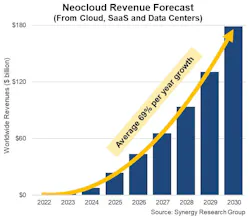
Neocloud revenues are in an upswing, surpassing $5 billion in the second quarter, up 205% from 2024.
A new Synergy Research Group report forecasts that neclouds are set to exceed $23 billion in revenues for 2025 and nearly $180 billion in 2030, growing at an average of 69% per year.
“While neoclouds do face fierce competition, they benefit from targeting segments that are growing explosively,” Synergy said. “neocloud plans and initiatives remain somewhat fluid, but in aggregate we see them steadily gaining market share in those high-growth target market segments.”
What is a neocloud?
A neocloud is a specialized cloud computing provider focused on delivering high-performance computing resources, particularly Graphics Processing Units (GPUs), for artificial intelligence (AI) and machine learning (ML) workloads. Unlike traditional "hyperscale" cloud providers that offer a wide range of services, neoclouds specialize in raw compute power to meet the demanding needs of AI training and inference, often with more efficient pricing and faster access to the latest hardware.
A specialized market
Neoclouds are providers that offer specialized cloud computing platforms that provide high-performance, GPU-centric infrastructure, and support artificial intelligence (AI) workloads.
Led by CoreWeave, neoclouds have become a challenger to traditional hyperscale cloud providers. Despite being different from other neoclouds, OpenAI is the largest of the group and will remain a key player over the coming years due to its Stargate initiatives.
Some of the key services of necoclouds are GPUs as a Service (GPUaaS, GenAI platform services, and high-capacity data centers. Joining CoreWeave and OpenAI, Crusoe, Lambda, and Nebius are the largest neoclouds. As a result of OpenAI’s emergence, neocloud also includes SaaS-like subscriptions to advanced, generative AI chatbot services.
A crop of new start-up companies, or crypto miners that are transitioning to being providers of high-performance computing services, have also entered the neocloud mix, including Altair, Applied Digital, Bitdeer, Core42, Core Scientific, DataRobot, Fluidstack, Hive Digital, HUMAIN, Hut8, IREN, Mawson, Northern Data Group, Nscale, TeraWulf, Together AI, and WhiteFiber.
While Amazon, Microsoft and Google also provide GPU and GenAI services, neocloud companies focus on GPUs rather than offering a broad portfolio of cloud services, which they claim brings many benefits.
GPUaaS and GenAI growth
Amidst the noise related to neocloud as well as Stargate service developments, GPUaaS and GenAI continue to see strong growth.
Jeremy Duke, Synergy Research Group’s founder and Chief Analyst, called the underlying “growth rates and future market size are truly impressive.”
Two areas of growth are GPUaaS and GenAI platform services, which are growing at around 165% per year, with neoclouds taking share in those markets.
“There is every reason to believe that they will continue to grow their market share, as cloud providers of all types struggle to match supply with burgeoning AI demand,” Duke said.
For related articles, visit the Data Center Topic Center.
For more information on high-speed transmission systems and suppliers, visit the Lightwave Buyer’s Guide.
To stay abreast of fiber network deployments, subscribe to Lightwave’s Service Providers and Datacom/Data Center newsletters.
About the Author
 Sean Buckley
Sean is the Editor-in-Chief of Lightwave. He establishes and executes Lightwave's editorial strategy across its website, email newsletters, events, and other information products. Before coming to Lightwave in July 2023, he served as editor of Broadband Communities. Earlier, he served as senior editor of FierceTelecom and the editor of the former Telecommunications Magazine. He got his start in the optical industry in 1998 when he became the editor of enterprise and optical networks at Information Gatekeepers. He has a BA in English from the University of Massachusetts, Boston, and lives in Dracut, Mass, with his wife, two sons, and his cat, Dove.