Marvell’s Celestial AI deal broadens its data center opportunity funnel
Key Highlights
- Marvell's acquisition of Celestial AI is set to close in early 2026, aligning with its focus on data center growth and shedding non-core assets.
- The photonic fabric technology platform offers 16 Tbps bandwidth per chiplet, enabling scalable, high-performance optical interconnects for AI and data centers.
- Industry analysts forecast the scale-up switch market will approach $6 billion by 2030, with Celestial AI contributing to a potentially $10 billion market opportunity.
- Celestial AI's technology is engaged with hyperscalers and ecosystem partners, with a major design win indicating strong industry interest and disruptive potential.
- The transition from copper to optical interconnects within racks and systems is driven by increasing bandwidth and reach demands, with Celestial AI providing a solution that doubles power efficiency over traditional copper links.

Marvell is acquiring Celestial AI for $3.25 billion, a provider of photonic fabric technology platform for scale-up optical interconnection, bringing it another step towards realigning its focus on AI and cloud data centers with its own co-packaged optics solution.
A key to the acquisition is to use co-packaged optics to respond to the fact that AI will require accelerated systems that are evolving into multi-rack configurations connecting hundreds of XPUs with an integrated high-bandwidth, low-latency, any-to-any scale-up fabric. This architecture allows each XPU to access the memory of every other XPU directly.
Set to close in the first quarter of 2026, Marvell’s Celestial AI acquisition comes as it sheds itself of other assets that are not core to its data center vision. Over the past six years, Marvell has divested its Wi-Fi business and acquired Avera, Aquantia, Inphi, and Innovium.

Matt Murphy, chairman and CEO of Marvell, said during the company’s third-quarter fiscal year 2026 earnings call that “these transactions have driven significant revenue growth and scale and have each proven to be an absolute home run.”
Earlier this year, Marvell sold off its automotive Ethernet business to Infineon. Marvell's deal to sell its Automotive Ethernet business comes as the company pivots its focus to being a key player in the data center market.
“This year, following the divestiture of our automotive Ethernet business, we are continuing to double down on data center with the acquisition of Celestial AI,” Murphy said. “These positions us to further capitalize on the massive opportunity and accelerated infrastructure.”

The acquisition drew praise from AWS. Marvell issued a warrant to Amazon on December 2, 2024, as part of an expanded strategic collaboration and in connection with its acquisition of Celestial AI.
Dave Brown, Vice President of Compute and Machine Learning Services at AWS, said, “optical interconnects will play an important role in the future of AI infrastructure.”
“Celestial AI has made impressive progress, and we expect its combination with a large-scale semiconductor company like Marvell will help further accelerate optical scale-up innovation for next-generation AI deployments,” he said.
Scale-up opportunity rising
A key part of the acquisition is focused on the scale-up switch market for AI. AI scale-up networks are high-speed, low-latency interconnects that utilize specialized Ethernet or optical technologies, designed to link multiple GPUs/Accelerators (XPUs) within a single server or rack, thereby creating a "supernode" for massive AI model training.
Marvell cited how industry analysts forecast that the merchant portion of the scale-up switch market will approach $6 billion in revenue in 2030.
Additionally, Marvell’s own forecast indicates that Celestial AI's revenue will reach a $500 million annualized run rate in the fourth quarter of fiscal 2028, doubling to a $1 billion run rate by the fourth quarter of fiscal 2029.
As the optical interconnect attaches to both the XPU and the switch, the opportunity could be a potentially $10 billion market, and Celestial AI could contribute to that trend.
“These are both very large and exciting incremental opportunities for Marvell,” Murphy said. “As we first evaluated Celestial AI, it reminded us of our early look at Inphi and the promise we saw in their PAM technology to transform the scale-out interconnect market. We see even greater potential for Celestial AI's photonic fabric to transform the scale-up interconnect market. Interconnect technology is as critical as switching and scale-up networks to enable hundreds of XPUs to be tightly coupled together.”
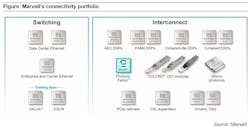
So, what does Celestial AI bring to the table?
Celestial AI has developed a photonic fabric chiplet, or PF chiplet, which integrates all the required electrical and optical components, including drivers, TIAs, equalizers, SerDes, microcontrollers, modulators, photodiodes, and waveguides into a compact form factor. It offers 16 Tbps of bandwidth in a single chiplet.
LightCounting said in a new research note that while Celestial AI’s photonic fabric is only a small piece of Marvell’s connectivity portfolio puzzle, “it may be an important one for the company’s future” because it is “synergetic with the 'coming soon' UALink and ESUN (Ethernet for Scale-Up Networking) switch chips and and this is where CPO is really needed.”
Perhaps even more compelling is that the chiplet is getting the attention of major hyperscalers.
“Celestial AI is deeply engaged with multiple hyperscalers and ecosystem partners who recognize the disruptive potential of this technology,” Murphy said. “Notably, Celestial AI has already secured a major design win with one of the world's largest hyperscalers, which plans to use Celestial AI's PF chiplets in its next-generation scale-up architecture.”
These PF chiplets will be co-packaged into both the hyperscaler's custom XPUs and the scale-up switches, providing connectivity. Besides connecting XPUs and scale-up networks, the photonic fabric technology platform can enable various other transformational applications. One is a pooled memory appliance that uses Celestial AI's photonic fabric to optically connect multiple XPUs to large shared external disaggregated memory banks. Another use case is that Celestial AI's photonic fabric could replace traditional electrical die-to-die connections in multi-die packages.
Murphy said these applications are “just the beginning of a broad set of new applications which can be enabled from this technology” and that it expects “meaningful revenue contributions from Celestial AI to begin in the second half of fiscal 2028.”
Despite what Celestial AI could offer, LightCounting said in a research note that Celestial AI’s technology comes with some risk. In particular, the research firm noted that while the company’s interposers have promise, it is “very disruptive to the current interposer technologies such as CoWoS.”
“It may be the right direction for the future, but it is years away from production (in our opinion),” LightCounting said. “To bridge this gap, we expect Celestial's initial product will be optical-engine chiplets that can be co-packaged with conventional XPUs. This approach is similar to Lightmatter's Passage L200 optical engine, which connects with an XPU or switch using UCIe.”
Copper to optical transition
As data center and hyperscalers look to increase support for XPUs is the amount of network links and bandwidth, there’s a need for a multi-span rack fabric.
However, bandwidth and reach continue to increase; every connection point in the data center must move from copper to optical. For rack-to-rack scale-out and data-center to data-center DCI connections, this transition has already taken place. The next inflection point is within the rack, within the system, and even within a package – where electrical connections must now give way to optics.
“Copper-based interconnects used in today's scale-up systems are approaching their fundamental limits in reach and bandwidth, creating a compelling need for optical solutions,” Murphy said. “Celestial AI's Photonic Fabric technology platform was purpose-built for this inflection. It enables large AI clusters that scale both within and across racks using a high-bandwidth, low-latency, low-power, and cost-effective optical fabric. This breakthrough enables a true optical solution with greater than two times the power efficiency of copper interconnects, but with far longer reach and significantly higher bandwidth.”
Celestial AI’s Photonic Fabric technology platform enables large AI clusters to scale both within and across racks using a high-bandwidth, low-latency and low-power optical fabric, which Murphy said “delivers a true optical solution with more than two times the power efficiency of copper interconnects, along with far longer reach and significantly higher bandwidth.”
Data center revenues rise
Data centers were a key element of Marvell’s third-quarter fiscal year (FY) 2026 earnings mix.
In its data center end market, Marvell delivered record third-quarter revenue of $1.52 billion, representing 2% sequential growth and 38% year-over-year growth.
The company has set an aggressive outlook for data centers.
Since it held a virtual call with investors in late September, where it outlined a framework for Marvell's revenue growth for fiscal 2027, it raised its data center growth potential to Cloud CapEx from 18% next year to over 30%. The company also cited strong demand for its products for next year.
“As a result, our outlook for next fiscal year is even stronger than the expectations we discussed in September,” Murphy said. “We expect our interconnect business, which is roughly half our overall data center revenue, to continue growing faster than Cloud CapEx next year, even with the higher outlook. We expect our custom business, roughly a quarter of our overall data center revenue, to grow by at least 20% next year, also from higher than prior expectations.”
Overall, Marvell reported third-quarter FY2026 revenue of $2.1 billion, up 37% year-over-year and 3% sequentially, driven by 38% year-over-year growth in data center revenue.
“Revenue was above the midpoint of guidance driven by stronger-than-forecast demand in our data center end market,” Murphy said.
For related articles, visit the Data Center Topic Center.
For more information on high-speed transmission systems and suppliers, visit the Lightwave Buyer’s Guide.
To stay abreast of fiber network deployments, subscribe to Lightwave’s Service Providers and Datacom/Data Center newsletters.
2025: A busy year for Co-packaged optics
As momentum for CPO grew throughout the year, there were some key M&A deals from vendors to shore up their positions in the market segment. Earlier this month, Marvell announced its $3.25 billion acquisition of Celestial AI, a next-generation CPO vendor. However, Ciena shelled out only $270 million for Nubis Communications, another co-packaged optics start-up, in September 2025. Celestial AI’s technology is based on photonic interposers, is similar to the approach of Lightmatter. Both Celestial AI and Lightmatter raised several million dollars in funding in early 2025.
About the Author
 Sean Buckley
Sean Buckley
Sean is the Editor-in-Chief of Lightwave. He establishes and executes Lightwave's editorial strategy across its website, email newsletters, events, and other information products. Before coming to Lightwave in July 2023, he served as editor of Broadband Communities. Earlier, he served as senior editor of FierceTelecom and the editor of the former Telecommunications Magazine. He got his start in the optical industry in 1998 when he became the editor of enterprise and optical networks at Information Gatekeepers. He has a BA in English from the University of Massachusetts, Boston, and lives in Dracut, Mass, with his wife, two sons, and his cat, Dove.