
A passive optical network (PON) is a type of fiber-optic telecommunications network that uses unpowered (passive) optical splitters to distribute a single optical signal to multiple endpoints.
In PON-based fiber broadband access networks, there are two types: passive and active.
Although both use fiber-optic cables for connectivity, this article will focus on PONs and highlight some differences between active optical networks (AONs) and PONs.
How Does a PON Work?
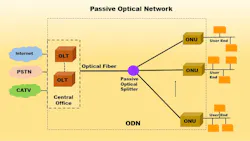
In a PON, the primary device is the optical line terminal (OLT), located in a service provider's central office (CO).
From this central location, a single fiber-optic cable runs from the optical line terminal (OLT) to a passive optical beam splitter. The splitter replicates the signal across multiple paths connected to optical network terminals (ONTs). As the signal follows the path, it reaches devices connected to the ONTs, such as phones and computers.
The science behind it
Light beams transmitted through fiber-optic cables transfer the data in a passive optical network. After the light (data) in the fiber leaves the OLT at the service provider’s office, it passes through a beam splitter closer to the users. The splitter multiplies and refracts the light wavelengths to an ONT near a subscriber’s service area.
Optical Network Differences: Passive vs Active
When learning about optical networking, the words “active” and “passive” can initially be a bit confusing. Active optical networks (AONs) use a powered (or ‘active’) router or aggregated switch to distribute data from a service provider to its customers, with each user service requiring a specific fiber and router/switch port. The fact that AONs need electronic devices to boost and manage signals is what makes the network “active”.
Passive optical networks use a single router/switch port and a single fiber between the router/switch and a passive splitter to provide service to a multitude of subscribers.
Because the splitter uses glass and mirrors to direct light and does not require an external electrical power source, it is considered “passive”.
PON’s advantages
Passive optical network technology comes with numerous benefits. One of the primary benefits is cost-effectiveness, as unpowered optical components are used instead of powered components supplied by the provider to end users.
The lower operational costs and reduced fiber and equipment requirements for delivering the service make PONs more cost-effective than AONs (which require high-priced network equipment). They are also considered more energy-efficient and eco-friendly because they consume less energy.
Additionally, the technology is considered easier to scale because providers can add more ONTs and adjust splitter configurations to meet additional user demands. PONs can also transmit data upstream and downstream at similar speeds while maintaining high quality.
PON Standards
There are two main elements in the PON technology segment: Gigabit PON (GPON) and Ethernet PON (EPON). Over the past two decades, standards bodies and vendors have helped create new PON flavors with higher speeds and better performance. GPON and XGS-PON are the most widely deployed PON technologies in fiber broadband networks today.
Following the success of the BPON (Broadband PON), the ITU-T’s G.984 GPON standard was devised to support 2.5 Gbps downstream/1.25 Gbps upstream.
The XGS-PON standard was released in 2016 and supports 10 Gbps symmetrical data transfer. The letter “X” in XGS stands for the Roman numeral “10”, “G” is for Gigabit, and the “S” represents the word “symmetrical”. So, XGS-PON quite literally means 10 Gigabit Symmetrical PON.
Following XGS-PON came 25G PON, designed to deliver lower latency and greater capacity for 5G and enterprise. 25G PON offers symmetrical 25 Gbps speeds and either 10 Gbps or 25 Gbps asymmetric upload speeds, with a major advantage: cost-effectiveness, as it can be deployed on existing fiber networks.
As technology evolves, 50G PON has emerged, offering symmetrical 50Gbps or asymmetrical 50/25Gbps (download/upload) speeds. While Dell’Oro notes that the deployment of 50G PON has been ramping up “slowly,” the standard was designed to meet the demands of applications such as AI, 5G backhaul, and VR, and is used in industrial and enterprise environments.
One of the most recent technological developments includes 100G PON. A significant advancement in 100G PON is a CableLabs specification that enables the use of coherent optical technology (CPON), expanding bandwidth and extending reach. CPON delivers symmetric upstream and downstream data transmission at data rates up to 100 Gbps, with future capabilities even higher.
100G PON is designed to meet the demands of enterprise services, smart city connectivity, 5G backhaul, and future broadband needs.
An evolution in application
Passive Optical Networking (PON) originated in the late 1980s and early 1990s as a cost-effective, passive alternative to active infrastructure for delivering data, voice, and video to users.
BT first proposed PON in 1987, leading to standardized ATM-based systems (APON/BPON) in the 1990s and later, Ethernet-based (EPON) and Gigabit (GPON) systems in the 2000s.
The initial purpose of PON “was to reduce the number of fiber runs needed to reach multiple end-user locations and to eliminate the need to provide power to transmission devices between the central office and the end user.”
As the internet has expanded and users’ needs have evolved, passive optical network applications have grown to provide connectivity to educational spaces, commercial buildings and offices, and even healthcare facilities.
About the Author

Serena Aburahma
Serena Aburahma is an experienced editor and writer for CI&M, Lightwave, and ISE. Serena has pitched and created content for B2B and B2C audiences across various industries, including technology, video games, insurance, cars, pop culture, and more. Much like the content Serena has written about, her interests vary as well. Aside from creative writing, she is particularly passionate about learning about everything and anything, meandering in nature, playing video games, traveling, and reading.
Voices of the Industry