SUNCALL’s VSFF licensing agreement with SENKO broadens its high-density network opportunities
Key Highlights
- SUNCALL is authorized to manufacture a variety of SN® products, including standard and specialty connectors, under the licensing agreement with SENKO.
- VSFF connectors are 40% smaller than duplex LC connectors, enabling up to three times the port density in the same panel space, ideal for space-constrained data centers.
- The connectors feature a push-pull mechanism for quick, secure installation, reducing deployment times and improving efficiency in large-scale data center setups.
- The agreement supports industry-wide adoption of SN® as a standardized VSFF interface, ensuring interoperability and long-term scalability for high-density optical networks.
- Growing data center investments driven by AI and cloud expansion highlight the importance of multiple sourcing options for critical high-speed connectivity solutions.
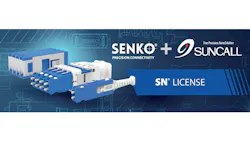
SUNCALL has entered into a licensing agreement to manufacture and supply products based on SENKO’s SN® connector technology, advancing the reach of qualified SN® connectivity solutions for data centers and other high-density environments.
The agreement expands the availability of SN® connectivity across the industry and reinforces SN’s position as a standardized VSFF interface for high-density optical networks.
By enabling additional experienced manufacturers to supply SN® products, SENKO continues to support interoperability and long-term scalability for data center and enterprise infrastructures.
Under the terms of the licensing agreement, SUNCALL is authorized to produce a broad portfolio of SN® products, including standard SN® connectors and adapter solutions, as well as specialty products such as SN® Uniboot connectors and SN® shuttered adapters.
“As demand for VSFF connectivity continues to accelerate, it is paramount for the industry to have multiple sourcing options for critical connector technologies such as SN®,” said Phil Ward, Director of Strategic Marketing at SENKO Advanced Components.
What is a Very Small Form Factor (VSFF) connector?
VSFF connectors are ideal for increasingly space-constrained data centers. A key attribute of VSFF is its size. These devices are smaller and take up less space than standard connectors, such as Duplex LC and MTRJ. VSFF connectors support multiple fibers and offer higher density for infrastructure cabling systems, enabling faster deployment.
Addressing constrained environments
Achieving greater scale for VSFF connectors will enable SUNCALL to address space-constrained environments such as data centers more effectively.
VSFF connectors, such as Senko SN, are 40% smaller than duplex LC connectors, providing up to three times the density. These connectors' vertical TX/RX design enables up to 432 fibers in a 1U panel, maximizing data center efficiency while saving space for high-density AI and cloud applications.
VSFF connectors also include features to simplify installation. They feature a push-pull boot mechanism that enables quick, secure connections with minimal effort. As a result, technicians can reduce deployment times—a key concern for large-scale data centers or those with tight build timelines.
SENKO’s SN® connector was designed to deliver up to three times the port density compared to traditional LC connectivity within the same panel footprint, making it a key enabler for space-constrained, high-fiber-count network environments.
This licensing agreement represents a positive signal for the optical connectivity market, demonstrating broad industry alignment around SN® as a scalable, open VSFF platform and ensuring robust supply as adoption continues to increase.
It will also be a welcome development as networks supporting data centers move to migrate from 400G to 800G. VSFF connectors can support a range of network speeds, including 400G, 800G, and 1.6 Tbps.

Rising data center capex
Having a broader supply of VSFF network connectors is especially timely, as data centers are experiencing growth driven by demand for AI and cloud services.
A new Dell’Oro Group report revealed that the multi-year AI expansion cycle is projected to drive worldwide data center capex to $1.7 Trillion by 2030.
Hyperscale and neo cloud service providers, along with sovereign AI initiatives, are entering a new phase of infrastructure expansion.
Baron Fung, Senior Research Director at Dell’Oro Group, said the four US hyperscale cloud service providers—Amazon, Google, Meta, and Microsoft—have raised the combined data center capital expenditures to nearly $600 billion.
“Despite increased scrutiny around AI infrastructure returns, hyperscalers continue to invest aggressively, supported by large cash reserves and a long-term focus on market share,” he said. “This growth is being driven by the deployment of larger and more complex AI clusters, which are increasing demand for high-performance networking, storage, inference capacity, and advanced power and cooling infrastructure.”
While the Top 4 US hyperscalers are expected to account for about half of global data center capex by 2030, Dell’Oro’s emerging AI model builders and neo cloud service providers are projected to grow at significant rates.
Fung said that this second class of providers will tip the global data center capex “to approach $1 trillion in 2026, reaching a major industry milestone sooner than anticipated.”
For related articles, visit the Optical Tech Topic Center.
For more information on high-speed transmission systems and suppliers, visit the Lightwave Buyer’s Guide.
To stay abreast of fiber network deployments, subscribe to Lightwave’s Service Providers and Datacom/Data Center newsletters
About the Author
 Sean Buckley
Sean is the Editor-in-Chief of Lightwave. He establishes and executes Lightwave's editorial strategy across its website, email newsletters, events, and other information products. Before coming to Lightwave in July 2023, he served as editor of Broadband Communities. Earlier, he served as senior editor of FierceTelecom and the editor of the former Telecommunications Magazine. He got his start in the optical industry in 1998 when he became the editor of enterprise and optical networks at Information Gatekeepers. He has a BA in English from the University of Massachusetts, Boston, and lives in Dracut, Mass, with his wife, two sons, and his cat, Dove.