Key Highlights
- The merger is backed by Stonepeak, with Alphabet remaining a significant minority shareholder, fostering growth and innovation.
- GFiber will leverage Astound’s extensive experience in building large-scale fiber networks and community partnerships.
- The combined company aims to expand fiber infrastructure into new markets across California, Colorado, and Iowa.
- Both companies bring complementary assets, including metropolitan networks and established customer bases, to accelerate growth.
- The deal is expected to close in Q4, subject to regulatory approvals, creating a stronger national broadband platform.
For more on Astound:
- Astound Broadband's 108-mile Oregon fiber link ushers in a multi-service look
- Astound Broadband continues to pivot to fiber-based broadband
And for more on GFiber:
GFiber and Stonepeak have agreed to combine GFiber with Astound Broadband to create a larger independent broadband provider, as the fiber broadband segment consolidates to meet new scale.
The new company will be majority-owned by Stonepeak, an investment firm specializing in infrastructure and real assets. Alphabet, GFiber’s parent, will remain a significant minority shareholder.
The combined business will be led by the existing GFiber executive team, using its expertise in high-speed fiber innovation to manage the larger combined network footprint.
Astound itself has been a story of consolidation. In 2018, TPG Capital acquired Wave Broadband. Wave was then combined with RCN Corporation and Grande Communications, both of which were acquired in February 2017, in a $2.25 billion deal; TPG bought RCN for $1.6 billion and Grande for $650 million.
News of the deal between GFiber and Astound should not be a total surprise.
A Bloomberg report in January revealed that Alphabet was in talks with Stonepeak’s Radiate Holding to strike a deal for fiber assets that would house Radiate’s fiber assets, Astound, as well as Google’s GFiber business.

GFiber’s independence story
GFiber, which established itself alongside other pioneers like Chattanooga, Tennessee-based EPB, as the poster child of gigabit fiber broadband, can use this new structure to gain operational and financial independence.
GFiber will now have the external capital and strategic focus needed to accelerate its next phase of growth, expanding its fiber technology nationwide.
“Building on GFiber’s success as a leading independent US fiber internet provider, this is an exciting next phase of their growth,” said Ruth Porat, President and Chief Investment Officer, Alphabet and Google. “GFiber will now have the opportunity to provide better internet access to more communities across the country as they combine with Stonepeak’s Astound business, while continuing to provide their award-winning customer experience.”
Complementary assets, processes
This deal, subject to customary closing conditions and regulatory approvals, is expected to close in the fourth quarter of this year and combines GFiber’s metropolitan networks with Astound’s established infrastructure, team, and capabilities to create a complementary national network platform.
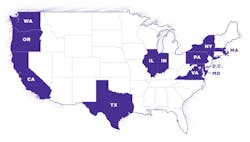
Both companies come to the table with plenty of markets to scale.
At the time of the deal’s announcement, Astound had established itself as the sixth-largest U.S. cable operator, serving over 1 million residential and business customers across major metropolitan areas in California, Illinois, Massachusetts, New York, Oregon, Pennsylvania, Texas, Washington, and the DC metro area.
GFiber, meanwhile, is available in select metropolitan areas across 15 U.S. states, including major hubs such as Atlanta, Austin, Charlotte, Kansas City, Salt Lake City, Nashville, and Huntsville, and is expanding into California, Colorado, and Iowa.
For its part, GFiber will be able to leverage Astound’s well-established processes and expertise in building out larger-scale broadband networks, as well as its experience working directly with communities as a public-private partner, such as Oregon’s Tillamook County.
Astound has also had an established process of building fiber broadband for over a decade. It has been edging out its networks to reach new neighborhoods adjacent to its existing footprint. This process began with HFC and shifted to FTTH builds, starting with GPON for single-family homes, multi-family units (MFUs), and multi-dwelling units (MDUs).
“This partnership will be transformational for the businesses, with GFiber and Astound’s complementary networks and extraordinary teams enabling the combined company to serve millions of customers better and the demand for a next-generation network and ubiquitous connectivity,” said Andrew Thomas, senior managing director at Stonepeak.
For related articles, visit the Broadband Topic Center.
For more information on high-speed transmission systems and suppliers, visit the Lightwave Buyer’s Guide.
To stay abreast of fiber network deployments, subscribe to Lightwave’s Service Providers and Datacom/Data Center newsletters.
About the Author
 Sean Buckley
Sean Buckley
Sean is the Editor-in-Chief of Lightwave. He establishes and executes Lightwave's editorial strategy across its website, email newsletters, events, and other information products. Before coming to Lightwave in July 2023, he served as editor of Broadband Communities. Earlier, he served as senior editor of FierceTelecom and the editor of the former Telecommunications Magazine. He got his start in the optical industry in 1998 when he became the editor of enterprise and optical networks at Information Gatekeepers. He has a BA in English from the University of Massachusetts, Boston, and lives in Dracut, Mass, with his wife, two sons, and his cat, Dove.