Broadband service remains resilient during record New England snowstorms
Key Highlights
- NECTA reports minimal outages during 2026's record cold and snowfall, demonstrating network resilience.
- Over 90% of New Englanders are satisfied with broadband reliability, speed, and affordability, with satisfaction levels rising.
- Consumer perception of broadband access has improved, with increased competition and more provider choices in Rhode Island and Vermont.
- Satisfaction with cable and streaming video services remains high, with a trend towards bundled, one-stop shopping options.
- The slowdown in cord-cutting indicates a stabilization in consumer preferences for traditional and streaming video services.

New England’s record cold and snowfall in 2026—two issues that can impact reliability- were no match for the region’s broadband networks.
According to the New England Connectivity and Telecommunications Association's (NECTA) Innovation Index, service providers did not report significant outages even as people leaned heavily on broadband for work, school and entertainment.
Covering Massachusetts, Connecticut, Rhode Island, Vermont and New Hampshire, the Index shows New England consumers are happy with reliability and increasingly satisfied with broadband and video affordability, even as other consumer costs have gone up.
“NECTA members provided stable networks capable of handling multiple devices at a cost that works for families and businesses during and following record snowfall and historic cold," said Tim Wilkerson, President of NECTA.
Customer satisfaction and affordability rise
Regardless of weather conditions, customer satisfaction with broadband and video services from local cable operators and telcos remains high and is rising.
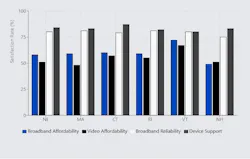
NECTA found that over nine in ten New Englanders report being satisfied with their broadband service, with growing shares expressing satisfaction across reliability, speed, connection quality, and bandwidth.
In particular, the organization found that consumers rated reliability as the number one issue, with the issue increasing again in 2025.
Likewise, the surveys revealed that satisfaction with cable and streaming video services also remains strong, with solid majorities satisfied with video service quality and reliability.
“Together, these results reinforce that both connectivity and video services are meeting consumer expectations for the essentials of entertainment, communication, and daily life,” NECTA wrote in its study.
Another key finding was that consumers were satisfied they could get affordable internet service and video despite growing concerns about the cost of living.
The study found that nearly six in ten New Englanders are satisfied with broadband affordability, and more than half are satisfied with the affordability of cable and video services, representing meaningful gains over last year.
“These increases suggest that consumers are recognizing provider efforts to deliver greater value, improved service, and expanded access while helping households manage rising everyday costs,” NECTA wrote.
New broadband choices
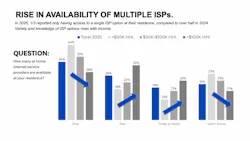
Broadband choice in New England is also expanding.
While regions vary, NECTA noted that access to more broadband providers has risen in Rhode Island and Vermont. In Rhode Island, the dominant providers are Cox, Verizon (Fios), and T-Mobile, with a growing presence from the newer provider i3Broadband. In Vermont, the broadband market is mainly dominated by Comcast, VTel and Fidium.
“Fewer New Englanders report having access to only one internet service provider at their residence compared to last year, indicating increased competition and choice,” NECTA said. “Perceived ease of access to fast, reliable broadband has improved across much of the region, particularly in Rhode Island and Vermont. These findings reinforce that lack of access is no longer the dominant barrier for most consumers.”
Video cord-cutting slows
Broadband was not the only service where consumers showed satisfaction with service.
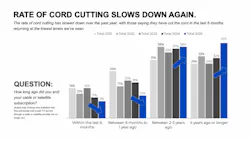
Despite the growing focus on streaming video, NECTA’s study of cord-cutting among video platforms was down again, reflecting signs of stabilization in consumers' views of video services.
The research found that 83% of consumers value "one-stop shopping" for video services, especially younger consumers.
“While streaming remains widespread, a large majority of New Englanders say that one-stop shopping for video services is important, including overwhelming agreement among younger adults,” NECTA said. “These findings suggest growing fatigue with fragmented platforms and rising subscription costs and point to increased interest in bundled or simplified video experiences.”
For related articles, visit the Broadband Topic Center.
For more information on high-speed transmission systems and suppliers, visit the Lightwave Buyer’s Guide.
To stay abreast of fiber network deployments, subscribe to Lightwave’s Service Providers and Datacom/Data Center newsletters.
About the Author

Sean Buckley
Sean is responsible for establishing and executing the editorial strategy of Lightwave across its website, email newsletters, events, and other information products.