Openreach furthers its sustainability effort with new Zyxel fiber ONTs
Key Highlights
- Openreach has installed over 500,000 Zyxel sustainable ONTs made from 95% recycled plastic, with plans for more installations as fiber adoption increases.
- The new ONTs feature minimal plastic packaging, sourced from recycled electronics and automotive parts, reducing waste and environmental impact.
- Openreach aims to remove 100 tons of plastic from its supply chain and transition its fleet to electric vehicles, supporting its 'Let's Reach Zero' sustainability strategy.
- The partnership enhances fiber network speeds up to 1.8 Gbps, with ongoing trials aiming for speeds up to 8.5 Gbps using advanced XGS-PON technology.
- The company plans to build a fiber network reaching 30 million premises by 2030, investing $20 billion in its expansion efforts.

Openreach has raised the bar for its environmental sustainability efforts through a partnership with Zyxel aimed at reducing plastic and packaging waste in the expansion of the UK's fiber network by using 'modems' made from recycled materials to connect customers.
Zyxel is launching a range of new Optical Network Terminals (ONTs) – wall-mounted electronic boxes that convert optical signals into electrical signals used by household appliances – with newly developed housings made from 95 percent recycled plastic for its PON-based fiber broadband network.
As this news emerged, Openreach's technicians had already installed half a million Zyxel sustainable ONTs. Looking forward, the service provider expects to install even more this year as customers switch to fiber broadband.
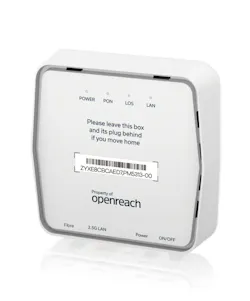
The GPON devices are made from recycled plastic and come in minimal plastic-free packaging made from recycled materials.
Openreach is working with Zyxel and other partners to manufacture the new devices – with casings made from recycled plastic granules. According to the two companies, the granules come from various sources within the polycarbonate (PC) plastic family, including recycled casings from laptops, tablets, or smartphones, personal protective equipment such as face shields and goggles, medical devices, as well as headlights, taillights, and interior trim from the automotive industry.
While its work with Zyxel may be new, Openreach has a long tradition of working with suppliers to reduce plastic and component use and has set itself the goal of removing single-use plastics (SUPs) from its 25 most-used product lines.
“With Zyxel, we have a partner who shares our focus on reducing the environmental impact of our construction projects – from using recycled materials in the equipment to reducing plastic in packaging – while supporting safe delivery at scale,” said Abby Chicken, Head of Sustainability at Openreach.
Greater flexibility
Openreach's work with Zyxel is also tied to the service provider's efforts to enhance customer speeds and flexibility.
In April 2025, the service provider launched a symmetric 1 Gbps broadband speed tier.
For this launch, Zyxel developed an ONT specifically tailored to Openreach, designed to make it easier for service providers to switch customers to fiber connections with speeds of up to 1.8 Gbps.
Zyxel's ONTs utilize integrated Secure Boot technology and are equipped with Airoha's next-generation chipset, thus meeting all requirements of the Telecommunications Security Act (TSA).
But 1.8 Gbps is just one part of its broader speed upgrade strategy. Openreach, according to an ISPreview report conducting trials of full-fiber broadband using XGS-PON technology this year. The trial will cover approximately 40,000 premises in Guildford and deliver download speeds of up to 8.5 Gbps.

Openreach's "Let's Reach Zero" strategy
Openreach’s partnership with Zyxel will further fuel Openreach's "Let's Reach Zero" strategy to reduce CO₂ emissions and waste, including a commitment to remove 100 tons of plastic from the supply chain.
The service provider’s ongoing migration off its copper network to all fiber, which consumes less energy than legacy networks, is an important aspect of the BT Group’s ambition to be net zero in its operations by the end of 2031, as is the move to convert the majority of Openreach’s fleet to electric or zero-emission vehicles in that timeframe.
In addition to adopting more efficient ONTs, Openreach is reducing its carbon footprint by transitioning its commercial fleet from gas to electric. The company now has over 5,000th electric vehicles (EVs).

Openreach added a further 2,000 EVs to its fleet by the end of March 2026 – contributing to its parent, BT Group’s ambition to reach net zero carbon emissions across its entire operations by 2031.
“As we build, we’re constantly challenging ourselves and others to develop new and better ways of working to look after the environment,” Chicken said in a video outlining its sustainability plan. “This plan – Reach Zero – is focused on three specific objectives: First, lowering our emissions; second, using fewer materials and reducing our waste; and third, minimizing our impact on the natural environments in which we work.”
Accelerated fiber build
Openreach’s work with Zyxel comes as the service provider continues to enhance its fiber broadband network goals.
Having already reached 22 million connections and adding thousands more every week, Openreach noted in its 2025 annual report that, given the way fiber broadband resonates with both new and existing customers, it plans to scale the network build further.
“We know the more full fiber we build, the more customers choose to connect,” Openreach said. “So, we have decided to accelerate our build plans for 2025-26, while still intending to pass 25 million premises by the end of 2026 and (subject to affordability and regulatory developments) to reach 30 million premises beyond that.”
To support its expanded network build, Openreach is retraining thousands of its existing technicians to help with the construction, connection, and maintenance of the new network.
For 2026, Openreach is investing $20 billion to build a new fiber broadband network for 25 million homes and businesses by the end of 2026.
Openreach said the network build is on schedule, and it intends to go even further, to up to 30 million connections by the end of the decade, “provided investment conditions remain favorable.”
For related articles, visit the Broadband Topic Center.
For more information on high-speed transmission systems and suppliers, visit the Lightwave Buyer’s Guide.
To stay abreast of fiber network deployments, subscribe to Lightwave’s Service Providers and Datacom/Data Center newsletters.
About the Author
 Sean Buckley
Sean Buckley
Sean is the Editor-in-Chief of Lightwave. He establishes and executes Lightwave's editorial strategy across its website, email newsletters, events, and other information products. Before coming to Lightwave in July 2023, he served as editor of Broadband Communities. Earlier, he served as senior editor of FierceTelecom and the editor of the former Telecommunications Magazine. He got his start in the optical industry in 1998 when he became the editor of enterprise and optical networks at Information Gatekeepers. He has a BA in English from the University of Massachusetts, Boston, and lives in Dracut, Mass, with his wife, two sons, and his cat, Dove.