U.S. hyperscalers shift market build-out targets to the Midwest and Texas
Key Highlights
- Hyperscalers are moving their data center investments toward Texas and the Midwest due to better power, land, and water resources.
- By the end of 2025, over 53% of new hyperscale data centers are expected to be in central U.S. regions, reflecting a strategic shift in location preferences.
- Major cloud providers like Amazon, Microsoft, and Google hold 58% of all hyperscale capacity, with ongoing projects expanding their global footprint.
- New gigawatt-scale campuses are emerging in non-traditional locations such as Abilene, Mount Pleasant, and Kansas City, driven by infrastructure constraints and market shifts.
- The focus on central U.S. regions signifies a broader trend of reallocating capital to support AI and cloud service growth outside established hubs.

As hyperscalers look to scale operations to accommodate the growth of AI and cloud services, they are seeking new locations to house their facilities that can provide alternative sources of power, land and water.
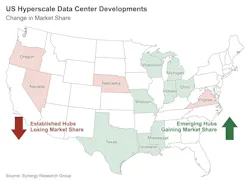
New data from Synergy shows that U.S. hyperscaler builds have begun to focus on facilities in the center of the country, particularly in Texas and Midwestern states.
The research firm noted that at the end of 2025, Texas and the Midwest accounted for 33% of operational US hyperscale data center capacity, while its “pipeline of future hyperscale data centers shows that they will account for 53% of new capacity coming online over the next few years.”
And while Northern Virginia will continue to see the greatest concentration of data centers, as AI has driven up infrastructure investment, providers are targeting areas with more readily available power.
“While established hubs will remain strategically important, the center of gravity for new hyperscale investment is clearly moving elsewhere,” said John Dinsdale, chief analyst at Synergy Research Group.
Texas, Midwest rise
Hyperscaler data center providers are increasingly turning to markets like Texas and the Midwest to build new facilities.
In Texas, Microsoft took over a data center construction project in Abilene, Texas, after OpenAI declined to move forward with its own plans. Data center developer Crusoe is working with Microsoft to build two new “AI factory” buildings and an on-site power plant.
Driven by multiple major projects from Amazon, Google, Meta, Microsoft, OpenAI, and CoreWeave, the Midwest states, including Wisconsin, Indiana, Michigan, and Missouri, will all grow rapidly in importance.
Amazon, for instance, plans to invest an additional $15 billion in Northern Indiana to build a data center. The new project will add 2.4 gigawatts of data center capacity in the region.
Likewise, Google announced in February that it would build its first data center in Minnesota’s Pine Island, a town of about 4,000 people, some 70 miles southeast of Minneapolis.
The data center will be located on a 480-acre site at Pine Island, a town of about 4,000 people, some 70 miles southeast of Minneapolis.
The data center will be located on a 480-acre site at Pine Island, a town of about 4,000 people, some 70 miles southeast of Minneapolis.
“As infrastructure constraints intensify and market dynamics continue to shift, hyperscale providers are increasingly reallocating capital toward central U.S. regions, with Texas emerging as the primary focal point,” Dinsdale said. “A new wave of gigawatt-scale campuses is taking shape in non-traditional locations such as Abilene, Mount Pleasant, South Bend, El Paso, Boone County, and Kansas City.”
Cloud providers dominate
A big contributor to data center growth is the large cloud providers.
Offering an array of services, including SaaS, IaaS, PaaS, search, social networking, e-commerce, and gaming, the top cloud providers collectively had 1,360 operational hyperscale data centers at the end of 2025. According to Synergy’s research, 580 are in the research firm’s known pipeline of future hyperscale data centers, and another 803 data centers will come online in the next few years, of which 437 are in the US.
While there are more operational data centers than in the pipeline, Synergy said the pipeline has a larger overall capacity, reflecting that hyperscale data centers have continued to increase in IT capacity.
Amazon, Microsoft, and Google today have the broadest data center footprint and are the leading cloud providers.
In addition to a large data center footprint in their home US market, each of these providers has multiple data centers in several other countries. In aggregate, Synergy said, “the three now account for 58% of all hyperscale data center capacity.”
Meta, Alibaba, Tencent, Oracle, Apple, and ByteDance, then other relatively smaller hyperscale operators, follow the top three in the next tier.
For related articles, visit the Data Center Topic Center.
For more information on high-speed transmission systems and suppliers, visit the Lightwave Buyer’s Guide.
To stay abreast of fiber network deployments, subscribe to Lightwave’s Service Providers and Datacom/Data Center newsletters
About the Author
 Sean Buckley
Sean Buckley
Sean is the Editor-in-Chief of Lightwave. He establishes and executes Lightwave's editorial strategy across its website, email newsletters, events, and other information products. Before coming to Lightwave in July 2023, he served as editor of Broadband Communities. Earlier, he served as senior editor of FierceTelecom and the editor of the former Telecommunications Magazine. He got his start in the optical industry in 1998 when he became the editor of enterprise and optical networks at Information Gatekeepers. He has a BA in English from the University of Massachusetts, Boston, and lives in Dracut, Mass, with his wife, two sons, and his cat, Dove.