Ziply Fiber’s 400G Northern link route appeals to low-latency hungry customers
Key Highlights
- The Northern Link Route spans 2,100 miles, connecting key cities from Chicago to the Pacific Northwest with ultra-low latency of 39.5ms round-trip.
- Initially launched in October 2024 along the western segment, the route is now fully operational along its entire length, including connectivity to Chicago.
- Designed to serve financial institutions, data centers, and hyperscalers, the route offers 400 Gbps capacity for high-speed, scalable data transmission.
- Ziply Fiber aims to expand its nationwide network, with this route being a significant step toward providing comprehensive high-capacity optical services across the US.
- The network expansion responds directly to customer demand for efficient, low-latency connectivity solutions in major economic hubs.
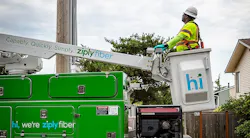
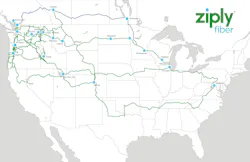
Ziply Fiber’s “Northern Link Route” has become a new long-haul, low-latency optical service option for enterprises, offering service between the growing Chicago and Pacific Northwest markets.
Offering 39.5ms round-trip latency with 400 Gbps, low-latency, high-capacity long-haul transport, the Northern Link route connects Hillsboro, Portland, Seattle, Spokane, Missoula, Billings, Bismarck, Fargo, Minneapolis, Madison, and Chicago, and dozens of other major cities in between.
Initially launched with limited operations along the Western portion of the route’s path in October 2024, the “Northern Link Route” is now ready for service along the entire 2,100-mile route, including full connectivity to and from Chicago.
An array of financial institutions, data center operators, hyperscalers, and others that need ultra-low latency, combined with the shortest path from the Midwest to the Pacific Northwest, is attracting them to the new route.

Chris Gellos, commercial general manager for Ziply Fiber, said the completion of the route ties in with the service provider’s broader network expansion ambitions.
“We aspire to provide a nationwide network, and we’re well on our way to doing that,” he said. “So, this Northern Link route is really the first of the routes that we’ve gone across the U.S.”
He added that the building of this network route is a response to customer demand.
“When you look at, you know, Chicago with traders, you know, any folks that are requiring low latency, high-speed transport that scales, that’s where we’ve had the most reception,” Gellos said.
Focus on reliability, unique routes
Ziply Fiber has continued to enhance its long-haul network to serve its enterprise and wholesale carrier customers with an eye towards reliability and redundancy. The service provider’s network can support any number of multi-site businesses and carriers, with 1.6 million serviceable locations, 29 data centers, and over 208 central offices.
Its network manages capacity to ensure there’s no more than 40% during peak loads, with only 3ms latency in the core network. The service provider also has 200 private peering relationships and redundancy engineered down to the aggregation network.
Gellos said that there's always enough capacity to take on the entire span of a fiber network if a section is cut due to an accident or weather event. “If we have a fiber cut, we don't want the customers to even know about it, because it'll carry on and not slow down the network anywhere else.”
|
Ziply Fiber’s Northern Link Route offers: |
|
|
· Shortest physical route between the Midwest and the Pacific Northwest |
400G wavelengths – 4X the capacity of most current connections |
|
· 39.5ms round-trip latency from Seattle to Chicago (using Bit Error Rate (BER) testing) – lowest of any West-East connection from the Midwest to the PNW3 |
100G wavelengths, 10 and 100G transit service |
|
Northwest connections to Seattle, Vancouver, Portland and Hillsboro |
|
Over the past six years, Ziply has continued to expand its footprint with 100G and now 400G high-capacity fiber routes.
What Ziply is doing to set its network route apart from others is bypassing the Bonneville Power Administration (BPA) route. BPA operates a 15,000-mile high-voltage transmission network across the Pacific Northwest (Oregon, Washington, Idaho, Montana, and parts of Wyoming, Nevada, Utah, and California), with fiber optic cables largely installed along these existing lines to support utility communications and regional broadband, often in partnership with entities like NoaNet, Gellos said that its focus is to architect unique routes.
“When you look at the Pacific Northwest, there is a route between Seattle and Portland that everybody has, the BPA route,” he said. “We have customers often that are coming to us looking for, well, how do we get from A to Z utilizing a diverse route? And since so many of these customers are large enterprises and use multiple carriers, they're looking for providers that offer diverse, unique routes.”
Being in the Pacific Northwest, Ziply Fiber has to navigate several environmental and physical challenges that are germane to the territories where it operates as a fiber builder.
“This route is unique because of the terrain, cold temperatures that restrict when we can build at times, and a lot of environmental concerns,” Gellos said. “It's an underground route, so that's important for the stability of the route and performance of the route. But that also adds complexity to building it.”
But the key priority for Ziply Fiber’s larger enterprise customers is reducing latency. It can also provide customers with a view of its serviceable locations via Connected2Fiber’s Connected World platform, which generates an inventory of its total addressable market of serviceable locations – from both on-net and near-net perspectives. The company provided Connected2Fiber with KMZ files and existing building lists.
“When we're talking to customers of this size, one of the very first questions we get asked is, what's the latency on the route, followed by, let me see the KMZ,” Gellos said. “It’s a primary component of their decision-making process. And so, when we're able to build these routes with low-latency capabilities and diverse, traversable paths, it plays well.”
Wavelength demands rising
Ziply’s timing of its new route, which offers 400G and 100G wavelength services, comes as demand for wavelength services continues to ramp.
Vertical Systems Group noted in its 2025 Wavelength LEADERBOARD that service providers cited U.S. customer demand for 400 Gbps services as escalating significantly in 2025. Likewise, the procurement of higher-capacity 800 Gbps wavelengths also increased, driven by hyperscalers, neocloud providers, AI and GenAI companies, datacenters, and large enterprises.
“The U.S. wavelength marketplace diverged sharply in 2025, with several vendors posting double-digit circuit growth while others remained flat or had declines. These shifts yielded an installed base that grew seven percent overall,” said Rick Malone, principal of Vertical Systems Group. “All major wavelength providers are now offering 400 Gbps waves across their footprints and are actively ramping 800 Gbps installations.”
Gellos agreed that it is seeing more of its large enterprise customers adopting higher-speed wavelength services. “Optical wavelengths are probably the fastest growing segment for us that we are hearing requests for now on the enterprise side of the business,” he said. “When we talk about enterprise large customers that need to transport data as a raw material for what they do, they are very interested in the wave products. So, we are building and installing wavelength circuits as fast as we can.”
He added that it is seeing more of its customer base “upgrading and migrating to higher-bandwidth speeds, so customers are coming in starting at 400, but there are also others going from 10 to 100 to 400 as well.”
New take on colocation
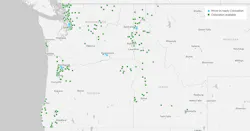
Complementing its fiber-based services, Ziply Fiber has continued to scale its colocation services. Today, the service provider has colocation services at more than 200 secure facilities across Washington, Oregon, Idaho and Montana.
Businesses can use Ziply’s colocation facilities to house their network servers and infrastructure as an alternative to building and maintaining their own facilities by using Ziply Fiber’s facilities – many located along the Northern Link Route—allowing enterprises to focus on their core business.
Gellos sees data centers and co-location being used in a complementary way. “Data centers and co-location have very similar use cases,” he said. “Someone wants to be in a data center to host their gear, connecting directly to networks, and the same applies for when they want to come to us for co-location.”
A big contributor to Ziply’s data center business foundation was the assets it purchased from Frontier. In May 2020, Searchlight Capital Partners and WaveDivision Capital completed the acquisition of Frontier Communications’ operations in the Pacific Northwest for $1.35 billion, forming Ziply Fiber. The deal covered Washington, Oregon, Idaho, and Montana, serving roughly 500,000 customers and focused on upgrading aging copper infrastructure to high-speed fiber.
This network segment has a long history in the markets it operates. Its origins date back to 1964, when it was the northwestern division of GTE, which became part of Verizon in 2000. It was then sold by Verizon to the former Frontier Communications in 2010.

These legacy COs have become a key asset in Ziply Fiber’s colocation arsenal. The service provider has been repurposing the former Frontier CO assets to accommodate next-gen networking equipment that is far less power hungry than the legacy Class 5 voice switches designed to deliver POTS service for over a century.
“The advantage that we have in buying up the LEC assets that we acquired previously is that we own and operate all of our own central offices,” Gellos said. “So that real estate has the equipment changes and gets changed out. We've replaced a bunch of legacy phone company gear with modern IP transport gear that takes up much less space and uses much less power.”
And with these new IP-based platforms consuming less power, Ziply Fiber has excess power available for enterprise customers. “If the Cos are consuming less power, that means there's excess power available,” Gellos said. “One of the key drivers for anybody going into a data center or a co-location facility is, 'Do I have adequate power, not just the network? " So, we have those two advantages. And it seemed to be natural to retrofit some of those central offices into co-location facilities.”
He added that the attraction for enterprise customers is that they don’t have to build their own facility and procure power. “They can come to us and say, I want to be in these geographic areas,” Gellos said. “We have become a perfect fit for those who want to be located in the Pacific Northwest and those areas where we have those facilities.”
Ziply, unsurprisingly, also continues to expand its fiber network into existing data center facilities. While the service provider has been aggressively expanding into more data centers, it has been keen to target specific ones with which it collaborates closely in markets like Hillsboro, Oregon.
Hillsboro currently houses several dozen data centers, with others set to open over the next few years, including a 350,000-square-foot, 27-megawatt data center by Flexential and a 285,000-square-foot, 36-megawatt site by Lewis
“We've taken this strategy of building into just about every data center we can get ourselves into, but then there's a handful that we have a closer relationship with that are preferred providers,” Gellos said. “We have built fiber access to many of them, and our architecture has been to ring those in the markets that we go into. In Hillsboro, Oregon, we've got them all tied together.”
For related articles, visit the Optical Tech Topic Center.
For more information on high-speed transmission systems and suppliers, visit the Lightwave Buyer’s Guide.
To stay abreast of fiber network deployments, subscribe to Lightwave’s Service Providers and Datacom/Data Center newsletters
About the Author
 Sean Buckley
Sean Buckley
Sean is the Editor-in-Chief of Lightwave. He establishes and executes Lightwave's editorial strategy across its website, email newsletters, events, and other information products. Before coming to Lightwave in July 2023, he served as editor of Broadband Communities. Earlier, he served as senior editor of FierceTelecom and the editor of the former Telecommunications Magazine. He got his start in the optical industry in 1998 when he became the editor of enterprise and optical networks at Information Gatekeepers. He has a BA in English from the University of Massachusetts, Boston, and lives in Dracut, Mass, with his wife, two sons, and his cat, Dove.