

Wi-Fi is a networking technology that uses radio waves to enable high-speed data transfer over short distances, including in homes, sports and concert stadiums, and business buildings. This technology brings wireless internet connectivity to physical devices and has become a foundational technology for modern connectivity.
At its core, Wi-Fi is a wireless local area network (WLAN) technology based on the IEEE 802.11 standard; however, the name Wi-Fi was coined two years later by the Wireless Ethernet Compatibility Alliance (WECA, now known as the Wi-Fi Alliance), a worldwide nonprofit organization formed to promote this wireless standard.
WECA hired a marketing firm to come up with names, and “Wi-Fi” was picked for the way it sounded, and is not an abbreviation for “wireless fidelity”.
What Is Wi-Fi?
Wi-Fi is a technology that allows devices such as laptops, smartphones, printers, and sensors to connect wirelessly to a network via an access point or wireless router to access the internet.
Most modern routers broadcast Wi-Fi on three frequency bands: 2.4 GHz, 5 GHz, and 6 GHz. The 2.4 GHz band offers long range and lower speeds, 5 GHz provides faster speeds at shorter ranges, and 6 GHz delivers the highest speed and capacity. The 2.4 GHz band travels farther and passes through walls more easily, while the 5 GHz band usually delivers faster speeds over shorter distances.
A key aspect of Wi-Fi connectivity is the network name or SSID. This is what a device would see when picking a wireless network and usually requires a password, agreement to terms, credentials, etc., to gain access.
How Wi-Fi Works
Wi-Fi uses radio waves to send data between a wireless device and a router or access point.
When a user does something online while connected to Wi-Fi, such as streaming a video or loading a website, the device sends a request to the access point or router, which forwards it through a broadband connection to the internet. Then sends the requested information back to the device wirelessly and quickly (if there’s a good connection with minimal traffic).
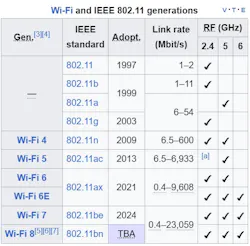
Wi-Fi Standards Evolution
Since the IEEE 802.11 standard was introduced in 1997, subsequent versions have been released. All the most recent Wi-Fi versions have simple names and begin with 802.11; the distinction comes in the suffix. The most recent versions are:
· Wi-Fi 4 (802.11n, released in 2009)
· Wi-Fi 5 (802.11ac, released in 2014)
· Wi-Fi 6 (802.11ax, released in 2019) & Wi-Fi 6E (802.11ax, released in 2021)
· Wi-Fi 7 (802.11be, released in 2024)
· Wi-Fi 8 (IEEE 802.11bn expected to be finalized around 2028–2030)
These versions differ in bandwidth delivery, operating frequency, and the number of supported channels.
Common Wi-Fi applications
Wi-Fi supports a range of environments beyond office and home usage. Other common Wi-Fi applications include:
· Enterprise Networks: Wireless access for users, collaboration platforms, and mobile devices.
· Industrial and IoT Environments: Connectivity for sensors, monitoring systems, and operational technology.
· Smart Buildings: Support for connected lighting, HVAC controls, security systems, and building automation.
· Healthcare and Education: High-density connectivity for users, devices, and critical applications.
· Public and Campus Networks: Large-scale deployments across transportation hubs, campuses, and public venues.
Wi-Fi Deployment Types
A company or organization has three types of wireless network deployments to choose from, depending on its needs. These deployments are:
· Centralized Deployment: The most common of the three wireless network deployment types is centralized. It is typically deployed in areas where networks and buildings are physically close. Centralized deployments consolidate the wireless network, in turn making upgrades simpler and supporting advanced wireless functionality.
· Converged Deployment: Converged deployments are used in branch offices and smaller campuses. The solution converges wireless and wired connections on a singular network device, the access switch. Because it can perform the functions of both a wireless controller and a switch, customers can maintain consistency across wired and wireless connections.
· Cloud-based Deployment: This type of deployment uses the cloud to manage network devices deployed across multiple locations. These devices are accessed remotely, with different services delivered depending on the cloud deployment model. These three types are public clouds, private clouds, and hybrid clouds.
Wi-Fi and Security
Because Wi-Fi signals are transmitted through the air, security is a key consideration. Current deployments usually use WPA2 or WPA3 encryption, authentication controls, and network segmentation to help secure traffic and prevent unauthorized access.
Security has become even more important as Wi-Fi supports more operational and critical applications.
Wi-Fi Recap
Wi-Fi is a wireless networking technology built on the IEEE 802.11 standard that uses radio waves to connect devices to local networks and the internet. While users may think Wi-Fi is simple, it depends on a combination of access points, standards, and wired infrastructure to deliver performance.
About the Author

Serena Aburahma
Serena Aburahma is an experienced editor and writer for CI&M, Lightwave, and ISE. Serena has pitched and created content for B2B and B2C audiences across various industries, including technology, video games, insurance, cars, pop culture, and more. Much like the content Serena has written about, her interests vary as well. Aside from creative writing, she is particularly passionate about learning about everything and anything, meandering in nature, playing video games, traveling, and reading.