Beyond Speed: How network sharing unlocks new wholesale–retail value in FTTH
Key Highlights
- The industry is moving from speed competition to focus on low latency, reliability, and quality of experience as bandwidth demand stabilizes.
- FANS enables multiple operators to share fiber infrastructure securely, increasing asset utilization and reducing deployment costs.
- Virtualization and software-defined access allow rapid service innovation without hardware upgrades, supporting new business models and market entrants.
- Shared fiber platforms facilitate wholesale-retail collaboration, lower barriers for new entrants, and expand coverage in rural and hard-to-reach areas.
- The new fiber ecosystem emphasizes efficiency, collaboration, and service differentiation over traditional speed tiers, shaping the future of FTTH deployment.

For more than a decade, fiber-to-the-home (FTTH) networks have been in a speed race. Each generation of PON technology promised more bandwidth, higher throughput, and greater competitive advantage. Still, as consumer requirements stabilize—and in many markets plateau—the industry is recognizing a new reality: there is no clear “net killer app” driving exponential bandwidth demand.
Even bandwidth‑intensive use cases like 16K UHD video are increasingly offset by more efficient compression algorithms. While overall bandwidth consumption continues to grow, the key shift is that the rate of growth has slowed dramatically, meaning raw speed alone no longer differentiates network performance – now it is about ultra-low latency communication.
Remote work, 4K streaming and cloud gaming have become mainstream, yet today’s widely deployed XGS-PON networks already deliver far more capacity than most households can fully consume. As bandwidth moves from scarcity to surplus, operators are shifting their competitive focus from the vanity of high-speed tiers toward something more strategic: efficient access to fiber infrastructure.
This change is driving a new wave of industry collaboration, where the question is no longer “How fast is your fiber?” but “How effectively can you share it?”
Enter Fixed Access Network Sharing (FANS)—the model that is redefining how operators build, monetize, and scale FTTH.
The limits of competing on speed
Historically, retail internet service providers (ISPs) sought to differentiate through ever-higher bandwidth tiers. However, this model faces three major challenges.
Firstly, consumer sensitivity to higher speeds is diminishing. Once customers reach 3—500 Mbps, their perceived experience seldom improves significantly at 1-2 Gbps, meaning operators are finding themselves investing in speed upgrades with limited retail payoff. The reality is that average peak usage remains around 5 Mbps, though it spikes when major gaming platforms such as Call of Duty or Fortnite release major updates.
The second challenge operators face is rising deployment costs. Building parallel fiber networks is capital-intensive and inefficient, and while overbuild strategies may satisfy regulators, they rarely maximize national fiber utilization.
Thirdly, operators locked into siloed infrastructure spend time and resources on network build-out instead of innovating in cloud, content, smart home, or enterprise solutions.
With these pressures mounting, the industry is seeking a more sustainable path forward.
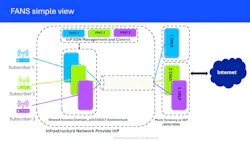
FANS: From siloed fiber to service‑ready platform
FANS creates a framework in which multiple operators—wholesale and retail—can share the same physical fiber access network while maintaining full control of their service logic, quality of service, traffic management, and customer experience securely. In this model, onboarding retail internet service providers have complete autonomy and traffic isolation.
Instead of owning parallel networks, retail providers access fiber through virtualized, isolated slices of a shared infrastructure. Wholesale providers, in turn, monetize the same fiber multiple times, dramatically increasing asset utilization.
Why this matters now is three-fold:
- Bandwidth requirements have matured: The value shifts from raw throughput to availability, reliability, cost efficiency and quality of experience.
- Virtualization and software-defined access are ready for scale: Modern disaggregation enables flexible, programmable sharing models impossible a decade ago.
- Regulators favor open access: Many markets now incentivize shared infrastructure to improve national coverage and reduce duplication.
The result? A more collaborative fiber ecosystem—and radically improved economics for all players.
New Wholesale–Retail business models enabled by FANS
FANS do more than reduce costs. It enables entirely new ways of doing business.
Multi-tenant fiber networks can host multiple retail ISPs, each independently managing their own service control, bandwidth tiers, customer experience, and network operations. This mirrors the mobile industry’s long adoption of mobile virtual network operators (MVNOs), but with far more flexibility.
FANS opens on-demand access for new entrants. Retail brands – utilities, mobile-only operators, and niche ISPs – can enter the FTTH market without laying a single strand of fiber, thereby opening new revenue streams and expanding the competitive landscape.
Sharing network capabilities also lowers the cost per subscriber, making business cases viable where standalone builds would fail – especially for rural and hard-to-reach areas.
By leveraging this, wholesale providers become platform operators. Instead of selling raw dark fiber or simple bitstream access, wholesalers can offer a ‘service-ready fiber platform’ that enables operators to instantly launch differentiated services. This increases wholesale value far beyond per-line pricing.
Maximizing asset utilization across the fiber lifecycle
With FANS, every fiber investment serves more customers, more operators, and more service types – bringing key benefits:
- Higher ROI per home passed: The same fiber becomes revenue-generating multiple times.
- Reduced operational complexity: Automation and virtualization allow each retail operator to manage its own network slice without interfering with others.
- Faster launch of next-generation services: Because the access layer is shared and programmable, innovation happens at the service layer—not through expensive hardware upgrades.
- Decoupling retail innovation from PON speed upgrades: Operators can introduce smart home services, home security bundles, SME connectivity, or edge‑cloud experiences without waiting for 50G and 100G deployment cycles.
In other words, operators can innovate at the retail layer even when the access layer remains stable.
Unlocking FTTH’s value
As industry pivots from speed to service, FANS represents a critical enabler of sustainable fiber expansion. It allows operators to grow faster with lower CapEx, reach more customers at lower cost, diversify revenue through wholesale and retail models, support vibrant competition and consumer choice, and focus resources on service differentiation rather than overbuilding infrastructure.
By treating fiber not as a siloed asset but as a shared, service-ready platform, operators unlock the next phase of FTTH value creation.
A strategic reset
The fiber industry is entering a new phase of maturity. The old playbook—compete on speed, build parallel networks, race toward the next PON generation—is giving way to a more collaborative, efficient, and innovation-driven model.
FANS take this shift further by enabling operators to maximize the utilization of existing networks, operate more economically, accelerate time to market, and create richer retail experiences—without relying on ever-higher speeds as the primary differentiator. Critically, this is powered by a full-stack architecture that includes OSS, SDN-based management and control, virtualized BNG, and multi-tenant-capable Optical Line Terminals (OLTs). Together, these components allow operators to deliver true wholesale flexibility and support the multi-tenant operation that makes the FANS model viable at scale.
Beyond speed lies shared value—and that’s where the future of FTTH is being built.
About the Author
 Dave Keane-Mirajkar
Dave Keane-Mirajkar
Dave Keane-Mirajkar is the senior director of solutions architecture for Aurora Networks. He has been in the Service Provider business since the late 1980’s. A UK national by birth, educated in England, he began his career at British Telecom in the electromechanical era of Telephone Exchange Switching. A short tenure at Cable and Wireless was followed by his first senior role at what has become Virgin Media, a national Cable Operator, where his notable achievements included the rollout of the first national UK IP/ATM network and Cable Broadband infrastructure in the late 1990s. This was followed by other notable achievements in the SP Cable space with the “Analog to Digital” transition, the forerunner to the interactive Digital TV we enjoy today.
From working in the service provider space to supporting service providers, David enhanced his career by moving to Cisco Systems in 1999, where he supported the Cable/MSO industry in EMEA, drawing on his previous experience. In 2013, David took on a role at a US startup as a Distinguished Consulting Engineer, where he gained valuable experience positioning Casa Systems as a new entrant in an already established CCAP/CMTS marketplace.
After rejoining Cisco in 2013, holding various Technical, Business, and Market management roles, he further enhanced his career by moving to the then-named ARRIS (now CommScope) in 2018, where his experience complemented CommScope’s support for MSOs transitioning to “Cloud Native” networks, architectures, and solutions. David and his wife, Sandra, live in Weybridge, UK. He is a very keen follower of West Ham United (soccer) and, time permitting, a keen private pilot.