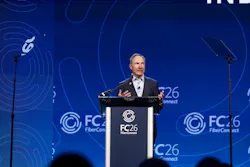
The Fiber Broadband Association (FBA) celebrated its 25th anniversary at Fiber Connect 2026 in Orlando, highlighting numerous milestones. In 2025, the fiber broadband industry passed 11.8 million homes, breaking 2024’s record, and it is on pace to beat that again this year. FBA research estimates that the total U.S. addressable market for Fiber-to-the-home (FTTH) will be in the range of 130 million homes when you include multiple fiber passings.
Fiber deployments have entered a historic investment cycle. Today, more than 100 million homes are passed by fiber, with another 60 million to be passed over the next five years. There are now 1,560 active fiber providers in the country, including 42 new fiber providers and 71 that doubled their footprint in the past six months.
Accelerating fiber rollouts
Fiber is one of the largest infrastructure expansions in modern history, with over 90% of the growth driven by private capital and built by companies such as altafiber, AT&T, C-Spire, GFiber, T-Mobile, Verizon, Ziply, and others.
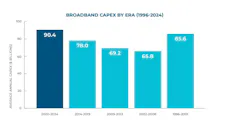
US Telecom reports that U.S. broadband providers invested nearly $90 billion into communications in 2024, bringing cumulative investment since 1996 to approximately $2.2 trillion, with tens of billions more to be invested over the next five years between the driving needs for more fiber to support AI, 5G and 6G wireless, and the steady growth of broadband across households and businesses, and the continued modernization of legacy copper and coax plant to fiber for reliability, scalability, and resilience.
AT&T alone is targeting over 60 million fiber locations by 2030, essentially doubling its footprint, because fiber investment pays off. It demonstrably grows market share, increases ARPU, reduces operational costs, lowers the carbon footprint, increases service attachment, and, most importantly, future-proofs the network for the inevitable growth that accompanies the deployment of new applications and technologies.
The AI factor
Broadband demand is no longer driven by a single application or trend, according to the latest consumer research conducted by RVA, as usage becomes more layered and multidimensional. While video still dominates downstream traffic today, upstream demand continues to increase as consumers upload, stream, collaborate, and increasingly interact with AI systems in real time.
Broadband is no longer simply about supporting a digital life; it is foundational to how entire economic and societal systems evolve. AI, automation, distributed work, rural migration, and immersive technologies are all converging onto the network at the same time.
Technologies will continue evolving, but the underlying requirements remain remarkably consistent: scalable, reliable fiber infrastructure capable of supporting an increasingly AI-driven, data-intensive, and geographically distributed society.
AI is a force reshaping how people work and interact with information, growing adoption across personal and professional use cases, as I discussed with RVA principal Mike Render at the end of May on Fiber for Breakfast. His research shows growing adoption of AI across both personal and professional use cases, from writing assistance and search to coding, modeling, decision-making, and automation, with productivity impacts already becoming significant.
RVA estimates an estimated 36% productivity improvement from AI usage, though Render believes that number might be understated. AI doesn’t just consume information; it continuously generates and exchanges it with other systems. As agent-based systems become more common, background traffic generated by automation, analysis, and machine-driven workflows could fundamentally change network utilization patterns.
The research also reinforced how quickly bandwidth-intensive technologies continue evolving beyond traditional streaming. Security cameras, cloud uploads, two-way video, AR/VR applications, automation systems, robotics, and future multi-sensory applications all push networks towards greater symmetry, lower latency, and more consistent reliability. The need for more bandwidth doesn’t stop when you plug into the network; it continues to grow as existing applications become more sophisticated and new ones arrive.
More importantly, fiber and AI are independent. AI infrastructure requires low-latency, high-capacity, and resilient interconnection. As AI moves from centralized training complexes to distributed inference and edge intelligence, fiber demand will continue to increase, regardless of the last-mile connection between the end user and AI processes.
The emergence of the thinking economy
But fiber to the home is not an end state; it is one part of an expansive 21st-century ecosystem connecting middle-mile networks, data centers, and the cloud to homes, businesses, and organizations. Fiber enables fundamental services we take for granted in today’s digital economy, including banking and other financial services, e-commerce, education, entertainment, health care, and public safety. We take it for granted that we can order groceries in the morning and they will show up in the evening, or fishing tackle in the afternoon, arriving on our doorstep the next day, with those transactions anchored by a seamless web of services that work effectively and securely.
Fiber is a strategic economic infrastructure. Communities with advanced fiber networks are better positioned to attract data centers, advanced manufacturing, technology investment, and health care.
Over the next five years, the fiber-based connectivity network that enables reliable, high-speed broadband across the country will continue to grow, expand, and become faster. This first-generation information economy, based on connectivity, will “level up” over the next five years through the application and proliferation of artificial intelligence (AI), leading to a Thinking Economy.
A Thinking Economy is where value is created by how you use it, processing information with intelligence and acting upon it instantly. In the Thinking Economy, analysis and speed are the primary virtues, and the three key traits for success are: how fast you understand, how well you decide, and how quickly you act.
Within this framework, fiber is the nervous system connecting everything and everyone. Information constantly flows in from the edge of the network from IoT devices, households and businesses ordering goods and services, factories fulfilling orders, and deliveries taking place every minute of every day. These diverse information flows are analyzed, stored, and acted upon by intelligent agents designed to improve productivity, increase convenience, and speed up processes.
AI is changing business processes and lives in many ways, but we still need humans in the loop to oversee the process and supervise decisions and outcomes. We need to embrace AI as a means of improving workers' productivity, not eliminating existing jobs. For example, AI is providing advanced tools to spot and treat medical conditions, but doctors still need to review and approve final plans before a course of treatment is implemented.
Fiber also provides the essential infrastructure for quantum technologies that will deliver increased computing power to solve hard problems in logistics optimization, drug and materials discovery, and manufacturing. It will enable new means of discovering geological resources and providing deeper biological insights for health care applications. The telecommunications industry’s 30-year development and refinement of photonics for high-speed data transmission provide the emerging field with ready-made parts and pathways, from enabling communication between geographically distributed quantum sensors to networking quantum computers working on massively scaled problems.
In the months to come, you’ll hear me and FBA talk more about the Thinking Economy and the necessity and role of fiber in AI across the ecosystem. Like the first-generation information economy, FBA is leveling up from its FTTH origins to expand our interests and reach across a broader infrastructure ecosystem encompassing middle-mile, data centers, and the ways fiber enables the emerging Thinking Economy.
About the Author
 Gary Bolton