RETN migrates 50% of its IP/MPLS traffic onto 400G ZR+ optics
Key Highlights
- RETN has moved 50% of its IP/MPLS traffic to 400G coherent pluggable optics, marking a key industry milestone.
- The deployment supports long-haul backbone links ranging from 300 to 950 kilometers, enhancing network capacity and efficiency.
- The company established a standardized IPoDWDM architecture to simplify network design and improve scalability.
- Market forecasts predict a 27% CAGR in IPoDWDM solutions, surpassing $7 billion by 2030, driven by data center interconnects and transponder applications.
- RETN's approach exemplifies the industry shift towards integrated IP-over-DWDM architectures, reducing network complexity and supporting future growth.


RETN, a growing independent global provider, has moved 50% of its IP/MPLS traffic over 400G coherent pluggable (ZR/ZR+) optical infrastructure, reflecting the service provider community's adoption of the technology across long-haul network routes.
Following RETN's large-scale deployment of 400G coherent optics across its Pan-Eurasian backbone in 2025, this latest development builds on the service provider's growing operational use of coherent pluggable technology.
What's significant about this milestone is that it marks the transition of this architecture from deployment into production-scale traffic carriage across upgraded segments of RETN-owned backbone infrastructure.
Standardized IPoDWDM architecture
RETN was well prepared for its ongoing IPoDWDM transition, which will enable it to more effectively adapt to new demands from its enterprise and data center customers.
In 2025, RETN completed a large-scale deployment of 400G coherent pluggable optics, with hundreds of modules operating across backbone links ranging from 300 to 950 kilometers.
During this deployment, RETN established a standardized IPoDWDM architecture that it says is designed to simplify network design, improve scalability, and increase energy efficiency across its core infrastructure.
RETN's IPoDWDM deployment aligns with the analysts' cited new growth period.
A recent Dell'Oro report revealed that the IPoDWDM market is forecast to grow at a 27 percent compounded annual growth rate (CAGR) over the next five years, surpassing $7 billion by 2030.
Deployment of scale-across data center interconnect (DCI) is expected to drive significant growth and shift the market toward more ZR+ optical pluggable modules, beginning this year.
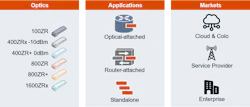
Fellow analyst firm Cignal AI also sees strong growth patterns for coherent pluggable optics. The research firm forecasts that the service provider and enterprise & government segments will grow faster than Cloud through 2030, as 400ZR+ 0dBm adoption broadens and low-cost pluggable transponders expand the addressable market beyond optical specialists.
Cignal AI noted that while the performance of 400ZR+ 0dBm optics has been proven and modules are widely available from numerous vendors, "the limiting factor in router-hosted adoption among service providers is operational rather than technical."
"Two forces further temper IP-over-DWDM growth in carrier networks: the proliferation of dense, low-cost pluggable transponders, and the pace of 400G and 800G router adoption," Cignal AI said. "800ZR+ optics, which support long-haul operation at 400G, will be especially popular in transponder applications. Service Provider revenue rises from roughly $293 million in 2025 to over $1.2 billion in 2030."

Integrating IP and optics
For RETN, the key element of its deployment is that it demonstrates how carriers are using ZR+/coherent pluggable-based transport to continue supporting a more integrated approach between the IP and optical layers.
This integrated approach has several benefits. Besides offering great flexibility and a streamlined backbone architecture across long-haul routes, it can reduce network complexity and improve energy efficiency.
RETN will continue to expand its coherent-enabled infrastructure across additional backbone segments, with all new backbone routes now built on a coherent pluggable-based IPoDWDM architecture as the default design standard.
Tony O'Sullivan, CEO of RETN, said that the completion of its network effort "reflects a wider shift in the industry away from strictly layered transport models towards more integrated IP-over-DWDM architectures in live backbone environments."
For related articles, visit the Optical Tech Topic Center.
For more information on high-speed transmission systems and suppliers, visit the Lightwave Buyer’s Guide.
To stay abreast of fiber network deployments, subscribe to Lightwave’s Service Providers and Datacom/Data Center newsletters.