New SOA platform targets all-optical 40-Gbit/sec network development
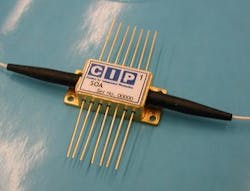
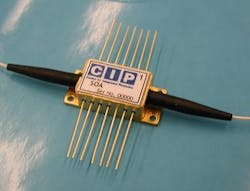
February 3, 2005 Ipswich, UK -- The Centre for Integrated Photonics (CIP) has launched a new semiconductor optical amplifier (SOA) offering optimized non-linear operating characteristics that may be used to implement advanced all-optical networking functions such as wavelength conversion. According to CIP, the new component has an extremely fast gain recovery that makes it ideal for use at 40-Gbit/sec transmission speeds. The device also offers large-spot interfaces with ultra-low reflectivity that enables it to be passively aligned when building integrated optical sub-systems.
Designed by a team with a background in telecommunications component and sub-system development, the SOA-NL-OEC-1550 is optimized for next-generation WDM applications and has already been used successfully for wavelength conversion and 2R (reamplifying and reshaping) signal regeneration at 40 Gbits/sec.
Among the optimized operating parameters offered by the 1550-nm indium-phosphide, multiple quantum well SOA device are a saturated gain recovery time (1/e) of less than 25 picoseconds--which supports 40-Gbit/sec transmission speeds--and a polarization dependent saturated gain of less than 0.5dB. The device also offers a high gain figure of over 30 dB for small signal inputs. To optimize performance in its target applications, the device features an internal active waveguide with a high confinement factor of over 20%.
These tuned characteristics allow the SOA to perform well in a range of advanced optical applications, say CIP representatives. The device can be controlled to exploit four-wave mixing, cross-gain modulation, or cross-phase modulation effects to implement all-optical wavelength conversion, providing a dynamic mesh connectivity capability to enhance the flexibility of point-to-point optical networks. The phase change characteristics of the non-linear SOA--and its high gain--may also be employed to regenerate optical signals. The device is also ideal for implementing all-optical Boolean logic functions.
"Investment in backbone network infrastructure is coming to the fore again, and this device with its novel 40-Gbit/sec performance offers a versatile platform for new developments," contends Neil Weston, CIP's vice president of sales and marketing. "To support this market, we are backing the component with comprehensive engineering and production services. CIP is able to optimize the performance characteristics of the device, or add extra functions--either by monolithic or hybrid integration techniques."
The new SOA joins a range of compound-semiconductor device functions for optical networking developed by CIP. The organization has its own semiconductor fabrication plant and is able to create variants of the SOA with application-specific performance requirements, including custom device lengths, additional active optical processing functions, or integrated arrays of devices. CIP's capabilities in hybrid integration also allow the SOA to be packaged with customer-specified planar silica waveguide optoelectronic elements such as interferometers; CIP makes a hybrid variant of the device with a Mach-Zehnder interferometer.
The new SOA is supplied in a butterfly package for use with an external temperature controller and is available for immediate delivery in small quantities.