Ultra high-frequency TCVCXOs boost SDH/SONET/GbE optical networks
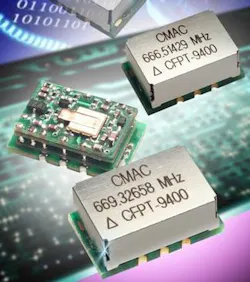
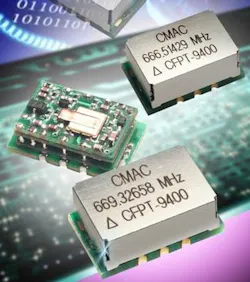
May 10, 2005 Durham, NC -- C-MAC Microtechnology has launched a range of low-jitter, high-frequency temperature compensated voltage controlled crystal oscillators (TCVCXOs) for use in TDM switching systems for optical fiber backbone infrastructure. The CFPT-9400 line of TCVCXOs combines a high-frequency fundamental crystal and the manufacturer's proprietary Pluto temperature compensation technology, and is designed to eliminate reception "slips" that compromise the effective bandwidth of SDH/SONET and Gigabit Ethernet (GbE) fiber networks.
According to the manufacturer, as telecoms carriers increase data rates across their long-haul fiber infrastructure, transmissions become more sensitive to short-term frequency discrepancies between transmitting and receiving equipment, which can lead to faulty reception of data packets. The discrepancies can be caused by jitter in the signal, or by rapid fluctuations in ambient temperature at either end of the fiber. The manufacturer contends that improving the jitter performance and temperature stability of the oscillators increases the effective capacity of the fiber network by reducing the number of dropped packets, and hence the number of re-sends required, thus increasing the effective capacity of the fiber network.
"Short-term frequency stability is a hugely important factor in long-haul fiber networks, and will become ever more so as carriers move from today's SDH/SONET and Gigabit Ethernet technology to 10 Gbit/sec and beyond," affirms Geoff Trudgen, senior design engineer with C-MAC. "Use of Pluto temperature compensation technology in a low-jitter, HFF-based oscillator gives us stability to within ±1.5 ppm over temperature range - far better than has previously been possible at such high frequencies - allowing the CFPT-9400 to fulfill the requirements of TDM fiber backbone switches in an efficient and cost effective manner."
According to the manufacturer, the CFPT-9400 achieves jitter performance of less than 3 ps rms 10 Hz to 80 MHz by avoiding the use of a phase locked loop in favor of a low-phase-noise HFF (high-frequency fundamental) crystal and harmonic multiplication. The HFF crystal is coupled through a surface acoustic wave (SAW) filter, suppressing any sub-harmonics of the operating frequency to typically less than ±55 dBc.
The manufacturer says incorporating its Pluto temperature compensation technology keeps frequency stability over the 0° to +80°C operating temperature range to within ±1.5 ppm. Besides eliminating temperature-related slips, the manufacturer says this places the device well within the Telcordia specification of ±20 ppm, enabling stability over a 20-year lifetime. Because its Pluto technology uses an analog temperature compensation technique, it also exhibits superior phase noise characteristics, eliminating another potential source of jitter, according to the company.
The CFPT-9400 is available in five output frequencies: 622.08000 MHz, 666.51436 MHz, and 669.32658 MHz for SDH/SONET switches with or without forward error correction (FEC); and 644.53125 MHz and 693.48299 MHz for GbE and 10-GbE applications, with or without FEC. Frequency adjustment of up to ±60 ppm is available through external voltage control.
Supply voltage is 3.3 V with a current consumption of 65 mA typical; output is 3.3 V PECL (LVPECL) -compatible. The device, packaged as an industry standard 14-mm x 9- mm SMD, is designed for lead-free soldering, and is compliant with RoHS regulations.