OEpic offers 1310-nm 10-Gbit/sec optical front-end solution for low cost next- generation transceivers
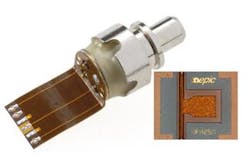
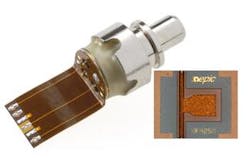
March 19, 2003--OEpic Inc. introduced today a 10-Gbit/sec 1310-nm opto-electronic front-end transmitter incorporating flex board interconnection technology (TO-Flex) for low cost, next-generation 10-Gbit/sec optical transceivers, such as XENPAK, X2, XPAK and XFP. The transmitter complements the company's 1310-nm optical receiver chipset released earlier, providing a complete optical front-end (OFE) chipset solution for intermediate and long-reach (IEEE 10GBASE-L) fiber-optic applications.
"We are aggressively expanding our product line based on the low cost, industry standard TO-Flex optical package platform," explains Dr. Yi-Ching Pao, founder, president and chief executive officer of OEpic. "Our new 1310-nm products coupled with our well-accepted 10-Gbit 850-nm VSR optical front-end chipset make OEpic the most complete optical front-end supplier in the industry offering products with high performance at the lowest price," he adds.
The 10-Gbit/sec front-end chipset is designed for 10-Gigabit Ethernet and Fibre Channel datacom applications in Storage Area Networks (SAN), Local Area Networks (LAN), and Metro Networks, such as 1310-nm datacom products meeting the IEEE 802.3ae LR standard. TO-Flex permits the use of the OEpic OFE chipset in all current 10-Gbit/sec transceiver multiple source agreements (MSAs).
The 10-Gbit/sec 1310-nm optical front-end transmitter consists of a distributed feedback (DFB) laser with internal monitoring photodetector for reaches up to 10 km (or an optional Fabry-Perot laser for 600 m to 2 km reaches). Optical transceiver OEMs can use OEpic's other products, such as a laser driver amplifier for a complete transmitter chipset.
Technical details of the 10G TO-Flex 1310-nm optical front-end chipset:
• The LD1030 Transmitter consists of a 1310-nm DFB laser with internal monitor photodiode. The device provides a typical optical output power of 0.9 mW at 35 mA and operates up to 12.5 Gbits/sec. It is available in an internally-matched 10-Gbit/sec TO-Flex package with LC or SC connector.
• The LF1030 Transmitter consists of a 1310-nm FP laser with internal monitor photodiode. The device provides a similar speed performance to the DFB version at a lower cost. It is available in an internally-matched 10-Gbit/sec TO-Flex package with LC or SC connector.
• The PT1030 Receiver consists of a PIN photodetector, integrated with an InGaP-HBT transimpedance amplifier (TIA). The device has a low power consumption of only 120 mW and a minimum sensitivity of -15 dBm at 1310 nm. It is available in an internally matched 10-Gbit/sec TO-Flex package with LC or SC connector.
• The DL1003 Laser Driver can be used with either the DFB or FP laser products. The device is biased at 5 V and 115 mA for a total power consumption of 575 mW. It is available in a 3-mm QFN package.
The 10G TO-Flex 1310 nm OFE chipset and evaluation boards will be available for sampling and evaluation in May 2003. Volume quantities will be available in Q3 of 2003.