Monitoring Hollow Core Fiber
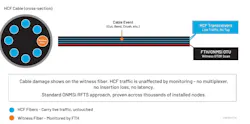
A practical, layered approach: from proven cable surveillance to Hollow Core fiber-specific degradation assessment
Hollow core fiber (HCF) is moving rapidly from research into trials and early operational deployments. Operators rightly ask how their installed HCF links will be monitored over their service life. The encouraging news is that a credible foundation already exists. VIAVI’s installed base of remote fiber test systems (RFTS) watches over thousands of fiber routes today, and the underlying methods — single-ended OTDR surveillance, alarming, and trending via ONMSi — extend naturally to HCF cables. This application note describes the recommended monitoring strategy for HCF — starting from what works today on standard fiber, then layering in the additional techniques needed to characterize the HCF itself as the technology matures.
Throughout, we make a deliberate distinction between two questions an operator may want answered. Is the cable healthy? — answered by surveilling a witness fiber inside the cable. Is the HCF link itself degrading? — answered by additional, complementary measurements on the HCF fiber. These questions need not be answered with the same instrument or technique, and in many deployments the simplest, most economical solution will combine them in layers.