Key Highlights
- Billions of dollars are flowing into U.S. fiber optic production, supporting the growth of the AI-powered Thinking Economy.
- Major companies like Meta, Amazon, and Verizon have announced multi-billion-dollar agreements to expand fiber manufacturing and network infrastructure.
- The fiber boom is creating thousands of jobs in the southern U.S., including manufacturing, construction, and workforce training programs.
- Investments are not only at the infrastructure level but also at the server level, with partnerships to increase capacity and replace copper with fiber in data centers.
- Fiber optic networks are critical for AI, providing scalable bandwidth, low latency, and reliability essential for data centers, edge computing, and AI workflows.

Billions of dollars are flowing into U.S. fiber optic cable production while billions more are anchoring multi-year fiber optic supply agreements between cloud operators and carriers. We are seeing the largest wave of capital investment in the fiber industry in its history, one that will result in mind-boggling amounts of new fiber being deployed across the country and around the world. This wave of investment is creating thousands of new jobs throughout the southern United States as we migrate from an information-based economy to an AI-powered Thinking Economy.
This story begins, as investment tales do, with supply and demand. AI projects around the country are consuming up to 16 times more fiber for increased GPU density inside the data center and more broadband between new and existing data centers and the rest of the world.
It’s not a single area of the AI ecosystem, but all the above: servers to racks, racks to racks, buildings to buildings on campuses, regional and metro connectivity, middle mile, and long haul, all needed to connect AI to users and AI to AI.
Cloud and service providers scale up
Cloud firms scaling into AI and service providers offering broadband connectivity alike need to secure long-term access to fiber, and they’re paying for it up front today. Meta and Corning kicked off this year’s wave of investments with a whopping $6 billion multiyear agreement in late January 2026, with Meta seeking strengthened domestic supply as well as the latest and greatest innovations in optical fiber, cable, and connectivity solutions for its data center projects.
The announcement included a new optical cable manufacturing facility in Hickory, North Carolina, and expanded production capacity across Corning’s North Carolina operations, with the agreement supporting Corning’s projected employment growth in the state by 15 to 20% for a skilled workforce of more than 5,000 employees there.
Not to be left behind, Amazon announced its own multi-year, multi-billion-dollar agreement with Corning in June to boost fiber manufacturing, the deal creating 1,000 jobs across Corning’s North Carolina facilities, hundreds of construction jobs, and a workforce training program.
Over the past two years, service providers such as Lumen and Verizon have signed their own long-term purchase agreements. Zayo became the latest to join the club in August, with the long-haul provider intending to add 15,000 new route miles by 2030 to its network, one it describes as “one of the largest network expansions in its history.”
Addressing server levels
But the need for fiber to propel AI further and faster is moving inward at the server level as well. In May, NVIDIA and Corning announced a multiyear commercial and technology partnership to add more capacity to meet the needs of AI buildouts. NVIDIA will invest up to $3.2 billion, with Corning adding three new plants focused on AI, creating at least 3,000 jobs and increasing Corning’s U.S. optical manufacturing capacity by a factor of 10, according to CNBC. The news report speculated that the deal is linked to NVIDIA moving to replace copper with Corning fiber in data center rack systems.
Corning’s publicly announced deals are estimated to have an aggregate value between $11 billion and $13 billion. Still, other fiber firms are also investing to increase U.S. optical fiber manufacturing capacity based on existing demand from their data center customers. Earlier this year, Japanese-based Fujikura declared it was investing up to $1.6 billion to approximately quadruple U.S. optical fiber cable manufacturing capacity compared to fiscal 2022 levels for producing more fiber and ribbon cable in South Carolina.
Prysmian announced in August that it would invest more than $1 billion in three sites in North Carolina, South Carolina, and Tennessee, as part of a global commitment to more than double domestic optical cable and fiber capacity. More than $1 billion of the North American Prysmian investment will go into the company’s Claremont, North Carolina, campus, doubling the size of the onsite fiber manufacturing facility and expanding the optical cable plant as well. The company's U.S. investments will deliver up to 600 new jobs and are anchored by a 10-year $6.4 billion purchase agreement with Molex, a wholly owned subsidiary of Koch Industries. Molex agreed to pay approximately $640 million up front to secure fiber access.
August also saw Lightera join the global wave of fiber optic manufacturing expansion. The company plans to fund new capacity across Lightera’s operations in the United States and affiliated manufacturing capabilities in Brazil, Japan, and India, with strong customer demand including long-term purchase commitments supporting the expansion. The additional production capacity is expected to progressively come online beginning in the second half of FY2028, according to the company announcement.
Verizon, AT&T take position
The slew of announcements throughout 2026 are linked to the direct production and supply of fiber. Still, deals are also taking place to purchase existing dark fiber, such as Google purchasing over $1 billion of Verizon’s dark fiber routes to connect its data centers.
Verizon's CEO Dan Schulman said the company expects to announce additional deals by the end of the year that will generate “multiple billions of dollars” in revenue over the next several years, ones he described as long-duration, high-quality revenue streams from some of the world’s most demanding infrastructure customers.
Verizon also anticipates additional revenue flowing in from the conversion of its legacy central offices (CO) to edge-based data centers supporting AI inference workloads, pulling out the copper, putting in fiber, and deploying inference edge computing to deliver low latency for services such as robotics. It and AT&T both wish to remove copper for many reasons, including substantially increased speed and reliability and lower power consumption.
AT&T continues to expand its fiber network to support AI, announcing in June 2026 that over 40 metro areas offer the company’s 400G wavelength connectivity, with availability across 440,000 properties with more than 2.3 million business tenants. The company cites 400G wavelength connectivity as providing faster, more reliable data movement, so applications and AI workflows perform consistently; AI access from anywhere to the cloud, including branch locations, campuses, and edge environments that need high-capacity connectivity to cloud and compute services; and scalable capacity for what it calls “AI-era” demand, reducing the need to add multiple smaller circuits as workloads increase.
Overall, AT&T plans to spend more than $250 billion through 2030 to build and modernize its network, part of a necessary modernization of vital telecommunication infrastructure to replace legacy copper with more reliable, resilient fiber to support critical applications such as enhanced 911 services and, of course, more AI.
It’s difficult to fully comprehend the scope of the increase in broadband capacity taking place over the next five years that AI is driving, due in part to the sheer scope and scale of the facilities being built around the country to create increasingly capable AI models, as well as the migration of agentic AI from those centralized locations into edge compute deployments for lower latency.
Fiber has played, and continues to play, a critical and foundational role in the growth and deployment of AI because it delivers effectively unlimited scalable bandwidth and low latency with exceptional reliability and robustness compared to any other medium. In a Thinking Economy, data is analyzed and acted upon rather than moved around. Fiber plays the role of the nervous system, the high-speed conduit that links everything together.
The fiber optic manufacturing industry and its partners are investing in scaling production to ensure the Thinking Economy becomes a reality in the months and years ahead.
FOR FURTHER READING
 verizon
 corning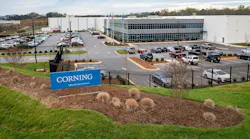

About the Author
 Gary Bolton