Dedicated Internet Access (DIA) to become the dominant Ethernet service

Dedicated Internet Access (DIA) is fast becoming the service that will take on the dominant spot in the Ethernet services market.
This service, a connection delivered via Ethernet or private-line circuits, isn’t shared with other business customers. Although providers offer it at a premium price, it provides business-grade features and higher speeds than many shared-access alternatives. Also, DIA services are supported by Service Level Agreements between the internet provider and the business or subscriber.
In addition to DIA, Vertical tracks five other Ethernet services – Ethernet Access to IP/MPLS, EPL (Ethernet Private Lines), EVPL (Ethernet Virtual Private Lines), Metro LAN, and WAN VPLS (Wide Area Network Virtual Private LAN Service).
The research firm said that two applications are driving DIA service revenue.
One is customer demand for dedicated high-speed WAN access underlay connectivity to support the expansion of Managed SD-WAN networks. The other primary DIA driver is the need for secure, proper gigabit-speed connectivity to cloud services.
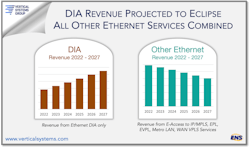
Today, VSG said that DIA services already contribute over one-third of U.S. Ethernet revenue. By 2026, the research firm expects DIA to eclipse aggregate revenue for all five other Ethernet services combined based on projected growth rates.
For related articles, visit the Business Topic Center.
For more information on high-speed transmission systems and suppliers, visit the Lightwave Buyer’s Guide.
To stay abreast of fiber network deployments, subscribe to Lightwave’s Service Providers and Datacom/Data Center newsletters.
About the Author
 Sean Buckley
Sean Buckley
Sean is the Editor-in-Chief of Lightwave. He establishes and executes Lightwave's editorial strategy across its website, email newsletters, events, and other information products. Before coming to Lightwave in July 2023, he served as editor of Broadband Communities. Earlier, he served as senior editor of FierceTelecom and the editor of the former Telecommunications Magazine. He got his start in the optical industry in 1998 when he became the editor of enterprise and optical networks at Information Gatekeepers. He has a BA in English from the University of Massachusetts, Boston, and lives in Dracut, Mass, with his wife, two sons, and his cat, Dove.