Bluebird Network wraps new Mississippi River fiber crossing

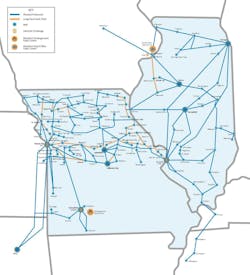
Bluebird Network has wrapped construction of a new 3,500-foot fiber river crossing 100 feet below the Mississippi River, connecting the west bank of St. Louis and the east bank of Illinois.
Already, the route has gotten the attention of a large hyperscaler and social media company. This company said it decided to partner with Bluebird Network because of its growing presence in the Midwest market and the fact that it owns its fiber network.
Owning its network allows Bluebird to have greater oversight of network performance. “Network providers have a distinct advantage when controlling their fiber in a new or existing market,” said Jamie Scott, Director of Outside Plant Engineering at Bluebird Network. “It’s not only good for their business model and their shareholders, but also their users.”
They were getting the build done not only required that it would not compromise the area’s indigenous history. Bluebird partnered with geotechnical engineering firms specializing in long-distance bores, boring companies, splicing and data contractors, and archaeologists to ensure there was no destruction of the indigenous history in the area around the boring site.
A vital element of the new build is scale.
Bluebird’s forthcoming National Telecommunications and Information Administration (NTIA) grant-supported long-haul route connecting St. Louis and Tulsa is designed to accommodate future industry needs with high fiber capacity between major metros. While Bluebird has not revealed the total fiber capacity of the project, the company said the far-reaching network can accommodate current and future needs, including carrier customers and data center operators.
The build will create a new fiber pathway between the cities, enable connectivity into underserved areas across Missouri and Oklahoma along this route, and fortify connectivity into the Bluebird Underground Data Center in Springfield, MO.
For related articles, visit the Business Topic Center.
For more information on high-speed transmission systems and suppliers, visit the Lightwave Buyer’s Guide.
To stay abreast of fiber network deployments, subscribe to Lightwave’s Service Providers and Datacom/Data Center newsletters.
About the Author
 Sean Buckley
Sean Buckley
Sean is the Editor-in-Chief of Lightwave. He establishes and executes Lightwave's editorial strategy across its website, email newsletters, events, and other information products. Before coming to Lightwave in July 2023, he served as editor of Broadband Communities. Earlier, he served as senior editor of FierceTelecom and the editor of the former Telecommunications Magazine. He got his start in the optical industry in 1998 when he became the editor of enterprise and optical networks at Information Gatekeepers. He has a BA in English from the University of Massachusetts, Boston, and lives in Dracut, Mass, with his wife, two sons, and his cat, Dove.