Key Highlights
- Fiber broadband reached 11.8 million U.S. homes passed in 2025, with a total of 98.3 million FTTH passings including multiple passings per home.
- The U.S. is on track to overtake cable as the dominant broadband platform by 2028, with over 60% household coverage and significant untapped potential for growth.
- Average fiber take rates have increased to 46.5%, rising further to 61% when secondary providers enter the market, indicating strong consumer preference and competitive dynamics.
- Canadian fiber deployment is extensive, with nearly 75% of households having fiber access, reflecting rapid international growth in fiber infrastructure.
- Consumer ratings favor fiber for speed, latency, and jitter, with market competition and improved customer experience fueling continued adoption.

As Tier 1 and Tier 2 operators rapidly expand fiber broadband availability, a new joint report from the Fiber Broadband Association and RVA notes that fiber could surpass cable as the dominant broadband platform by 2028.
According to the new study, fiber broadband deployments reached 11.8 million U.S. homes passed in 2025 alone, totaling 98.3 million FTTH passings when including homes with multiple passings.
Mike Render, Founder and CEO at RVA, and the report’s author, said that 2025 was “another record year.”

“The industry has been on a steady upstream, except for a decline in 2020, with nearly 12 million homes marketed and ready for sale,” he said. “This is about 1,000 times bigger than my first report, which had 12,000, so we have made quite a bit of progress.”
On a cumulative basis, the U.S. has nearly 100 million fiber locations and 40 million homes now connected. Interestingly, 84.6% of these homes are unique.
Render noted that some of these unique homes “have two or three providers passing the locations with fiber and in a few cases three providers.”
Redundant passings rise
As more service providers roll out fiber-based broadband, the amount of redundant passings to homes and businesses continues to rise.
While 84 percent of one pass is considered a pass, RVA calculated that 16 percent of passes are redundant in neighborhoods. Within this group, 1 percent have three or more passings, while 15 percent have two passings.
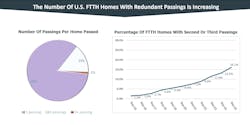
“People are seeing the need to compete with fiber and go into certain places with another fiber,” Render said. “Despite the speed of deployment, take rates have crept up a bit, which is significant because it takes about five years once you build and you start marketing to homes to become actual connections.”
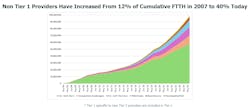
The rise in redundant passings also reflects the increasing presence of diverse FTTH players. While the market was initially driven by large telcos such as Verizon with Fios, the number of competitive FTTH players has gone from 12 percent in 2017 to 40 percent in 2025.
“Competitive providers are represented by a large range of players, including Google and now T-Mobile, as well as small wireless players getting involved in fiber broadband,” Render said.
Another key provider segment that’s gaining ground in the competitive FTTH race is Tier 2 cable MSOs. Wide Open West, which recently became a private company, passed approximately 15,500 new homes in the third quarter, boosting total homes passed to over 106,600 with a 16% penetration rate in Greenfield markets.
“Tier 2 cable MSOs as well as Tier 2 and Tier 3 telcos are increasing the build of fiber,” Render said.
And while fiber has the advantage of reaching take rate goals faster, second providers are competing successfully.
Optimum, for example, has an 84% take rate in markets like New York City, where it competes with Verizon Fios. During the third quarter, Optimum reported adding X FTTH customers.
“When a second fiber provider is available, the total FTTH take rate increases,” Render said. “Analysis shows the current overall FTTH take rate with two providers is about 61% (which will likely increase over time).”
Room for growth
The joint survey results revealed that the U.S. is well on its way to fiber availability goals, with fiber broadband now passing over 60% of U.S. households and on track to overtake cable and all other technologies as the dominant U.S. delivery platform as early as 2028.
However, fiber passing is not the only notable metric for FTTH. The survey data indicate that average take rates climbed to 46.5% for primary passings.
Despite this progress, there’s plenty of room for further growth.
There are 61 million remaining potential first-time fiber passings, and 69 million second- and third-passings remain untapped, creating opportunities for overbuilding and competitive fiber deployments. Render estimates there’s a total of over 129 million fiber passings remaining.
“The addressable market for fiber is still huge,” Render said.
According to data RVA collected from VCTI, which divides zip codes into Broadband Serviceable Locations (BSLs), there are still opportunities not only for initial passings but also for second and third passings.
When a secondary provider enters a fiber market, the total FTTH take rate jumps to about 61%, demonstrating that fiber-to-fiber competition increases adoption.
“We think there’s a big opportunity, especially in more dense areas and in more urban areas for second and third passings,” Render said.
And while rural markets, which have lower density, have traditionally been more expensive to serve, Render said, “Take rates increase, which offsets the capital expense to build in these areas.”
Speed's influence on content, productivity
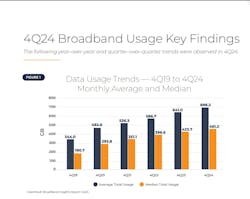
While there is a constant sentiment that traditional broadband methods like cable modems or even wireless offer enough bandwidth, fiber’s symmetrical bandwidth can accommodate the growing need for upload speeds.
Devices like high-definition cameras, such as a Ring device, require a consistent upload speed.
One of the speed advantages of a fiber connection is that a provider can offer a consumer or business a range of symmetrical speeds, from 1 Gbps to 10 Gbps, and even new speeds like 25 Gbps and later 50 Gbps, something Render said is “unique to fiber.”
“A lot of people have tried to position that fiber speeds are not necessary, and I can do all of these tasks with 100 or 50 Mbps, but the main point is productivity,” he said. “If you have too low a speed and discounting the streaming part of the usage, you are waiting 2 seconds if you don’t have the speed, which is a reason to sell fiber and help people into higher speed tiers available.”
He added that “if time is important to you, and it is to most people, a gigabit or more is important today.”
Opportunities beyond FTTH
Fiber will continue to find utility in the consumer market; its presence in a community will continue to have a rippling effect, enabling opportunities such as data centers, towers and small cells, grid and energy infrastructure, in-home fiber, quantum, AI, and fiber sensing.
These opportunities are still early in their market maturity and offer long-term growth potential beyond traditional FTTH.
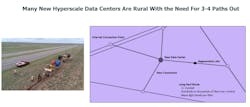
One of the most significant areas of potential growth is fiber-to-the-data center. While the data center industry has emphasized the need for greater power, cooling, and more silicon solutions, fiber availability remains a key constraint.
“There’s not enough fiber between existing centers and the new data centers,” Redner said.
In its five-year outside interconnect forecast, RVA found it would take 92,000 route miles to be built, totaling 213 million fiber miles.
Both large and regional service providers have an opportunity to offer wholesale dark and lit fiber services to the data center industry. “There are lots of opportunities in the data center market even for small providers,” Render said. “This is because these data centers are built out in the middle of rural areas where they have three to four paths out to ensure redundancy, and who knows that better than local providers in a rural area?”
For related articles, visit the Business Topic Center.
For more information on high-speed transmission systems and suppliers, visit the Lightwave Buyer’s Guide.
To stay abreast of fiber network deployments, subscribe to Lightwave’s Service Providers and Datacom/Data Center newsletters.
Canada’s FTTH progress
Led by Bell Canada, Telus, and a host of competitive players, Canada continues to make progress in the FTTH race. Canada, which had a total of 12.5 million unique homes marketed and 14.5 million total fiber passings, nearly 75% of Canadian households.
Bell Canada had 4.8 million high-speed subscribers as of the end of the third quarter. The service provider’s retail high-speed Internet subscriber base increased by 442,225 following the acquisition of Ziply Fiber. Meanwhile, Telus plans to extend fiber-to-the-premises to more locations through 2029.
RVA’s Mike Render noted that “Canada is ahead of the U.S. in terms of penetration of homes passed, but it gets tougher from there because their rural areas are more rural than the U.S.”
About the Author
 Sean Buckley
Sean Buckley
Sean is the Editor-in-Chief of Lightwave. He establishes and executes Lightwave's editorial strategy across its website, email newsletters, events, and other information products. Before coming to Lightwave in July 2023, he served as editor of Broadband Communities. Earlier, he served as senior editor of FierceTelecom and the editor of the former Telecommunications Magazine. He got his start in the optical industry in 1998 when he became the editor of enterprise and optical networks at Information Gatekeepers. He has a BA in English from the University of Massachusetts, Boston, and lives in Dracut, Mass, with his wife, two sons, and his cat, Dove.