Key Highlights
- The global cloud market reached $419 billion in 2025, with a 30% growth in Q4 2024, marking the ninth consecutive quarter of acceleration.
- AI-specific cloud services have been a major driver of growth, boosting revenue across providers and enhancing the overall cloud portfolio.
- Amazon remains the market leader with 28% share, while Microsoft and Google continue to grow rapidly, achieving 21% and 14% market shares respectively.
- CoreWeave's revenue surpassing $1.5 billion signifies the rising prominence of AI- and GPU-focused cloud services.
- Regional growth is strongest in Australia, India, and Europe, with the US maintaining its position as the largest cloud market.

GenAI’s ongoing emergence is driving a surge in growth in the cloud services market, which accelerated in the fourth quarter.
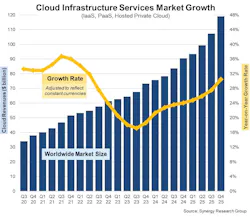
Synergy Research’s latest market report found that fourth-quarter enterprise spending on cloud infrastructure services jumped by almost $12 billion from the previous quarter and by $29 billion from the fourth quarter of 2024.
The research firm said the “scale of these increments far surpasses anything previously seen in this market,” adding that the 2025 full-year market reached $419 billion.
With 30% growth from the fourth quarter of 2024, this marks the ninth consecutive quarter of accelerating year-on-year growth and the highest growth rate the market has seen in more than three years.
John Dinsdale, Chief Analyst at Synergy Research Group, said that “GenAI has simply put the cloud market into overdrive.”
“AI-specific services account for much of the growth since 2022, but AI technology has also enhanced the broader portfolio of cloud services, driving revenue growth across the board,” he said.
Amazon’s lead continues
As in earlier quarters, Amazon maintained its lead in the cloud market, but Microsoft and Google continued to achieve substantially higher growth rates.
The fourth quarters of the worldwide market shares of Amazon, Microsoft, and Google were 28%, 21%, and 14%, respectively.
Tier two players also had a significant showing in the fourth quarter, with CoreWeave, OpenAI, Oracle, Crusoe, and Nebius showing high growth rates.
Synergy noted that CoreWeave is now generating more than $1.5 billion in quarterly cloud revenue and has joined the top ten cloud providers, driven by its AI- and GPU-focused services.
Now that most cloud providers have released their fourth quarter earnings, the research firm estimates that quarterly cloud infrastructure service revenues (including IaaS, PaaS and hosted private cloud services) were $119.1 billion, with full-year 2025 revenues reaching $419 billion. Public IaaS and PaaS services account for the bulk of the market and grew by 34% during the period.
Public cloud is one of the fastest-growing segments, with the top three cloud providers accounting for 68% of the market.
“The leading cloud providers have all seen their revenue growth rates jump,” Dinsdale said. “Meanwhile, neoclouds remain relatively small compared with the leaders, but they too are now contributing meaningful incremental growth.”
Worldwide geographic growth
From a geographic perspective, the cloud market continues to grow rapidly across all regions.
Leading the charge were Australia, India, Indonesia, Ireland, Mexico, South Africa, and Taiwan, all growing at rates above the worldwide average.
However, the U.S. remains by far the largest cloud market, with its scale far exceeding that of the Asia-Pacific region. The U.S. market grew by 30% in the fourth quarter.
In Europe, the largest cloud markets are the UK and Germany, but the fastest-growing markets were Ireland, Poland, and Sweden.
For related articles, visit the Business Topic Center.
For more information on high-speed transmission systems and suppliers, visit the Lightwave Buyer’s Guide.
To stay abreast of fiber network deployments, subscribe to Lightwave’s Service Providers and Datacom/Data Center newsletters.
About the Author
 Sean Buckley
Sean Buckley
Sean is the Editor-in-Chief of Lightwave. He establishes and executes Lightwave's editorial strategy across its website, email newsletters, events, and other information products. Before coming to Lightwave in July 2023, he served as editor of Broadband Communities. Earlier, he served as senior editor of FierceTelecom and the editor of the former Telecommunications Magazine. He got his start in the optical industry in 1998 when he became the editor of enterprise and optical networks at Information Gatekeepers. He has a BA in English from the University of Massachusetts, Boston, and lives in Dracut, Mass, with his wife, two sons, and his cat, Dove.