Fidium expands presence in Flexential’s Texas and Minnesota data centers
Key Highlights
- Fidium is expanding its presence in three Flexential data centers in Dallas, Plano, and Minneapolis–St. Paul to support hybrid IT solutions.
- The partnership provides access to 100G and 800G wavelength services, Ethernet, Dark Fiber, and Construction-as-a-Service offerings.
- Fidium operates over 67,000 route miles across more than 20 states, with access to 155 on-net and 145 near-net data centers, enhancing enterprise connectivity options.
- The collaboration aims to simplify how enterprises connect across hybrid environments, offering lower latency, costs, and architectural control.
- Fidium’s strategic fiber investments and extensive network infrastructure position it as a key enabler of digital transformation for hyperscalers and enterprises.
Fidium’s latest pact to enhance its presence in three of Flexential’s data centers--Dallas and Plano, Texas and Minneapolis–St. Paul, Minnesota, is another proof point of how fiber-based connectivity is the main foundation for cloud and hybrid IT solutions.
This agreement builds on Fidium’s rapidly expanding national data center footprint and recent partnerships, providing the infrastructure enterprises need for AI, cloud, and edge workloads with direct access to 100G and 800G Wavelength services, Ethernet, Dark Fiber, and Construction-as-a-Service (CaaS) offerings.
With more than $1.9 billion invested in fiber infrastructure since 2020, Fidium offers a host of unique routes and a dense metro in its 20+ state service area. By combining Fidium’s dense fiber footprint and Flexential’s nationwide colocation and interconnection platform, the relationship helps solve one of the biggest challenges in hybrid IT, simplifying how and where enterprises connect.
Wide-reaching network
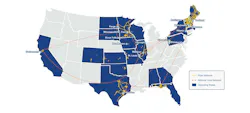
Fidium Fiber operates one of the largest independent fiber networks in the United States, spanning more than 67,000 route miles across 20 states. Currently, it has access to 155 on-net data centers and 145 near-net facilities.
Fidium also operates a limited number of owned and operated data centers across its footprint. These facilities serve as regional network anchors and complement the broader on-net and near-net ecosystem by reinforcing connectivity and optionality.
Having this set of on-net and near-net assets gives Fidium’s hyperscaler customers more options to expand their presence, with lower latency, lower costs, and greater architectural control.
Sean Baillie, SVP of Carrier, Channel, Data Center, and Hyperscale at Fidium, said “our customers increasingly view connectivity as a strategic layer of digital transformation” and “they want choice, speed, reach, and simplicity when building out their network edge."

Growing markets
For Fidium’s wholesale fiber network business, Texas and Minnesota have been growing markets with more data center targets continuing to emerge.
Besides seeing continual growth in major markets like Austin, Dallas, Houston and San Antonio, Baillie said it is seeing developments across the state.
“GPU and large language deployments are driving the data center growth in Texas, and the bandwidth demands that come along with that are astronomical,” he said. “We have a high-value network that we keep expanding, and our data center footprint in Texas is growing.”
While Minnesota is a bit behind, Fidium continues to see hyperscaler activity across the state.
Fidium continues to get to see the demands from Minnesota’s data center providers from a network perspective.
“We are seeing the next wave of network development in Minnesota, and our networks are well-suited to support them,” Baillie said.
Opportunity-driven expansion
When Fidium is looking to expand its network across Minnesota, Texas, and other states to serve data center providers such as Flexential, it considers how potential customers can be connected to the network.
“Edging out our network is opportunity-driven, and the data center landscape is the obvious place to go,” he said. “We’re putting in a lot of money into data center expansion,” Baillie said.
Data centers may be a key target for extending their fiber network, but it also looks at other opportunities, such as local businesses that might be housed along the same path.
“We have a program called Smart Build,” Baillie said. “If there’s a data center nearby that needs fresh fiber and diverse routes, we’ll look at everything in between and design the route to not only be latency sensitive, but also give us edge-out capabilities.”
As Fidium sites new targets, it also keeps an eye on its network equipment inventory, particularly network equipment cards and fiber.
The service provider models its needs over 12-24 months to ensure it can get the network elements it needs promptly as demand climbs to 400, 800, and, increasingly, terabit speeds.
“We’re also purchasing cards and equipment to support bandwidth demand, so we pay a lot of attention to maintaining stock, which enables us to turn up bandwidth as necessary,” Baillie said.
But the key challenge Fidium is seeing is that many potential new customers have what might be described as unprecedented fiber network requirements.
“There’s a segment of fiber buyers out there--large native online businesses—require solutions that don’t exist to support their AI deployments,” Baillie said. “You are talking very high-count fiber in the long-haul, metro, and middle mile.”
Bandwidth demands rising
Having sufficient network equipment on hand is necessary, as Fidium needs to ensure it can quickly respond to bandwidth demands.
For Fidium, demand in these data center buildings has risen over the past year.
“Today, 400, 800G and terabit requests are more regular than they were 12 months ago,” Baillie said. “We are at the early stages of a bandwidth explosion.”
For example, a typical new AI data center in Texas might require ten 400G wavelengths on day one.
Baillie noted that while these are not large facilities, “they are filled up with GPUs and are bandwidth hungry.”
While Fidium currently sells a range of services, including everything from low-level Ethernet or a Dedicated Internet Access (DIA) circuit and everything in between, there’s a growing appetite for higher bandwidth circuits.
“We’re seeing consistent demand for 10 Gbps wavelengths, but where it is really exploding is with 400, 800, and Tbps levels,” Baillie said.
For related articles, visit the Business Topic Center.
For more information on high-speed transmission systems and suppliers, visit the Lightwave Buyer’s Guide.
To stay abreast of fiber network deployments, subscribe to Lightwave’s Service Providers and Datacom/Data Center newsletters.
About the Author

Sean Buckley
Sean is responsible for establishing and executing the editorial strategy of Lightwave across its website, email newsletters, events, and other information products.