ALLO Fiber's Smart School Program bridges the Lincoln, Nebraska, school districts' education and workforce development gap
Key Highlights
- ALLO Fiber emphasizes a community-focused approach, building out entire neighborhoods with fiber rather than cherry-picking locations.
- The Smart Schools program uses Passpoint Wi-Fi technology to provide secure, seamless connectivity for students’ Chromebooks across Lincoln.
- Partnerships with local schools and government agencies aim to bridge digital divides and promote educational equity.
- ALLO Fiber’s infrastructure supports workforce development initiatives, connecting students with local employers and training programs.
- Expansion efforts include rural broadband deployment and collaborations with county and city governments to extend high-speed internet access.

ALLO Fiber's president and CEO Brad Moline, believes that if you are going to work with a community, you can’t approach things the same as a traditional incumbent service provider.
While ALLO Fiber has continued to grow since its founding in 2003, with a fiber footprint across Nebraska and Colorado, the company has maintained its small-business style, creative culture, and entrepreneurial environment.
“We did not want to be how the incumbents often look: corporate, distant and tactical,” Moline said. “We support all phases of a community, which is core to our strategy and has driven decisions we have made along the way.”

Unlike some providers that cherry-pick locations, ALLO Fiber will build out the entire community with fiber when it launches in a new market.
It combines the whole-community-build approach with a diverse set of products for each community.
“If we put fiber in a community, we build out everywhere,” Moline said. “We also find products that match all demographics.”
He added that in the last five years, since COVID, ALLO Fiber looked at “how to change the ecosystem so we’re not just a Me-Too provider with a similar set of broadband, voice and video services.”
Digital equity commitment
A big part of ALLO Fiber's community commitment is ensuring that all students have equal access to broadband service, regardless of their economic status.
ALLO Fiber is enhancing its commitment to school services with its Fiber Smart Schools solution, in partnership with Lincoln Public Schools (LPS). LPS students can securely connect their school-issued Chromebooks across Lincoln and other ALLO Fiber communities to improve their learning experience.
About 2,000 LPS high school students already have access to Smart Schools, and LPS plans to offer any student in grades 6–12 the opportunity to opt in.
This collaboration reflects a shared commitment to digital equity in Lincoln. By utilizing nearly 100,000 business and residential access points in Lincoln, ALLO and LPS are expanding the classroom boundaries and eliminating broadband barriers that disproportionately affect underserved students.
Built on ALLO Fiber’s SmartTown Wi-Fi infrastructure powered by Calix, Smart Schools will be available to approximately 23,000 students in grades 6–12 who sign up, allowing them to connect their school-issued Chromebooks to high-speed Wi-Fi from virtually anywhere in Lincoln — at a local business, in a community venue, or at home.
Student Chromebooks for those who sign up will be assigned a secure profile that connects instantly to SmartTown zones. This education-based connectivity greatly supports students’ academic success.
The COVID-19 pandemic, which required many students to attend school and complete homework remotely, highlighted the need for reliable broadband.
“During COVID, the CEO of Calix, Michael Weening, was talking and saying I can’t believe kids have to sit outside of a coffee shop or a burger joint to learn,” Moline said. “We should be ashamed of ourselves, and we need to find a way to fix this.”
Today, in Lincoln, Nebraska and other communities, ALLO Fiber has a market share of more than 50% across consumer, business, and government.
While Lincoln public schools and a large portion of the residential market are leveraging ALLO Fiber’s service today, the reality is that not everyone can afford a broadband service.
“If you are going to be part of a local community, there are kids whose families can’t afford internet,” Moline said. “And if you’re assigned homework on a Chromebook, you can’t do your homework.”
But given the mobile nature of students, Moline believes that any internet school system should not be limited to the students’ school district.
“The other side is how we learn and how communities operate is ever evolving,” Moline said. “Shouldn’t kids be able to learn everywhere, meaning if they travel to another town for an academic event or sporting event, shouldn’t they be able to sign onto their school immediately?”

Jason Ball, President of the Lincoln Chamber of Commerce, said that outside consultants to the city have cited the school system as a means to both community engagement and access to the long-term future workforce.
"We are also a one-city, one-school district model, which is different than the central school district, so all those components lay a framework for when ALLO Fiber comes in and does a project like this, all the more powerful," he said.
He adds that the value of the ALLO Fiber project is that you “get true city-wide reach for students through a deployment like this.”
What is Passpoint?
Passpoint (Hotspot 2.0) uses industry-standard 802.1X and WPA2/WPA3-Enterprise security to create a SIM-like Wi-Fi experience. Passpoint, delivered by the Wi-Fi Alliance, allows devices like smartphones and laptops to automatically connect to Wi-Fi networks without having to select a network and enter a password each time. It’s designed to improve the security and ease of connecting to public Wi-Fi networks.
A new Wi-Fi approach
To enable the new connectivity system for Lincoln Public Schools, ALLO Fiber adopted a new approach.
As part of the new Wi-Fi idea, the goal was to ensure that any student using a Chromebook could join a private network, like a cell phone.
Each student device comes with a Smart Schools Wi-Fi profile, enabling it to automatically join any SmartTown zone. School IT departments can manage access remotely, saving time and reducing support requests.
Once a Chromebook is provisioned, it automatically discovers and authenticates to any SmartTown Passpoint SSID, without requiring passwords or re-authentication. A student’s credentials renew automatically, enabling uninterrupted roaming, ensuring students stay connected on the same secure network wherever SmartTown is available, without the extra steps and interruptions.
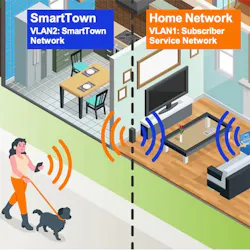
Smart Schools implement content filters, user segmentation, and enterprise-grade WPA2/WPA3 security to align with CIPA compliance and student safety requirements. Only authorized devices and users can connect, ensuring a secure online environment.
“The approach Lincoln Public Schools took was, yes, we want everyone to be connected, but we want everyone to be safe,” Moline said. “Now, we have several school districts that want to join, which means that when someone comes to Lincoln for a state tournament game or a learning consortium, they can join our network.”
To make this program work for the school district, Allo did not have to look too far to get routers in Lincoln.
Through a partnership with Calix, the focus was to create a safe connectivity system.
Leveraging Calix’s SmartTown Wi-Fi infrastructure, Smart Schools will be available to approximately 23,000 students in grades 6–12 who sign up, allowing them to connect their school-issued Chromebooks to high-speed Wi-Fi from virtually anywhere in Lincoln — at a local business, in a community venue, or at home.
Once a student or consumer joins the SmartTown community and onboards their devices, they will automatically connect to SmartTown Wi-Fi, if available.
Student Chromebooks for those who sign up will be assigned a secure profile that connects instantly to Smart Town zones.
Today, ALLO Fiber has 100,000 Wi-Fi routers broadcasting throughout the city.
While the latest generation of routers ALLO Fiber offers consumers and businesses can support 10 Gbps, today, its subscribers are accessing 2 Gbps. As a result, spare capacity is abundant.
“We worked with Calix to leverage that spare capacity to create a separate SSID path to join for learning,” Moline said. “It goes under the umbrella we call SmartTown.”
Overcoming Wi-Fi gaps
ALLO Fiber’s timing for its new Wi-Fi service could not be better.
It will fill the gap left by schools after the FCC voted in September 2025 to end E-Rate funding for off-premises Wi-Fi hotspots and school bus Wi-Fi.
As a result of the FCC’s action, the Universal Service Administrative Company was directed to deny pending funding year 2025 requests for E-Rate funds to support the off-premises use of Wi-Fi hotspots.
According to the regulator, the decision reversed a previous rule, deemed unlawful, that permitted schools and libraries to use federal funds for lending hotspot devices.
For its part, ALLO Fiber is not charging for its service, which was jointly developed in tandem with Calix.
“People, including the school districts, see the power of this, and we may be able to monetize it, but we feel it’s so important that we would develop first and monetize it second,” Moline said.
Workforce development applications
ALLO Fiber's presence and its new wireless networking technology in the Lincoln School District have implications that extend far beyond just connectivity.
In Lincoln, business leaders advocated for getting students started and capturing their interest at a younger age, before they leave college.
“Because of the workforce stress we felt, it pushed Lincoln employers into creative relationships with the school system, with the Southeastern Community College and the university system,” Ball said. “Those relationships already exist, and ALLO’s access for students opens up new avenues safely to interact with employers.”
One example of this innovation is CareerPathway.com, which connects individuals, employers, education, and workforce partners on one platform to explore opportunities, build pathways, and connect talent with real-world needs.
Lincoln sees the broadband provider’s presence as a way to drive new workforce development efforts.
The City of Lincoln invested in workforce development with American Rescue Plan Act (ARPA) funds along with its partners. Starting in 2022, the city awarded $12 million in ARPA funding to support workforce development and training at nine Lincoln-based nonprofit and educational organizations.
About 870 people completed job training programs, gaining new skills or finding employment. The funding also supported infrastructure and technology improvements for workforce development programs to sustain workforce programming.
“Once teachers can demonstrate capabilities and see employers come on and be a partner or through ALLO directly,” Ball said.

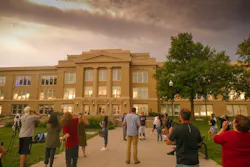
Before the Smart School Program launched, one example of ALLO Fiber's effect in the community was bringing connectivity to the Branched Oak Observatory. Located 25 minutes northwest of Lincoln, Nebraska, Branched Oak Observatory consists of a “sky park” and an education complex.
The facility allows astronomers to explore the night sky through telescopes, large and small.
“ALLO Fiber was the company that built out to the Branched Oak Observatory, which has been set up on a farm,” Ball said. “Because it is far enough out of town, it would have been difficult for a lot of telecom providers to make happen, and they do a lot of work with the school systems.”
He added that this project “opens up a lot of potential applications for how students are going to access information and become workforce sooner in Lincoln.”
But the workforce development effort is not relegated to manufacturing.
At the local Bay High School in Imperial, Nebraska, the curriculum focuses on content creation and emerging digital technologies. Students can focus on various skillsets, including marketing, journalism, and entrepreneurship.
Tanna Hanna, Chief Brand Officer at ALLO Fiber, said it continues to engage with Bay High to help foster the digital arts workforce.
“We have sent some people in to help shape the curriculum,” she said. “They also come through our Lincoln Store with students, so they get to see hands-on demonstrations of fiber splicing and technician skillset.”
Other Wi-Fi possibilities
While ALLO Fiber’s focus for its new Wi-Fi service is schools, the service provider sees potential for it in Lincoln and other cities it serves for other applications.
First responders and electric utilities could leverage the platform.
Moline said that there are a variety of things that could be tied under the umbrella.
“It requires you to have material market share, and you need to serve business, gov, and residential in a ubiquitous manner,” he said.
Outside of Lincoln, ALLO Fiber is expanding its service throughout Lancaster County, the county where Lincoln is located.
ALLO Fiber has a contract with Lancaster County to lease its broadband conduit network to expand broadband internet access. This project, which involves laying conduit and installing pull boxes, covers areas including Lincoln, Hickman, Waverly, and numerous surrounding villages and rural communities.
“Because of the great partnership between Lancaster County and Lincoln, they have a conduit system, and we participate in that,” Moline said. “We’re working from a major metro to small suburban towns and very rural communities.”
For related articles, visit the Business Topic Center.
For more information on high-speed transmission systems and suppliers, visit the Lightwave Buyer’s Guide.
To stay abreast of fiber network deployments, subscribe to Lightwave’s Service Providers and Datacom/Data Center newsletters.
About the Author
 Sean Buckley
Sean Buckley
Sean is the Editor-in-Chief of Lightwave. He establishes and executes Lightwave's editorial strategy across its website, email newsletters, events, and other information products. Before coming to Lightwave in July 2023, he served as editor of Broadband Communities. Earlier, he served as senior editor of FierceTelecom and the editor of the former Telecommunications Magazine. He got his start in the optical industry in 1998 when he became the editor of enterprise and optical networks at Information Gatekeepers. He has a BA in English from the University of Massachusetts, Boston, and lives in Dracut, Mass, with his wife, two sons, and his cat, Dove.