Hollow Core Fiber: A new look for data centers
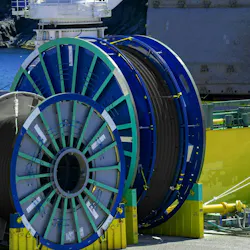
Hollow Core Fiber (HCF) is capturing the hearts and minds of the optical industry, particularly to serve data center providers and financial trading companies that require high-speed, low-latency capabilities.
So, what is hollow core fiber (HCF)?
Simply put, HCF is a type of fiber in which the glass core—the region where light propagates—is replaced by air.
As a result, data center providers and propagates 50% faster in air than glass, reducing latency by an estimated 33-40%.
Other benefits of HCF include less light interaction with glass, which reduces nonlinearities and dispersion. This has two key benefits: higher power transmission and higher bandwidth. Today, the primary driver for HCF is hyperscaler demand for low latency to support AI workloads.
An array of established and emerging fiber manufacturers is stepping up to the HCF plate, including Corning, Lightera, Microsoft, Prysmian, Relativity Networks and STL.

Already, hyperscaler data center and cloud providers are finding utility with HCF. Microsoft has been using HCF cables in its Azure data centers since 2023.
Compared with conventional Single Mode Fiber (SMF), it achieved a 47% increase in data speeds and lower latency — key metrics for advanced AI and cloud services.
“As manufacturing scales, Azure plans to expand deployment of the full end-to-end HCF network solution to help increase capacity, resiliency, and speed for customers, with the potential to set new benchmarks for latency and efficiency in fiber infrastructure,” wrote Francisco Rey, Partner, general manager of Hyperscale Network Connectivity at Microsoft, in a blog post.

Reshaping data centers
While HCF has potential use in the traditional service provider space, data center providers, particularly hyperscalers, for scale across data center needs. A single fiber supports higher data rates per wavelength due to low chromatic dispersion.
STL, which recently released its own HCF offering, sees the technology’s ability to address latency, as well as accommodate multiple optical frequency bands. The vendor has developed what it calls a Hybrid Cable architecture for hollow core fiber. Its cable combines three key elements: hollow-core fiber for low latency and power delivery; a G.654 standard-compliant fiber for long-haul transmission; and G.657. A1 NOVA to ensure versatility and broad network coverage.
“Along with latency, there are two things that are important about hollow core fiber: available bandwidth and its ability to support the O-band, E-band and the S-band,” said Dr. Badri Gomatam, CTO of STL.

But bandwidth and latency are only one part of the equation. HCF technology enables cloud-computing hyperscalers to locate data centers closer to power sources and water sources, whether they be conventional electric utilities or green-energy providers.
Jason Eichenholz, CEO and founder of HCF vendor Relativity and an early pioneer of HCF, said during the Hollow-Core Fiber: A Disruptive Shift in Optical Networking webinar that data centers are a perfect fit for hollow core fiber, as it will enable them to manage better the power issues they face today.
“The data center industry, as we all know, is dealing with what many are calling a power crisis,” he said. “All fiber in general is completely reshaping the infrastructure required to build data centers, but unfortunately, the power availability problem, not the technology problem, is the primary driver in determining where and how quickly a data center can get built.”
He added that data center providers can leverage HCF “to achieve lower latency and geographic optionality in where they can site a data center, whether it’s to support cloud services, an AI data center, or inference.”
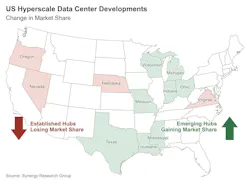
Relativity’s HCF thesis about powering reflects the realities that data center providers face as they build new data centers. New data from Synergy shows that U.S. hyperscaler builds have begun to focus on facilities in the center of the country, particularly in Texas and Midwestern states.
The research firm noted that at the end of 2025, Texas and the Midwest accounted for 33% of operational US hyperscale data center capacity, while its “pipeline of future hyperscale data centers shows that they will account for 53% of new capacity coming online over the next few years.”
And while Northern Virginia will continue to see the greatest concentration of data centers, as AI has driven up infrastructure investment, providers are targeting areas with more readily available power. Texas has become a key target. Likewise, Midwest states, including Wisconsin, Indiana, Michigan, and Missouri, will all grow rapidly in importance, as they have attracted multiple major projects from Amazon, Google, Meta, Microsoft, OpenAI, and CoreWeave.
“As infrastructure constraints intensify and market dynamics continue to shift, hyperscale providers are increasingly reallocating capital toward central U.S. regions, with Texas emerging as the primary focal point,” said John Dinsdale, Chief Analyst at Synergy Research Group. “A new wave of gigawatt-scale campuses is taking shape in non-traditional locations such as Abilene, Mount Pleasant, South Bend, El Paso, Boone County, and Kansas City. While established hubs will remain strategically important, the center of gravity for new hyperscale investment is clearly moving elsewhere.”
Service provider interest?
HCF’s focus is squarely on data centers, but the next question is about whether traditional wireline and wireless service providers see any potential in HCF.
While it did not respond to Lightwave for comment, Comcast has been an early advocate of HCF.
In 2022, Comcast worked with Lumenisity, now Microsoft, to connect two locations in Philadelphia, enabling its network engineers to test and observe the performance and physical compatibility of hollow-core fiber in a real-world deployment.

The cable MSO claimed this 40-kilometer hybrid deployment of hollow core and traditional fiber is believed to be the longest among Internet providers. During the trial, Comcast tested bidirectional transmission, used coherent and direct-detect systems (allowing for forward and backward technology compatibility), and produced traffic rates ranging from 10 Gbps to 400 Gbps, all simultaneously on a single strand of hollow core fiber.
Elad Nafshi, EVP and Chief Network Officer at Comcast Cable, said: “We continue to develop and deploy technology to deliver 10G, multigigabit performance to tens of millions of homes. Hollow-core fiber will help to ensure that the network powering those experiences is among the most advanced and highest performing in the world.”
Meanwhile, in 2024, Lyntia, a Spanish-based fiber wholesale provider, worked with OFS, Nokia, and LuxQuanta to conduct a proof of concept of quantum cryptography systems in a real-world data center production network environment using hollow core fiber.

During a field trial in Madrid, the feasibility and effectiveness of hollow core technology were confirmed. It also demonstrated a round-trip latency reduction of 4.287 μs over a 1.386km link, a more than 30% reduction relative to conventional single-mode fiber. The capacity deployed during the field trial was 6x100Gbps on a single 600Gbps wavelength and 10x10Gbps on a single 100Gbps wavelength.
Despite the potential that traditional service providers may see in HCF, the immediate interest remains with data center providers.
Eichenholz said the reason data center providers are more aggressively adopting HCF is that they need more bandwidth right away and don’t want to go through the traditional testing rigors typical of traditional service providers.
“While we have been talking to the traditional telecom carriers who are evaluating our fiber and using it, they have a very robust methodology on how they want to understand the mechanical properties and the splicing methods and fault identification,” he said. “We’ve got a lot of innovation into OTDRs and other ways to measure this fiber, but their hair is not on fire; the hyperscaler’s hair is on fire.”
Gwenn Amice, Subject Matter Expert from EXFO, agreed. “We have heard about hollow core fiber being used in downtown London to inter[1]connect the trade markets, but it’s like flying fish, which exist, but they are not the majority,” he said during Lightwave’s Hollow-Core Fiber: A Disruptive Shift in Optical Networking webinar.

Building an HCF ecosystem
As the HCF market comes together, the need to create a well-honed ecosystem of vendors and provider partners will be critical. Already, major fiber manufacturers have developed pacts to advance the development and reach of their HCF product lines.
To scale production of HCF, Microsoft struck agreements with Corning and Heraeus Covantics. In September, Microsoft announced it would work with Corning to accelerate the production of hollow core fiber (HCF) in North Carolina as part of a broader effort to build an HCF ecosystem as it rolls out the fiber to connect its Azure data centers.
Corning will manufacture Microsoft’s proprietary Hollow Core Fiber (specifically, Double Nested Antiresonant Nodeless Fiber, or DNANF) at its North Carolina facilities. The vendor has stated publicly that it sees a potential market size of $1 billion by 2030 for both its Glass Works AI portfolio and HCF.
“With Hollow Core technology, we’re talking about cases where the difference between the speed of light through glass and the speed of light through air actually matters,” said Wendell Weeks, CEO of Corn[1]ing, during the company’s third quarter earnings call. “This illustrates how important DCI could become as our customers look to decrease their latency.”

Uptstart Relativity Networks is also getting active in the HCF partnership game. Last March, it established a hollow core fiber (HCF) manufacturing partnership with Prysmian that targets data center opportunities.
As part of this partnership, Prysmian and Relativity Networks co-manufacture fiber and cable based on Relativity Networks’ HCF technology, which was developed in collaboration with the College of Optics and Photonics at the University of Central Florida. Prysmian will manufacture Relativity Networks’ HCF fiber at a dedicated facility in its production center in Eindhoven, the Netherlands.
Eichenholz said that its decision to work with Prysmian came as it faced the choice between manufacturing cables alone and bringing on a partner.
“We have a long-term manufacturing agreement with Prysmian,” he said. “They’re a global leader in cable systems. We have a dedicated HCF production facility now up and running in Eindhoven, Netherlands, that leverages that core intellectual property and our manufacturing know-how and how we’ve been deploying fiber coming out of the university.”
For most of 2025, Relativity worked with Prysmian to transfer technology, bring the Eindhoven facility up, and get those draw towers up and running. Relativity’s partnership with Prysmian and Microsoft’s work with Corning and Heraeus show the potential for HCF production.
“Microsoft was vertically integrating, leveraging what they had been doing with Lumenisity, which it acquired in 2022,” Eicheholz said. “You need that core manufacturing infrastructure, and the winners in this race are going to be the companies that have access to the vertically integrated supply chains to make the fibers and to cable them.”
Besides working with Prysmian, Relativity Networks has established an installation partnership with NPS (Network Planning Solutions), a UK-based company specializing in fiber-optic installation, design, and project management. Recently, Relativity Networks partnered with NPS to deploy HCF.
“We started with a trusted installation partner, NPS, in the UK, to leverage their experience and cover the full project support life cycle, including planning and the network,” Eichenholz said. “Along with installation, pre-staging and handover support, we need the testing and validation that must evolve alongside the fiber itself, and this is where collaboration between companies like Relativity, EXFO, and others becomes critical.”

Mario Simard, Product Line Man[1]ager at Advanced Fiber Instruments of VIAVI Solutions, agreed and expects to see more HCF projects announced, as the industry is in the “early stage.”
“We’re going to see more deployments of hollow core fiber happening in the next 12 months,” he said at the Scaling the AI Data Center: Optical Technologies Redefining Data Center Interconnection event during OFC 2026. “We’re going to learn from the initial deployments happening today.”

Nokia sees possibilities with HCF,
but noted that hollow-core fiber
complicates platform design. The
vendor released its new multi-rail
in-line amplifier in March, designed
for scalable multi-fiber deployments.
This solution delivers what it claims
is a 40-fold increase in in-line amplifier density over today’s solutions, or
160 fiber pairs in a single rack
Julia Larikova, VP Product Line Management for Nokia, said during the Scaling the AI Data Center: Optical Technologies Redefining Data Center Interconnection event during OFC 2026 that hollow core fiber is somewhat orthogonal to the multirail design that’s gaining traction in the optical industry right now.
“The focus right now is more about putting more ILAs at shorter distances and making them smaller and lower power, so there’s a disconnect,” she said. “Hyperscalers are driving the demand for hollow core fiber because they need it now, but to scale hollow core fiber deployments, the alignment of scaling deployments and training people on it and testing needs to happen.”
And while HCF can handle multiple optical bands simultaneously, there needs to be more industry-wide work to understand the economics across multiple spans.
“If we can show that there is economic savings at the amplifier level, which is the biggest issue right now, and how hollow core fiber solves that problem better than multilayer ILAs, I think you can make a difference much quicker,” she said.