Broadband Forum sets sights on the subscribers' experience
Key Highlights
- Broadband providers are prioritizing application-specific QoE over traditional speed metrics to better serve diverse user needs.
- Standards like TR-499 and USP/TR-369 are crucial for consistent measurement, device management, and rapid deployment of new services.
- AI is transforming broadband networks by enabling autonomous operations, predictive analytics, and real-time QoE monitoring for applications like gaming and smart homes.
- The adoption of USP is accelerating, with 88% of providers planning to implement it, significantly reducing service deployment times from months to weeks.
- Open-source platforms integrating USP facilitate faster service rollout and easier management of connected devices, enhancing overall customer experience.

While speed has been top of mind for broadband providers, there’s growing demand to differentiate for consumers by enhancing the quality of experience (QoE) to accommodate the unique devices and applications in the home.
Today’s broadband network providers have mainly cited speed and price as their main differentiators. However, application-appropriate QoE is becoming a priority. Still, service providers need to educate end users so they understand what QoE and latency mean.
The Broadband Forum has been tackling the QoE and QoS issue with its TR-499 standard, which focuses on defining broadband service metrics. It provides a framework for measuring and evaluating the delivery quality broadband services, ensuring consistency and reliability in performance assessments to help BSPs and stakeholders maintain Quality of Service (QoS) delivery.

Broadband providers are seeing the value of differentiating customer QoE on a per-service basis. They are adding application-aware intelligence and monitoring to ensure relevant QoE per application, which the forum notes is an important differentiator when monetizing new services.
There are several customer groups where QoE could be relevant.
Consider the teleworking community. While the number of people working from home (WFH) has decreased slightly since the COVID pandemic leveled off and some organizations have instituted a back-to-office mandate, the segment still accounts for an average of 25% of households applying for a WFH service. Also, there’s a sizeable percentage (around 20%) of gaming households.
Craig Thomas, CEO of the Broadband Forum, told Lightwave during the recent Fiber Connect show in Orlando that service providers need to show subscribers their service is not just a commodity.
“What we're seeing now is how to make fiber and broadband service more appropriate to the applications that people want to use it for, rather than just as a big dumb pipe,” he said. “We can talk fiber all the time, but the subscriber's applications are running on their device and the Wi-Fi connection. So, how do we bridge that from Wi-Fi to the application? And that's the broadband fiber environment, not just the last mile connection.”
AI’s broadband application moment
Artificial intelligence is driving the broadband industry to shift its focus from who has the fastest raw download speeds to providing a symmetrical bandwidth connection with ultra-low latency and high reliability.
Unlike traditional multimedia, which is primarily download-based, AI workloads are bidirectional, interactive, and data-intensive, requiring a total reimagining of infrastructure, network operations, and consumer services.
The Broadband Forum is responding to AI’s potential in broadband with its AI in Broadband Networks (MR-529) document, which sets out a vision for how broadband networks should evolve with AI, outlining the AI development trends and network characteristics for services-led broadband networks and their service requirements. It maps out how broadband service providers (BSPs) can progress towards fully autonomous networks that deliver consistent, high-quality customer experiences by establishing a standardized, software‑defined foundation.
While Thomas acknowledges that AI will continue to influence the broadband industry, there are different definitions of what AI is. There are various flavors of AI in broadband: subscriber AI, network-based AI, and performance and predictive AI, which focuses on network planning.
“If I ask ten different operators about AI, I bet I'll get at least five different answers,” he said. “What we need to do is come from a common starting place.”
This common starting place centers around how the broadband standardizes on the right data models, management interfaces, inventory control, and QoE mechanisms.
“By creating this common starting point, we’ll be talking the same language,” Thomas said. “So, it doesn't matter if you're going multi-vendor or vendor A, B, or C, or building your own AI, you know that it's the same data that's coming in and you're representing that.”
After the common elements are agreed upon, Thomas added that the next step is to work on the APIs so there’s a common language. “By having whichever agent I plug in, they have to speak the same language.”
BSPs can leverage Broadband QED (Quality of Experience Delivered), a Broadband Forum framework that shifts network measurement away from simple bandwidth speed toward real-time user experience. By decomposing network latency into actionable metrics, a provider can ensure consistent performance for demanding applications like video streaming and gaming.
“A provider needs to make sure that it is recognizing the right performance because the AI agent sitting in the home is saying this is how the network is performing, but it has to link to everything else. And the experience has got to be end-to-end, from right from the device, all the way to whether the app is being hosted.”
For example, broadband providers can leverage a mechanism that would suit the needs of a gaming application or a smart home environment.
“If somebody says, I want a gaming experience, I'm going to set up the appropriate gaming experience or latency. If I want a smart home, I'm going to make sure all my devices are always connected and secure,” Thomas said.
What is USP?
The Broadband Forum’s User Services Platform (USP), standardized as TR-369, is an industry-standard architecture for managing, monitoring, upgrading, and controlling connected devices. It serves as an evolution of the legacy TR-069 protocol, tailored to meet the needs of today’s connected homes and IoT ecosystems.
USP adoption tipping point
As broadband providers advance their QoE initiatives, the adoption of Broadband Forum’s User Services Platform (USP), or TR-369, is gaining momentum. TR-369 is the next-generation evolution of the TR-069 standard.
While TR-069, a widely adopted management standard, relies on a single server to manage routers and modems, TR-369 is a cloud-native framework that supports multiple controllers, instant event-driven messaging, and seamless management of smart home IoT devices.
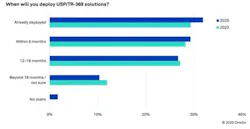
USP adoption has reached a tipping point, with joint research from Omdia and the Broadband Forum showing that approximately 88% of service providers are either currently deploying the standard or plan to implement it within the next 18 months. Omdia surveyed 16 global Broadband Service Providers from 32 countries.
As part of an ongoing drive to deliver differentiated services and boost customer revenue, BSPs are planning to adopt Broadband Forum’s User Services Platform (USP/TR-369) standard to introduce AI, Wi-Fi sensing, L4S, and more into their home broadband offerings.
“When we conducted our survey with Omdia late last year, nearly 90% of service providers said they plan to deploy USP,” Thomas said. “ Now, the difference between USP and the way there was this thing called TR-69, which we stopped counting how many devices were. Twenty-something years of billions and billions.”
He added that USP’s utility isn’t just about device management for the CPE, VoIP, or video set-top box. It can also handle device management for anything behind it.
“Wi-Fi managed devices matter, thread devices, Zigbee, and others,” Thomas said. “The service provider can manage that service. I see. So, it gives him the gateway to offer these new containerized things.”
USP has also been gaining prominence in the open source community.
prpl Foundation’s prplWare and RDK’s RDK-B software, two of the most widely used carrier-grade open-source platforms for home broadband management, have integrated releases from the Open Broadband USP Agent (OBUSPA) project into their middleware stacks. This allows BSPs to offer new applications faster on end-user devices such as routers and residential gateways.
The Broadband Forum’s User Services Platform (USP) protocol has significantly reduced the time required for BSPs to deploy new services, from 9-18 months to 2-4 weeks. The availability of open-source USP implementation further enables an environment in which individual components of the device can be upgraded without requiring a full firmware update.
“When you look at purple and RDK, they're inherently putting USP into their OS stacks, which is a great marriage,” Thomas said.
For related articles, visit the Broadband Topic Center.
For more information on high-speed transmission systems and suppliers, visit the Lightwave Buyer’s Guide.
To stay abreast of fiber network deployments, subscribe to Lightwave’s Service Providers and Datacom/Data Center newsletters.
About the Author
 Sean Buckley
Sean Buckley
Sean is the Editor-in-Chief of Lightwave. He establishes and executes Lightwave's editorial strategy across its website, email newsletters, events, and other information products. Before coming to Lightwave in July 2023, he served as editor of Broadband Communities. Earlier, he served as senior editor of FierceTelecom and the editor of the former Telecommunications Magazine. He got his start in the optical industry in 1998 when he became the editor of enterprise and optical networks at Information Gatekeepers. He has a BA in English from the University of Massachusetts, Boston, and lives in Dracut, Mass, with his wife, two sons, and his cat, Dove.