Cable meets fiber: Sharing one roof under vBNG
Key Highlights
- Shared access infrastructure (FANS) allows multiple providers to utilize the same physical network while maintaining independent policies and customer experiences.
- vBNG centralizes service logic and policy control, enabling scalable, automated, and edge-aware subscriber management across diverse access types.
- SRv6 introduces deterministic, programmable routing that ensures performance guarantees and service differentiation in multi-tenant environments.
- The combined architecture reduces operational complexity, accelerates service deployment, and unlocks new revenue opportunities through efficient resource utilization.
- This modern approach shifts the network paradigm from hardware-bound to software-driven, fostering innovation and improved QoE for real-time applications.

For years, "cable vs. fiber" has been framed as a rivalry: HFC against PON, DOCSIS against XGS-PON, node splits against deeper fiber. That framing is now outdated.
The more interesting question is how cable and fiber can operate as shared access infrastructure, with service differentiation occurring higher up the stack — multiple providers using one physical network to deliver many services under a common policy and control.
That's the promise of Fixed Access Network Sharing (FANS) and virtual Broadband Network Gateway (vBNG) architectures: to decouple access infrastructure from service control, enabling networks to be shared, automated, and monetized without forcing every provider to duplicate every piece of field equipment. Add SRv6, and you gain deterministic, programmable forwarding built for multi-tenant environments.
This isn't just a modernization story. It's a business-model story — about unlocking more value from existing assets, cutting operational friction, and enabling faster, more flexible service creation across both footprints.
The challenge: Complexity is outgrowing operations
Operators are no longer asked to simply "deliver broadband." They're expected to support:
- Multiple access types (HFC, FTTH, fixed wireless), often in the same metro
- Multiple brands or wholesale tenants on the same infrastructure
- More service tiers and specialized SLAs — gaming-grade latency, enterprise availability, managed Wi-Fi, premium video, security bundles
- More dynamic traffic from cloud apps, upstream workloads, and real-time services
- New latency-sensitive use cases: cloud gaming, XR, industrial monitoring, real-time collaboration
The traditional model anchors subscriber termination, policy, service logic, and routing to tightly coupled, location-specific hardware. Every new partner, brand, or product line then adds duplicated configurations, manual processes, and special-case engineering — an operational and economic bottleneck.
To scale, the access network must behave more like the cloud: multi-tenant by design, policy-driven, API-enabled, and programmable end-to-end.
FANS: One physical access network, many providers
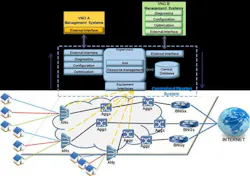
FANS makes sharing at scale practical. The core idea is simple — separate the physical access infrastructure from the service control plane, so that multiple providers can share the same last mile while maintaining their own policies, subscriber experiences, and product portfolios.
That separation unlocks benefits that are hard to achieve when access and service logic are bound together:
- Better economics: When providers share the same plant — fiber distribution, HFC nodes and amps, aggregation, sometimes portions of the metro — utilization rises — more revenue per mile, a stronger ROI case for expansion.
- Faster service introduction: Wholesale and brand-within-a-brand strategies usually stall on onboarding friction: provisioning, addressing, CPE policy, and routing segmentation. FANS moves those into a centralized software layer, turning "engineer and deploy" into "configure and launch."
vBNG: the engine that makes sharing scalable
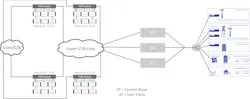
The vBNG is the pivot point. Legacy BNGs were appliance-oriented and constrained by geography and scale. A cloud-built vBNG centralizes policy and unifies service logic: subscriber session termination (IPoE/PPPoE); AAA, policy, and entitlement; QoS and classification; service chaining and value-added services; telemetry and analytics.
Instead of scattering service complexity across the access edge, you concentrate it in one programmable, automatable layer.
Elastic scale: vBNG functions scale horizontally and are lifecycle-managed like software — essential where subscriber counts swing with campaigns, tenant onboarding, or M&A, without "truck-roll scaling."
Edge-close, centrally controlled: Centralization doesn't have to mean longer paths. Modern vBNG designs run in distributed cloud zones or edge data centers, placing subscriber functions near users while keeping policy and automation central. The result: less complexity in the field, more control in software.
DOCSIS and DAA belong under this roof, too: It's tempting to read vBNG as a fiber play. Still, at its core, a vBNG is a virtualized packet-processing engine — and DOCSIS subscriber traffic is just packets that need to be terminated, policed, and forwarded. Distributed Access Architecture already begins the split, pushing PHY (Remote PHY) or PHY-plus-lower-MAC out to the node. vBNG completes the picture. The DOCSIS MAC is distributed across the stack: timing-critical lower MAC and PHY stay at an RPD (plus) node, while the upper MAC, scheduling policy, subscriber control, and packet processing run as virtualized functions in the same cloud-native layer that already serves PON and Ethernet. That is the future of DOCSIS/DAA — a virtual BNG paired with a DOCSIS MAC distributed across vBNG and RPD(plus) —, and it means cable doesn't sit beside the fiber control plane; it converges onto it.
SRv6: Deterministic programmability across shared resources.
Layer in SRv6 (Segment Routing over IPv6) and the forwarding plane gains explicit, programmable path control. In multi-tenant access, that plane must do three things well: keep tenants and service classes separate, guarantee performance for premium and latency-sensitive traffic, and adapt to congestion and failures without manual re-engineering.
SRv6 enables a "routing-as-instructions" model — packets carry segment lists defining their path and behavior. That means traffic engineering aligned to service intent: low-latency flows onto delay- and jitter-optimized paths, bulk traffic onto capacity paths, tenant traffic onto isolated slices, and high-value enterprise services onto paths with stronger guarantees.
In a shared environment, determinism is a competitive feature. When two providers share the same plant, differentiation comes from who delivers more consistent QoE (Quality of Experience)— and SRv6 gives the operator the toolkit to enforce it. Because it's inherently programmable, SRv6 fits intent-based networking: the network responds to policy ("this premium tier needs X latency," "reroute best-effort around this congested region," "this chain must include security inspection") instead of per-device tweaks.
The "one roof" model: Shared access, differentiated services
Together, FANS, vBNG, and SRv6 form a blueprint: shared physical access across cable and fiber; tenant-aware control and centralized policy via vBNG; programmable forwarding via SRv6; and automation-first provisioning, assurance, and lifecycle management.
Under one roof, operators can treat the access plant as a common platform while letting each provider — or internal brand — define its own products, policies, and customer experience. That's the shift from network as a monolith to network as a service platform.
Why this matters now
Shared infrastructure only works if resources are managed intelligently. vBNG centralizes control; SRv6 enables controlled forwarding. Together, they eliminate overprovisioning and make multiple SLAs on a single platform feasible. And when the vBNG and vCMTS core collapse into one packet-processing fabric, the savings compound — one forwarding layer, one automation model for both cable and fiber.
QoE isn't peak speed; It’s how the network behaves at 7:30 pm, when everyone is streaming, gaming, video-calling, and uploading at once. Deterministic steering and per-service policy keep experiences consistent under load. As fixed access becomes the foundation for more real-time applications, the ability to guarantee and verify performance becomes the differentiator.
A practical path forward
No need to boil the ocean. Start where the benefits pay for themselves:
1. Wholesale/tenant onboarding with strong isolation and centralized policy.
2. Premium tiers that demand consistent latency and jitter.
3. Operational simplification — automated provisioning, less per-device complexity, unified telemetry.
4. Edge service enablement — subscriber functions near users, policy still consistent.
Each step builds confidence, creates tangible ROI, and lays the groundwork for broader multi-access convergence.
Cable and fiber don't have to compete
The future of fixed access isn't winner-takes-all. It's a platform story: using shared infrastructure more efficiently while creating room for differentiation, faster innovation, and better customer experiences.
FANS provides the commercial and operational framework for sharing. vBNG provides the programmable control layer that enables scalability. SRv6 provides the deterministic, traffic-engineered forwarding that makes it performant. Together they form a modern access blueprint — programmable, scalable, automation-ready, and built for both cable and fiber under one roof.
About the Author
 Cornel Ciocirlan
Cornel Ciocirlan
Cornel Ciocirlan, VP, Product Management, Aurora Networks
Cornel is VP, International Technology for Aurora Networks. In this role, he is responsible for technology direction in EMEA regions with a broad focus on new technologies such as Virtualization, Transition to Cloud, Distributed Access, and Multi-Gigabit Services. Prior to joining Aurora Networks, Cornel was Technical Director at Digi Romania and was responsible for the engineering and build-up of the Digi Romania network. Cornel studied Mathematics & Computer Science at Bucharest University in Romania. In January 2026, CommScope sold its CCS segment and rebranded the parent company as Vistance Networks; at the same time, its Access Network Solutions (ANS) segment was rebranded as Aurora Networks.