Aureon targets hyperscaler AI opportunities with multi-carrier 100 Tbps route
Key Highlights
- Aureon's new 100 Tbps fiber route connects Ellendale, North Dakota, to Chicago, supporting AI and cloud deployment growth.
- The network is engineered for scalability, with plans to reach 400 Tbps to accommodate future data demands.
- Multi-carrier collaboration involved coordination among Aureon, t3 Broadband, Nokia, and Midco, highlighting complex deployment efforts.
- Midwest is emerging as a significant data center hub due to available land, power, and strategic geographic positioning.
- The project positions the Midwest to add over 5 gigawatts of new data center capacity in the coming years.


Aureon has launched a 100 Tbps long-haul transport route engineered to support the rapid growth of large-scale AI and cloud deployments.
Built with partners t3 Broadband, Nokia, and Midco, the route links Ellendale, North Dakota, to Chicago via a diverse, low-latency fiber corridor across the Midwest, bolstering the region’s role as a critical on-ramp to major data center hubs.
Set to reach 100 Tbps by July, the new route is expected to scale to 400 Tbps to support future AI-driven growth, with Aureon managing ongoing support and maintenance.
Providing a connection to Chicago will be a key attraction for this route. As an established connectivity network hub, Chicago boasts an array of fiber connectivity and interconnection onramps and offramps for existing and new data center facilities.
Priscilla Favors, VP Wholesale Sales at Aureon, said its status as a regional player and its wholesale partnerships reflect that “hyperscalers are looking for very unique, diverse routes.”
“There were a lot of players looking for this solution as we were getting bids from other carriers as well for the same route,” she said. “And it was a very internal good exercise team effort from us just to look to see how a small company like us could be very swift and move quickly to meet the demands of an opportunity like this. And it took us about 30 days.”
Chris Burns, COO of Aureon, agreed that, as a regional player, Aureon can respond quickly to emerging capacity requests from hyperscalers and data center providers.
“We bring a lot of agility to the table, based on who we are,” he said. “We've always worked with partners throughout our history, right?” he said. “So, we're able to move pretty quickly in this space.”
Multi-carrier coordination
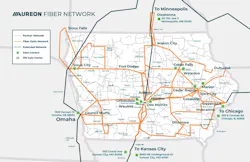
The partnership of Aureon, i3, and Midco illustrates that each provider brings their own unique expertise and network assets to the table.
However, setting up this new network deployment was not easy. The deployment required coordination across three different networks, vendors, and timelines.
Aureon, created as a partnership among multiple rural service providers in the Midwest to provide long-haul connectivity, traces its roots to Iowa Switch Company. Through its own capital and various acquisitions, Aureon has over 60,000 miles of owned and partner fiber, direct data center access in key Iowa and regional markets.
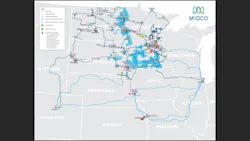
Similarly, Midco and t3 have also built sizeable networks coupled with experience serving data centers.
Given the hyperscaler community’s need for bandwidth, Aureon and its partners, Midco and t3, had to respond quickly with a solution.
While Aureon had a place to interconnect with Midco, which was key to the proposal for the new route, Favors noted the main challenge was extending network facilities into Chicago.
“There were some challenges with getting to Chicago, so we were all trying to figure that out, looking at different options,” she said. “A lot of the data centers and hyperscalers, once they move, they need it yesterday, right? So, there were time constraints in trying to make that happen very quickly.”
Favors added that “we knew what we had already, what we were capable of, and then using those partnerships to put it all kind of together.”
Midco’s Vice President of Business Sales, Justin Hebda, agreed and added that “working with Aureon to deploy a solution leveraging Midco’s fiber network, combined with the depth and reach of our network, allowed us to deliver high-capacity transport quickly and reliably.”
Along with its suite of fixed wireless, 5G wireless services and microwave transport, t3 provides optical transport solutions covering the edge, aggregation/middle mile networks, and long-haul transport networks.
Chris Crowe, CEO of t3 Broadband, which brought its engineering expertise and network assets to the table, noted that “coordinating across multiple carriers and aligning network architecture at this scale requires a high degree of technical precision.”

In addition to coordinating across three service providers, the trio also aligned on using Nokia’s coherent optical technology.
“Fortunately, both operators, Midco and Aureon, landed on Nokia as a vendor partner, right?” Burns said. “When you think about the criticality the customers have and the speed of delivery, I think that was a tremendous benefit being on the same optics, the same transport platform allowed us to kind of coordinate supply chain issues, make sure we were aligned across the partnership and with the vendor.”
He added that “there were a lot of synergies that were important when you think about the short time to deliver the service.”
A growing hub
Aureon’s timing for this new fiber network project comes as the Midwest is fast becoming a major destination for data centers.
While large-scale data center infrastructure development was concentrated in Northern Virginia, Dallas, Phoenix, and Silicon Valley, the Midwest has traditionally played a small role in the data center ecosystem.
But these markets have become saturated, and data center providers are struggling to access the necessary power and land.
Midwest markets could add more than 5 gigawatts of new capacity in the coming years.
Hyperscale data center operators have begun to target other markets, such as the Midwest, that have the necessary land, power infrastructure, and geographic positioning to support new facilities.
According to a recent Datacenters.com post, projections suggest that “Midwest markets could add more than 5 gigawatts of new capacity in the coming years.”
However, 5 gigawatts of new capacity appear to be only the beginning. As AI and cloud infrastructure continue to grow, the Midwest will see hyperscalers expand services further.
All of this creates a perfect storm for carriers like Aureon’s and its new partner network, which will provide fiber connectivity and interconnection points to the desirable Chicago market.
Datacenters.com noted that as “additional data centers are built in surrounding areas, the region’s network ecosystem will continue to expand” with new connectivity options.
The demand for the route that Aureon has created with its partners reflects how Tier 2 markets like Iowa are becoming new alternative markets for data center build-outs.
“One of the things is we have land, and we have power, which makes us very appealing,” Favors said. “And we're seeing tremendous growth in that space. We've been involved with a couple of other projects, not as large as this one, but we're continuing to see that grow.”
Des Moines, Iowa, has become a key data center hub. The Des Moines data center market is a top-tier U.S. hub, featuring over 50 operational facilities, nearly 10 million square feet of space, and over 1,200 megawatts of compute capacity.
Aureon itself has one data center provider customer that is seeking a minimum of 1,000 acres of land in Iowa.
“We've got some land, so we're looking for those needs as well,” Favors said.
While Aureon is the latest provider to build a large middle mile network targeting hyperscaler needs, they are not alone. Fellow rural providers Dakota Carrier Network (DCN), Range, and WIN are building the Heartland Fiber Project, which will span seven states – Colorado, Wyoming, Montana, North Dakota, Minnesota, Wisconsin, and Illinois.
“The Heartland Project is another opportunity for a diverse route through Iowa, but there are multiple needs,” Favors said. “We’re looking forward to other opportunities we can take advantage of as well.”
But this current project is only one part of Aureon’s network drive. The service provider is considering similar pacts with other fiber providers.
“We're in the middle of the key north-south, east, west routes,” Burns said. “So, we're thinking about partnering to bring services to market. It's all about understanding who has existing infrastructure.”
Eying Managed Optical Fiber Networks (MOFN)
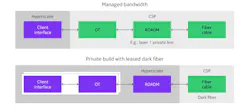
Beyond providing fiber-based capacity, Aureon is eyeing the potential of Managed Optical Fiber Networks (MOFN).
Championed by optical vendors, including Adtran, Ciena, Nokia, and Ribbon, MOFNs Networks are dedicated, high-capacity optical networks built and operated for a single organization by a third-party service provider.
This model gives hyperscalers and large enterprises another option besides leasing "dark fiber" with the ability to purchase traditional shared network services, allowing businesses to offload hardware and maintenance complexities.
While the MOFN concept had an initial trade-off, it is that hyperscalers could not get network resource visibility around service health, alarms, performance metrics, or potential SLA issues. Nokia has developed what it calls a “smart” MOFN model, in which CSPs maintain operational control. At the same time, hyperscalers gain the transparency they need to treat the network as an extension of their cloud infrastructure.
Aureon, which has several decades of experience in monitoring service performance across partners, sees the potential in MOFN.
“You hear about these MOFN models and hyperscalers wanting a partner to work with to look beyond just the fiber capacity,” Burns said. “That's something we're looking at as well.”
Remote challenges
While Iowa may be emerging as a new data center attraction, the challenge for providers looking outside the large hubs is not just procuring land, but power.
Many times, these data centers are in very remote markets where power options are likely minimal.
“We've had some opportunities that we've been working with, and then we've had to shift locations because they're like, we couldn't get the power we needed, that location's out, we're searching for a new one, right?” Favors said.
Burns agreed and added that as data center providers look to locate facilities in rural markets, energy companies are offering new powering options.
“There's a lot of renewable energy options, wind generation, and there's talk about firing up the energy center up in Cedar Rapids in 2029,” he said.
For related articles, visit the Data Center Topic Center.
For more information on high-speed transmission systems and suppliers, visit the Lightwave Buyer’s Guide.
To stay abreast of fiber network deployments, subscribe to Lightwave’s Service Providers and Datacom/Data Center newsletters.
About the Author
 Sean Buckley
Sean Buckley
Sean is the Editor-in-Chief of Lightwave. He establishes and executes Lightwave's editorial strategy across its website, email newsletters, events, and other information products. Before coming to Lightwave in July 2023, he served as editor of Broadband Communities. Earlier, he served as senior editor of FierceTelecom and the editor of the former Telecommunications Magazine. He got his start in the optical industry in 1998 when he became the editor of enterprise and optical networks at Information Gatekeepers. He has a BA in English from the University of Massachusetts, Boston, and lives in Dracut, Mass, with his wife, two sons, and his cat, Dove.