Uniti’s CEO wants a larger share of the optical wavelength market

Keep up to date with Lightwave’s Q1 2026 earnings coverage.
You can check our publication’s key segments:
And
Here are other stories on Uniti:
· Uniti’s CEO says we’re in the early innings of an unprecedented fiber build
· Uniti’s hyperscaler fiber service sales funnel continues to grow
· Uniti’s CEO says its hyperscaler funnel represents about $1.5B of total contract value
· Uniti wraps its Windstream merger, accelerates residential and business fiber strategy
·
Uniti may still have only a small share of the optical wavelength market. Still, it remains confident that its alternative-market fiber build-out strategy and product roadmap are the ones it needs to enhance its status.
Kenny Gunderman, CEO of Uniti, told investors during its first quarter earnings call that the company is “preparing to become more of a share taker in the waves market.”
“The waves market is projected to grow at close to 10% a year, and we believe that could be conservative,” he said. “Uniti has less than 5% waves market share today, which is similar to our other fiber products, where we are an insurgent share taker.”
Accelerating wavelength activation
Uniti continues to enhance its wavelength capabilities by launching new products like FastWaves, which it claims can accelerate service activation times.
FastWaves' appeal is that Uniti is taking a proactive approach by pre-deploying muxponders across select high-demand long-haul routes on its Intelligent Converged Optical Network (ICON). The service provider said this approach enables eligible 100G and 400G wave services to be delivered in three weeks or less. In some cases, Uniti can provision a wavelength circuit in days.
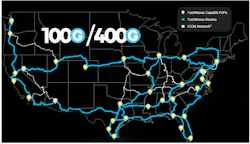
Already, FastWaves is resonating with customers. In one case, Uniti Wholesale sold a new customer eight 400G circuits and delivered FastWaves-eligible circuits in 14 days, reflecting the desire for faster wavelength delivery.
Visibility is also key. With the iconnect customer portal’s Route Creator tool, customers can view eligible routes, generate quotes, and place orders directly, further streamlining the buying process and helping compress time from quote to service delivery.
“We recently launched FastWaves, a product which has substantially faster turn-up intervals than we've had in the past,” Gunderman said. “We're not enabling wavelength capability across the country. We're being selective about where we like waves, and we're focusing on routes that are unique to Uniti that give us a competitive advantage.”
He added that “these routes are particularly enhanced by the unique build cycle that we're currently undertaking for the hyperscalers.”

Deepening hyperscaler wavelength sales
While Uniti continues to be a proponent of selling dark fiber, the company sees potential to deepen its wavelength customer base within the hyperscaler community.
As we complete long-haul builds connecting Tier 2 and 3 markets, we expect hyperscalers to become increasingly large-wave customers, eventually pivoting away from the current dark fiber-intensive build cycle and becoming more regular wave customers.
Research groups like Vertical Systems Group reflect Uniti’s thesis.
In its 2025 U.S. Wavelength Services LEADERBOARD, VSG noted that wavelength providers cite that U.S. customer demand for 400 Gbps services escalated significantly in 2025.
Likewise, higher-capacity 800 Gbps wavelengths also increased in sales to hyperscalers, neocloud providers, AI and GenAI companies, data centers, and large enterprises.
Gunderman pointed to a single hyperscaler customer that purchased a 20-terabit wave package for a hyperscaler, “the single largest lit bandwidth order in Uniti's history,” adding that “there are an increasing number of deals like this in our sales funnel.”
Fiber infrastructure, Kinetic drive revenues
Driven by gains in Fiber Infrastructure and its Kinetic consumer business lines, Uniti reported consolidated first-quarter revenue of $987.5 million.
Uniti’s Fiber Infrastructure contributed $294.8 million of revenues and $192.7 million of contribution margin for the first quarter of 2026. Fiber Infrastructure’s capital expenditures during the quarter were $70.4 million, and upfront payments received from customers were $152.4 million.
Gunderman said it “had another strong quarter of new bookings at Fiber Infrastructure, the third highest quarter on record.”
Meanwhile, Kinetic generated $548.0 million in revenue and $235.5 million in contribution margin for the first quarter of 2026, achieving approximately 43% contribution margin. Kinetic’s capital expenditures during the quarter were $251.9 million.
“At Kinetic, we had the strongest quarter ever of gross adds and the highest number of homes constructed in nearly 4 years,” Gunderman said.
Another key development during the quarter was Uniti Solutions, which contributed $191.8 million in revenue and $95.8 million in contribution margin for the first quarter of 2026, achieving margins of approximately 50%.
For related articles, visit the Business Topic Center.
For more information on high-speed transmission systems and suppliers, visit the Lightwave Buyer’s Guide.
To stay abreast of fiber network deployments, subscribe to Lightwave’s Service Providers and Datacom/Data Center newsletters.
About the Author
 Sean Buckley
Sean Buckley
Sean is the Editor-in-Chief of Lightwave. He establishes and executes Lightwave's editorial strategy across its website, email newsletters, events, and other information products. Before coming to Lightwave in July 2023, he served as editor of Broadband Communities. Earlier, he served as senior editor of FierceTelecom and the editor of the former Telecommunications Magazine. He got his start in the optical industry in 1998 when he became the editor of enterprise and optical networks at Information Gatekeepers. He has a BA in English from the University of Massachusetts, Boston, and lives in Dracut, Mass, with his wife, two sons, and his cat, Dove.