Virginia Fiber Express Networks kicks off multi-state wholesale fiber network build
Virginia Fiber Express Networks, a subsidiary of Infraforward Strategies, has secured Competitive Local Exchange Carrier (CLEC) and Interexchange Carrier (IXC) operating licenses and Land Use permits from the Commonwealth of Virginia, marking the first step in the service provider’s move to build an alternative fiber wholesale route for the nation’s key data center hub.
With these operator licenses and initial permits now complete, VFE Networks and its partners can begin construction and stay on track with its proposed Ready for Service date in 2027.
As a six-phase fiber network, it will connect multiple areas of Virginia, North Carolina, and Maryland with diverse, high-capacity fiber infrastructure and services.
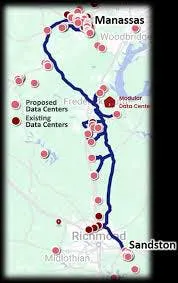
Set to be available in the third quarter, VFE 1.0 will connect Manassas to Sandston on diverse segments with conduit, dark fiber and lit services. An Edge Data Center (EDC) in Fredericksburg, VA, hubs the phases routed southeast to Virginia Beach and northeast to Baltimore and provides power and space for customer equipment. A future EDC in Richmond will support the expansions to Charlotte and Charlottesville.
Phase 1 delivers a new 126-mile diverse fiber route from Northern Virginia to Richmond-Sandston.
Adam Noll, industry advisor and founder of Edgeology, said the role of fiber has become front and center within the AI data center and cloud services industry segments.
“Fiber connectivity has evolved from a secondary engineering consideration into one of the most strategic assets in AI and cloud infrastructure,” he said. “In today’s market, diverse dark fiber is not only a constraining factor for new data center development, but it's also an ROI multiplier that determines scalability, resiliency, and long-term asset value.”
New diverse route
A key element of the first phase of the network is that it is engineered to use rights-of-way other than Interstate 95, providing a redundant path that hyperscalers, AI centers, MTDCs, network service providers, and data center developers require as Northern Virginia faces growing constraints in land, power, and space and connectivity.
In addition to the Edge Data Center (EDC) in the Fredericksburg area with solar tower/battery backup power, the network will have connections into several other data center locations.
VFE has also established terminations with QTS, Equinix and Meta:
· QTS MTDC: A termination in Manassas and Sandston
· Equinix and Digital Realty connections in Manassas
· Meta connection at White Oak Technology Park, Sandston
Additionally, VFE has planned laterals to I-95 data center campuses in Stafford, Spotsylvania, Caroline and Henrico counties.
VFE Networks will offer conduit and dark fiber IRUs and capacity leases, including dark fiber, waves, and spectrum services.
And because it is starting with a clean slate, it is among the first carriers to design its network for 800G and 1600G DWDM wavelengths.
The network will be supported by Corning 864 fiber cable and Ciena DWDM 800G and 1.6Tbps wave technology (WaveLogic 6).
“These licenses and permits unlock our ability to build and operate infrastructure designed for the demands of the data center industry, pushing south out of an increasingly constrained Northern Virginia market,” said Joel Allen, CEO of Virginia Fiber Express Networks. “Our diverse, non-I-95/ Route 1 route and interconnected network phases reflect a commitment to infrastructure that is resilient, future-proof and purpose-built to support autonomous network deployment while being aligned with Virginia’s long-term support of broadband expansion.”
Local knowledge base
VFE is not going alone in building its proposed six-phase network.
In addition to its network equipment partners, the service provider has established key partnerships with two major construction partners, Express-tek and S&N Infrastructure.
Express-tek brings two generations of fiber engineering and permitting expertise to Phase 1, while S&N Infrastructure contributes over 40 years of specialty communications construction experience across the Mid-Atlantic and Southeast. Together, the three organizations form a vertically integrated team built for large-scale fiber deployment.
What these two companies bring to the table is their understanding of the Virginia market.
“Our local knowledge of Virginia’s right-of-way landscape positions VFE Networks to move efficiently from licensure to construction,” said Stephen Brown, President of Express-tek.
Sean Davis, President & CEO of S&N Infrastructure, agreed and added that “S&N has built and maintained communications networks across the Mid-Atlantic and Southeast for over 40 years, and we know how to execute in Virginia.”
For related articles, visit the Optical Tech Topic Center.
For more information on high-speed transmission systems and suppliers, visit the Lightwave Buyer’s Guide.
To stay abreast of fiber network deployments, subscribe to Lightwave’s Service Providers and Datacom/Data Center newsletters.
Virginia Fiber Express, which is a nod to the Virginia Railway Express that connects some of the same cities on VFE’s route, consists of multiple phases.
PHASE 1: 126 Miles
Current Phase
- Manassas/Gainesville/Warrenton
- Fredericksburg
- Richmond (Sandston)
PHASE 2: 298 Miles
Diverse route from Sandston to Charlotte connecting to Atlanta
- Sandston
- Boydton
- Charlotte
- York County (SC)
PHASE 3: 99 Miles
Northern route from Fredericksburg to Jessup, MD & NJ/NY interconnect points and subsea cables.
- Fredericksburg
- King George
- Howard County (MD)
PHASE 4: 149 Miles
Phase 1 extension on a diverse route to cable landing stations at Virginia Beach.
- Fredericksburg
- Yorktown
- Virginia Beach
PHASE 5: 104 Miles
Phase 1 extension connecting middle and western Virginia fiber networks
- Richmond
- Charlottesville (R-29)
- Staunton (I-81)
About the Author

Sean Buckley
Sean is responsible for establishing and executing the editorial strategy of Lightwave across its website, email newsletters, events, and other information products.