NRECA to FCC: LEO satellite is not a substitute for future-proof fiber broadband networks
Key Highlights
- NRECA advocates for support of fiber networks that are scalable to meet future broadband demands, opposing technology-neutral policies that treat all technologies equally.
- Electric cooperatives have secured over $1.6 billion in FCC rural broadband funding, playing a vital role in expanding fiber connectivity in underserved rural areas.
- The current FCC speed benchmark of 100 Mbps symmetrical is outdated; NRECA recommends setting higher, more future-proof standards to match consumer demand and technological advancements.
- AI-driven data growth is increasing upstream bandwidth needs, making it essential for broadband support policies to prioritize symmetrical, high-capacity networks.
- NRECA warns that outdated speed benchmarks and technology-neutral policies risk leaving rural communities with subpar, inadequate broadband infrastructure.
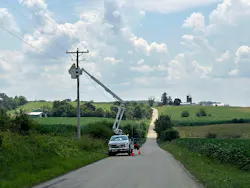
As the FCC moves forward with its evaluation of how to revamp the Universal Service Fund (USF), NRECA, which represents electric cooperatives that are providing fiber-based broadband, says the commission should ensure any overhaul of the program supports broadband networks that are built to meet future demand, not just today's minimum standards.
In May, the FCC issued a Notice of Proposed Rulemaking (NPRM), seeking comment on updating a subset of the Commission’s high-cost mechanisms that apply to rate-of-return carriers. Specifically, the Commission is reviewing high-cost mechanisms that fund legacy rate-of-return carriers not currently subject to any forward-looking buildout obligations, as well as model-based mechanisms slated to sunset soon.
The FCC also wants to comment on ways to modernize its cost-based, legacy high-cost support mechanisms to align them with the modern communications landscape, taking into account new sources of funding and technological developments. In addition, the Commission seeks comments on whether to extend the Alternative Connect America Cost Model I (A-CAM I) support mechanism that is set to sunset by the end of 2026.
One key issue NRECA is concerned about in the FCC’s NPRM is the notion of funding broadband in a technology-neutral manner. An FCC technology-neutral policy means that rules, definitions, and funding programs apply based on functional service outcomes rather than the underlying physical delivery system.
The FCC NPRM asked, “should our determination of a competitor providing qualifying service be technology-neutral, or should we look at the technology used to provide the services, such as whether it is provided by fiber, cable, fixed wireless, or LEO satellite?”
NRECA's response is that the FCC should not be “technology neutral” in developing broadband funding programs for rural broadband. The advocacy group notes that the shift away from federal programs that favor fiber-based technology toward “technological neutrality in federal programs has yielded a move toward the lowest common denominator, justified as a way to avoid picking technological winners and losers.”
However, NRECA added that the technology-neutral concept the FCC put forth is flawed because it defines technologies like fiber and LEO satellite as the same.
Earlier this year, in a letter to state broadband offices, SpaceX suggested that it may be “untenable” for low Earth orbit (LEO) satellite internet providers, such as Starlink, to participate in the Broadband Equity Access and Deployment (BEAD) Program unless they receive exemptions from certain contract requirements.
“Being “technology neutral” in this context is a fallacy, as it involves treating unequal technologies the same. If certain technologies are incapable of consistently meeting certain service thresholds informed by statutory definitions or by consumer choices already being made in the marketplace, they are not equal and do not merit “neutral” treatment as compared to more capable technologies,” NRECA said. “The simple fact is that fiber optic networks are qualitatively more capable, scalable, and future-proof than LEO satellite or other technologies.”
Meeting broadband definitions
By not considering how specific technologies work and instead emphasizing “technology neutrality,” NRECA noted that federal programs risk picking winners and losers among consumers.
However, since this could result in certain populations receiving only subpar service, “technology neutrality” is contrary to the universal service objectives outlined in Section 254 of the Communications Act.
NRECA suggests that the Commission should not provide High-Cost capital expenditure or operating expenditure support in areas where a terrestrial competitor reliably provides benchmark (at least 100 Mbps symmetrical) service, or where there is an enforceable commitment to provide such service.
“With respect to existing LEO satellite access, the Commission should not allow the availability of service from LEO satellite to preempt HighCost support for development and operation of a terrestrial network providing symmetrical service of 100 Mbps or better that is scalable to meet future demand,” NRECA said.
Electric cooperative’s broadband momentum
Electric cooperatives have emerged as a major force in the rural broadband market, bringing fiber-based connectivity to areas that other service providers have deemed too costly to serve.
According to NRECA, over 250 electric cooperatives are deploying or developing plans to deliver broadband service to their consumers.
“Electric cooperatives are playing a crucial role in broadband infrastructure development to serve rural unserved and underserved locations themselves or through partnerships with affiliated or unaffiliated ISPs,” NRECA said.
To get a foothold in the rural broadband market, electric cooperatives were active participants in key FCC broadband funding programs like the Rural Digital Opportunity Fund (RDOF) and the Connect America Fund (CAF).
Over 100 electric cooperatives secured roughly $1.6 billion in rural broadband funding through RDOF and the CAF program. Several cooperatives applied collectively through groups like the Rural Electric Cooperative Consortium (RECC), led by Conexon; fiber-focused groups like FiberRise; and individual local utilities.
In all, 32 electric cooperatives won $250 million in CAF II funds, and 185 electric cooperatives won $1.5 billion in RDOF funds.
“The High-Cost Program’s Connect America Fund Phase II (CAF II) and Rural Digital Opportunity Fund (RDOF) Auctions (Auctions 903 and 904, respectively) were the catalysts for most electric cooperatives’ start in the broadband business,” NRECA wrote. “These rural electric cooperatives made the commitment to serve their members and communities when few other Internet service providers would – and the Commission, through the High-Cost Program, has been an invaluable partner in this endeavor.”
While NRECA supports the FCC’s move to modernize the high-cost USF programs, including the $42.45 billion Broadband, Equity, Access and Deployment (BEAD) program, it emphasized that any “reform effort must continue to ensure that residents in rural areas are not relegated to second-tier broadband service as network demand inevitably continues to increase.”
AI drives upstream data usage surge
As AI continues to proliferate, it is driving up upstream data usage growth. In its AI Impact on Wide Area Networks, Cisco noted that about 9% of AI inference flows carry more upstream than downstream traffic, compared with about 0.5% of typical web traffic. Cisco also projects that AI and agentic AI will increase consumer-driven network traffic by about 6.6x, representing roughly 63% additional growth compared to non-AI scenarios.
Prioritizing symmetrical speeds
By leveraging fiber-based architecture, a large group of NRECA’s rural electric cooperative members provides symmetrical, gigabit-capacity broadband service in some of the nation’s most rural and sparsely populated areas.
These cooperatives got broadband to their communities by participating in the FCC’s high-cost CAF-II and RDOF funding programs.
Whether it provides fiber or another medium for broadband, NRECA noted that any high-cost funding recipient should be able to provide, at minimum, 100 Mbps symmetrical speeds with service rates comparable to those seen in larger cities and towns.
“The Commission should require any recipient of High-Cost support to provide symmetrical service of at least 100 Mbps that is scalable to meet future demand,” NRECA said. “A deployment condition tied to a 100/20 Mbps benchmark is contrary to consumer demand and experience and serves only to perpetuate dated and/or subpar network infrastructure in rural America.”
However, the 100 Mbps benchmark set by the FCC trails not only what providers are offering, but also how much bandwidth consumers are using today. Outside of MSOs and legacy copper that offer asymmetrical services, most broadband providers offer symmetrical services that far exceed 100 Mbps.
“The 100/20 Mbps definition, as proposed in the NPRM, already lags well behind where the market is today,” NRECA said. “The vast majority of NRECA member cooperatives that provide broadband already offer a 100 Mbps symmetrical service tier – and do so in extremely rural, sparsely populated areas. For many of our members, it is the very lowest speed tier they offer.”
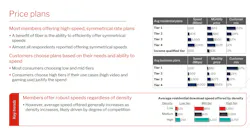
A 2025 Rural Broadband Benchmarking Report by NRECA and the National Rural Telecommunications Cooperative (NRTC) found that nearly fifty percent of residential customers choose symmetrical broadband speed tiers exceeding 475 Mbps.
The study also found that customers choose plans based on their needs and ability to spend, with a large portion of consumers choosing low and mid tiers. However, consumers choose high tiers if their use cases (high video and gaming use) justify the cost.
Another factor the report found is rising upload speeds. OpenVault found in its second-quarter OpenVault Broadband Insights (OVBI) 2026 report that broadband upstream usage increased almost 20% year over year.
“Consumer demand for upload speed is increasing much faster than consumer demand for download, and the number of “power users” is expected to increase at an even faster rate,” said NRECA and NRTC.

There’s no better place to see how symmetrical speeds are being used in rural markets than to look at some of NRECA’s members.
Suwannee Valley Electric Cooperative in northern Florida offers three main speed tiers: symmetrical 100 Mbps service, symmetrical 1 Gbps service, and symmetrical 2 Gbps service.
Similar to Suwannee Valley Electric Cooperative, Pierce Pepin Cooperative Services in Ellsworth, Wisconsin (offering broadband under its SwiftCurrent Connect subsidiary) reports that 99.5% of customers receive symmetrical 250 Mbps or higher, with the 500 Mbps symmetrical service tier the fastest-growing. SwiftCurrent noted that less than 1% of its users select the 100 Mbps symmetrical service, adding that the 100 Mbps service is available only to qualified low-income households.
Given service providers' move to offer higher symmetrical speed tiers, the FCC’s 100/20 Mbps definition could leave rural markets vulnerable to inadequate service.
“A deployment condition tied to a 100/20 Mbps benchmark is contrary to consumer demand and experience, and serves only to perpetuate dated and/or subpar network infrastructure in rural America,” NRECA said. “Simply put, no federal funds should be devoted to build and operate networks that are not scalable to meet growing bandwidth demand. To meet the statutory requirements of comparable services at comparable rates, the speed benchmark must be set aggressively and updated regularly to keep up with the marketplace.”
For related articles, visit the Broadband Topic Center.
For more information on high-speed transmission systems and suppliers, visit the Lightwave Buyer’s Guide.
To stay abreast of fiber network deployments, subscribe to Lightwave’s Service Providers and Datacom/Data Center newsletters.
FOR FURTHER READING

The Alabama Fiber Network (AFN) has finished phase one of the state’s middle-mile broadband backbone, meeting its initial network build-out goal.

Vibrant Broadband is building hybrid fiber and fixed wireless networks to improve rural internet access in Minnesota, serving over 7,000 customers since 2019.
The research and education network provider is advocating for alternatives to federal funding for expanding broadband availability.
About the Author

Sean Buckley
Sean is responsible for establishing and executing the editorial strategy of Lightwave across its website, email newsletters, events, and other information products.