Verizon takes on $1B dark fiber data center deal with Google
Key Highlights
- Verizon's $1 billion dark fiber deal with Google underscores its role in powering AI data centers and cloud infrastructure.
- The company's AI Connect initiative offers programmable networks, data center services, and security, aligning with future growth strategies.
- Verizon owns over 500,000 route miles of fiber across North America, supporting high-capacity AI and cloud connectivity.
- Transitioning from copper to fiber has reduced energy footprints and enabled the repurposing of central offices into data centers.
- Verizon expects multiple billion-dollar deals by year-end, with long-term, high-quality revenue from demanding infrastructure customers.
Keep up to date with Lightwave’s earnings coverage.
You can check our publication’s key segments:
And
Here are other stories on Verizon:
- Verizon’s Frontier acquisition bolsters its fiber/wireless converged plans
- Verizon’s CEO will consider inorganic deals and partnerships to reach 40 to 50M fiber passings
- Verizon’s CEO says convergence is our most significant near-term growth opportunity
- Verizon’s CFO says Frontier’s assets are a catalyst for fiber expansion and broadband growth
- Verizon’s CEO says it's on track to reach 650K new Fios subscribers in 2025
Verizon revealed during its second-quarter earnings call that it signed a $1 billion dark fiber deal with Google, illustrating the growing role fiber has in shaping AI data centers.
The deal with Google reflects Verizon’s AI Connect initiative, which was developed by former CEO Hans Vestberg in 2025. Along with dark fiber, AI Connect offers programmable networks, data center/cloud/GPUaas and security services.
Dan Schulman, CEO of Verizon, told investors that the deal with Google is “quite consequential because it foreshadows where our revenue growth profile is going from here.”
While he would not point to any specific customers, Schulman added that it has other large customers with similar needs in tow.
“We have other deals that we expect to announce by year-end that, taken together, are expected to be worth multiple billions of dollars in revenue over the next several years,” he said. “These are long-duration, high-quality contracted revenue streams from some of the most demanding infrastructure customers in the world.”
Differentiated assets
Verizon’s deal with Google may be the latest high-profile fiber deal for a hyperscaler, but the provider is certainly not alone.
Fellow ILEC Lumen, which shed its consumer fiber business earlier this year to focus on wholesale and enterprise services, struck a deal in 2024 with Corning to reserve 10% of the fiber maker’s global fiber capacity for each of the next two years to interconnect AI-enabled data centers from Microsoft and others.
Lumen also opened its Northline Fiber network to directly connect Seattle to Minneapolis and expand connectivity across a key northern U.S. corridor between the Pacific Northwest and central U.S. markets.
Meanwhile, Zayo noted in its second-annual Bandwidth Report, between 2024 and 2025, demand for Long Haul Dark Fiber doubled as Zayo’s largest customers expanded connectivity between AI data centers to support significantly larger AI workloads.
Nevertheless, Verizon remains confident that its network assets will enable it to pursue similar deals.
Verizon owns a sizeable long-haul and metro fiber network spanning over 500,000 route miles across North America that it has built organically and through various acquisitions like Frontier and the former MCI.
Also, the service provider has, through its AI Connect initiative, begun constructing high-capacity, long-haul fiber pathways to support Amazon Web Services data center regions last year.
“The build-out of AI infrastructure across the United States is one of the largest capital cycles of our lifetime and Verizon is uniquely positioned to participate in it,” Schulman said. “We own one of the most extensive long-haul and metro fiber footprints in North America. We have spent decades building the kind of carrier-grade, low latency, highly resilient transport network that hyperscalers need to connect compute to compute, model to model, and region to region.”
Realigning COs
Dark and lit fiber services are just one part of Verizon’s AI data center push.
Like fellow ILEC AT&T, Verizon is moving fast to retire legacy copper wiring which for over a century supported its traditional POTS business line for consumers and businesses.
Verizon noted that its transition from copper to fiber has enabled the retirement of central offices that once required up to 13 floors of equipment, shrinking them to just one or two floors. This reduces the energy footprint of real estate and cooling by as much as 60% to 80%.
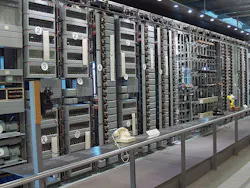
While Verizon sold off most of its own data center facilities in 2017 to Equinix, Verizon sees an opportunity to reposition these COs to become data center locations to support AI and other applications.
“We have thousands of central offices, many of which were taking copper out of, and we are retrofitting them to be remote data centers that are power-ready, permitted, fully redundant infrastructure,” he said.
Schulman added that it is already seeing good demand for these facilities. “There are multiple conversations underway with partners who are eager to utilize these power-ready and permitted locations,” he said.
For related articles, visit the Business Topic Center.
For more information on high-speed transmission systems and suppliers, visit the Lightwave Buyer’s Guide.
To stay abreast of fiber network deployments, subscribe to Lightwave’s Service Providers and Datacom/Data Center newsletters.
About the Author
 Sean Buckley
Sean Buckley
Sean is the Editor-in-Chief of Lightwave. He establishes and executes Lightwave's editorial strategy across its website, email newsletters, events, and other information products. Before coming to Lightwave in July 2023, he served as editor of Broadband Communities. Earlier, he served as senior editor of FierceTelecom and the editor of the former Telecommunications Magazine. He got his start in the optical industry in 1998 when he became the editor of enterprise and optical networks at Information Gatekeepers. He has a BA in English from the University of Massachusetts, Boston, and lives in Dracut, Mass, with his wife, two sons, and his cat, Dove.