Dycom’s CEO says it has secured half a billion in verbal agreements for BEAD projects
Key Highlights
- Dycom has secured over $500 million in verbal awards related to BEAD deployments, indicating strong market positioning.
- The company’s Q3 revenues increased by 14.1%, reaching $1.45 billion, with notable contributions from AT&T and Lumen.
- Dycom expects its FY2026 revenue to grow between 13.8% and 15.4%, driven by fiber and broadband infrastructure projects.
- Two-thirds of the planned deployments are expected to involve fiber or HFC infrastructure, aligning with state funding priorities.
- The company is optimistic about converting verbal awards into firm backlog as funding flows increase, supporting future growth.

Keep up to date with Lightwave’s earnings coverage.
You can check in our publication’s key segments:
And
Here are other stories on Dycom:
· Dycom forecasts that data center network infrastructure will be a $20 billion market
· Dycom’s CEO says Charter/Cox and Verizon/Frontier deals are a positive sign
Dycom likes its chances in the Broadband Equity Access and Deployment Program (BEAD).
The company’s confidence is driven by the fact that the NTIA earlier this month approved 29 proposals. Louisiana already has access to BEAD funding.
In all, $29.5 billion in total spending is expected from the states and territories based on preliminary subgrantee results, split between grants and subgrantee match amounts.
Speaking to investors during its third-quarter 2026 earnings call, Daniel Peyovich, CEO of Dycom, said that it has secured a large swath of BEAD-related projects.
“We have already secured over half a billion dollars in verbal awards related to BEAD deployments, which is not yet reflected in our reported backlog,” he said. “This speaks to our strong ability to capitalize on the significant spending on fiber and HFC networks over the next four-plus years.”
He added that while it feels “good about starting to see revenue in Q2, there is going to be a ramp to it, so it’s not going to be all at once.”

Capitalizing on fiber focus
While the Trump administration has focused on opening up the BEAD funding process to remove the fiber-focused strategy by making provisions to support various technologies, including fixed wireless and satellite, fiber is still being favored by various states.
According to NTIA, some states like Rhode Island have emphasized fiber, others like Nebraska have been focusing on fixed wireless, and some like Montana are leaning more on satellite.
NTIA approves 29 BEAD proposals
NTIA’s approval progress for BEAD proposals continues to gain steam, adding nine new proposals in early December to bring it to a total of 29. In November, NTIA approved 18 proposals, with Texas and West Virginia following not long after. Among the nine new states to get approvals are: South Dakota, Nebraska, New Jersey, Arizona, Colorado, Indiana, Wisconsin, Michigan, and Ohio. Citing the Trump Administration’s Benefit of the Bargain reforms, NTIA said these states saw a surge in participation, competition, and private sector matching contributions—driving down costs and advancing service to customers. NTIA estimates that the Benefit of the Bargain savings will ultimately reach $21 billion. One state, Louisiana, has signed its award amendment, allowing the state to access BEAD funds to begin delivering broadband to its constituents.
However, Dycom still believes there are plenty of fiber opportunities ahead for them within the BEAD program.
“Two-thirds – about two-thirds to date, two-thirds of the locations are going to be served by either fiber or HFC infrastructure, so we're excited about that,” Peyovich said. “It really lines up well with how we've been thinking about it to date. That addressable market is probably going to be in the neighborhood of $20 billion to include the matches from the subgrantees, so significant spending to do over the next four or five years.”
He added that “we don't have any in our backlog, but significant opportunities that, now, as the funding starts to flow, we hope to move from verbal into backlog for next quarter.”
Contract revenues rise
Dycom reported that contract revenues rose 14.1% to $1.45 billion for the quarter ended October 25, 2025, compared to $1.3 billion for the previous year’s quarter.
On an organic basis, Dycom’s contract revenues increased 7.2% after excluding contract revenues from acquired businesses that were not owned for the entirety of both the current and prior year quarters. Total contract revenues from acquired businesses were $110.9 million for the quarter ended October 25, 2025, compared to $21.0 million for the same period a year ago.
Total contract revenues from acquired businesses were $378 million for the nine months ended October 25, 2025, compared to $47.6 million for the prior year period.
AT&T and Lumen each exceeded 10% Dycom’s total revenues for the quarter. AT&T's revenue was $362 million, and Lumen's revenue was $170.3 million. Customers exceeding 5% of total revenues for the quarter were Brightspeed, Charter, Comcast, Frontier, and Verizon.
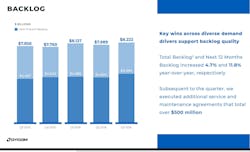
Dycom’s backlog at the end of the third quarter was $8.22 billion, including $4.99 billion that is expected to be completed in the next 12 months.
During the quarter, the company executed additional service and maintenance agreements totaling over $500 million. “While these agreements won’t be in our backlog until next quarter, they demonstrate our ability to maintain our position as the service provider of choice, while prioritizing profitable growth and shareholder returns,” Peyovich said.
Due to what Dycom said was “strong performance and favorable demand outlook,” the company is increasing the midpoint of its revenue outlook for the year.
Dycom’s fiscal 2026 will include 53 weeks of operations due to our fiscal calendar, with the extra week occurring in the Company’s fiscal fourth quarter when operations are normally seasonally impacted by winter weather.
As a result of our strong performance, we are increasing the midpoint of our full-year revenue outlook, expecting revenue of $5.4 billion to $5.43 billion, representing a range of 13.8% to 15.4% total growth over the prior year,” Peyovich said. “This outlook excludes any results from the pending acquisition of Power Solutions, expected to close in our fiscal Q4, as the impact is dependent on the date of completion.”
For related articles, visit the Business Topic Center.
For more information on high-speed transmission systems and suppliers, visit the Lightwave Buyer’s Guide.
To stay abreast of fiber network deployments, subscribe to Lightwave’s Service Providers and Datacom/Data Center newsletters.
About the Author
 Sean Buckley
Sean Buckley
Sean is the Editor-in-Chief of Lightwave. He establishes and executes Lightwave's editorial strategy across its website, email newsletters, events, and other information products. Before coming to Lightwave in July 2023, he served as editor of Broadband Communities. Earlier, he served as senior editor of FierceTelecom and the editor of the former Telecommunications Magazine. He got his start in the optical industry in 1998 when he became the editor of enterprise and optical networks at Information Gatekeepers. He has a BA in English from the University of Massachusetts, Boston, and lives in Dracut, Mass, with his wife, two sons, and his cat, Dove.