Clearfield solidifies a disciplined approach to data centers
Key Highlights
- Clearfield is focusing on underserved, smaller data centers that support edge compute, aiming to capture new growth opportunities outside hyperscale markets.
- The company plans to launch two new product lines, a splice case and a fiber management cassette, optimized for non-hyperscale data centers, enhancing its market offerings.
- Clearfield's revenue growth is driven by strong sales to MSOs and national carriers, with international markets also showing significant gains, despite some setbacks in community broadband.
- The company's disciplined, low-volume, high-mix manufacturing approach positions it well to serve emerging secondary markets driven by power and land constraints in traditional hubs.
- Looking ahead to 2026, Clearfield anticipates continued growth in fiber connectivity, with projected net sales of $160-$170 million and steady demand from large regional and MSO customers.

Keep up to date with Lightwave’s earnings coverage.
You can check our publication’s key segments:
And
Here are other stories on Clearfield:
Clearfield has taken another step toward its push into the data center industry, with a particular focus on smaller providers that support edge compute needs.
Speaking to investors during its fiscal fourth-quarter and full-year 2025 earnings call, Cheri Beranek, CEO of Clearfield, said the company sees an opportunity to serve what it calls the underserved market of non-hyperscale data centers.
“As hyperscalers rely on smaller ISPs to push part of their compute workloads closer to the edge, Clearfield's position with regional providers opens a new growth vehicle to the company,” she said. “This disciplined approach positions Clearfield for measured growth as the market continues to recover.”
As part of its data center strategy, Clearfield will introduce two significant new product lines in time for the January BICSI tradeshow: a splice case line and a next-generation Fiber Management Cassette, optimized for non-hyperscale data centers.
“These launches mark the start of a new generation of innovation as we extend our reach within and beyond traditional broadband markets,” Beranek said.

A disciplined approach
While the hyperscaler space continues to attract significant attention, Clearfield will focus on regional or smaller data center opportunities.
The company’s bet is timely, given the rising global demand for data centers. New demands for AI and cloud services are increasing as traditional large markets face challenges related to power availability. This has led to a significant shift in development toward new and emerging secondary markets across North America, Europe, and Asia-Pacific.
Power and land constraints are pushing development away from established hubs such as Northern Virginia, the largest market, and toward other communities.
Beranek emphasized that its focus on the smaller data center market is driven by a “disciplined approach.”
“We could go after hyperscaler data center providers, and we would lose because that's a high-volume, low-mix solution,” she said. “That's not the way Clearfield is designed. It's not how our manufacturing lines are configured. We compete aggressively in a low-volume, high-mix world.”
She added, “data centers at the edge that push to the edge where we're going to see our customers as smaller data centers picking up the compute power requirements from the big guys as they move out” is “where we're really going to have a significant opportunity because it's our space.”
MSOs, carriers lead revenues
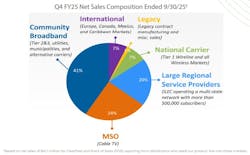
From a revenue standpoint, Clearfield saw strength in cable MSOs and National Carriers, while Community Broadband struggled due to delays in implementing BEAD funding for communities.
Clearfield’s net MSO sales for fiscal year 2025 were $32.4 million, up 38% from $23.5 million in fiscal 2024. Net sales to MSOs were $10 million in the fourth quarter, representing 24% of total net sales and up approximately 33% from the prior-year fourth quarter.
In a joint letter to Clearfield’s shareholders, the company noted that its “MSO business experienced a sequential uptick of 9% from the third quarter, driven by higher volumes from portfolio customers in this market.”
“The MSO market has been a strong growth driver for Clearfield as we leverage the brand awareness of Clearfield in Community Broadband with the regional MSOs who share similar geographies,” Clearfield said.
Likewise, Clearfield saw gains in National Carrier sales, which totaled $9.7 million for the year, representing 6% of total net sales, up 11% from the prior year. Sales for this market were $2.7 million in the fourth quarter, representing 7% of total net sales and down approximately 12% from the prior-year fourth quarter.

Driven by continued demand from several large regional Service Provider customers with significant FTTx build set sales in this segment, quarterly sales were $8.1 million, representing 20% of total net sales and up approximately 28% from the prior-year fourth quarter.
Finally, net international market sales, which include sales into Canada, the Caribbean, Mexico, and other parts of Central and South America, were $5.2 million in fiscal 2025, representing 3% of sales and up 70% from the prior year.
Despite gains with MSOs and larger carriers, Clearfield faced challenges in its community broadband segment, where net sales in Community Broadband declined 7% to $17 million from the prior-year fourth quarter and 9% sequentially.
“Community Broadband was partly affected by the government shutdown, but I would say it was more affected over the course of the year by the delay in BEAD,” Beranek said. “The smaller the service provider, the more the delay in BEAD has affected both the deployments and their planning, their engineering dollars, and their engineering availability, and then financing, setting aside money to deal with BEAD.”
Clearfield’s net sales from continuing operations were $150.1 million, compared to $125.6 million in fiscal year 2024, an increase of 20%. Our year-over-year and fourth-quarter performance was driven by continued penetration into the MSO and large regional service provider markets.
Looking towards 2026, Clearfield expects net sales from continuing operations to be in the range of $160 million to $170 million, operating expenses as a percentage of revenue to remain consistent with fiscal 2025, and net income per share to be in the range of $0.48 to $0.62.
“We expect growth to be driven by steady demand for Fiber Connectivity with continued strength across our Large Regional and MSO customers,” said Dan Herzog, CFO of Clearfield.
For related articles, visit the Business Topic Center.
For more information on high-speed transmission systems and suppliers, visit the Lightwave Buyer’s Guide.
To stay abreast of fiber network deployments, subscribe to Lightwave’s Service Providers and Datacom/Data Center newsletters.
About the Author
 Sean Buckley
Sean Buckley
Sean is the Editor-in-Chief of Lightwave. He establishes and executes Lightwave's editorial strategy across its website, email newsletters, events, and other information products. Before coming to Lightwave in July 2023, he served as editor of Broadband Communities. Earlier, he served as senior editor of FierceTelecom and the editor of the former Telecommunications Magazine. He got his start in the optical industry in 1998 when he became the editor of enterprise and optical networks at Information Gatekeepers. He has a BA in English from the University of Massachusetts, Boston, and lives in Dracut, Mass, with his wife, two sons, and his cat, Dove.