Shentel’s CEO says it would be interested in acquiring a pure-play fiber player
Key Highlights
- Shentel aims to complete its fiber build by the end of 2026, with a focus on organic growth and strategic acquisitions.
- The company is interested in acquiring pure-play fiber providers, avoiding cable and copper assets to strengthen its fiber footprint.
- In 2025, Glo Fiber revenue grew by 39%, surpassing incumbent broadband revenue, driven by customer and RGUs growth.
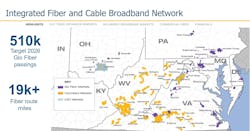
- Shentel expanded its fiber network to over 19,000 route miles across eight states, with more than 679,000 passings.
- The company is strategically passing on higher-cost markets, focusing on markets with better ROI, and expects to reach positive free cash flow in 2027.

Keep up to date with Lightwave’s Q4 2025 earnings coverage.
You can check our publication’s key segments:
And
Here are other stories on Shentel:
· Shentel’s CEO says it is on track to complete its fiber broadband build by the end of 2026
· Shentel's CEO: Residential Glo Fiber and commercial fiber to surpass incumbent revenues next year
Shentel is moving quickly to complete its fiber broadband build by the end of this year, ending 2025 with about 427,000 homes and businesses in its Glo Fiber expansion markets and, in incumbent broadband markets, more than doubling subsidized passings year-over-year to 22,000.
While the service provider’s build focus has been through organic moves, it has not ruled out purchasing other fiber assets to expand its presence in markets like Blacksburg, Virginia, with its WideOpen Blacksburg purchase, or in new markets with Horizon.
Speaking to investors during its fourth-quarter earnings call, Ed McKay, CEO of Shentel, said that while it is aware of the consolidation trend in the fiber broadband industry, which is gaining momentum as seen with Verizon and AT&T completing deals with Frontier and Lumen’s consumer fiber assets, the near-term priority is to wrap up its fiber build.
“We've certainly seen consolidation start,” he said. “We believe consolidation will continue. At this point, we're focused on completing our build plan, accelerating customer growth, and then reaching that positive free cash flow inflection points in 2027, so that's really our focus right now.”
He added that, as it “looks further into the future, from an M&A standpoint, we'd be most interested in a pure-play fiber provider, less interested in a cable provider, and not interested at all in a copper provider.”

Fiber ROI focus
Shentel’s fiber-first strategy continued to pay off during the fourth quarter, as the company reported year-over-year growth in both Glo Fiber and Commercial Fiber, driving a notable shift in its revenue mix. The service provider’s fiber-based lines of business are surpassing its incumbent broadband revenue.
The company’s sales and marketing team continues to drive growth in our Glo Fiber expansion markets.
During the fourth quarter, it added 5,300 new customers and more than 6,000 total data, video, and voice revenue-generating units. For the full year 2025, it added approximately 23,000 new customers and 26,000 RGUs in total. As a result, total Glo Fiber revenue-generating units surpassed 103,000 by year-end, up 33% compared to the prior year.
It also operates in markets with competitive dynamics that it claims set it apart from its broadband peers: 88% of its Glo Fiber passings are in duopoly markets with only one wireline broadband competitor, and in its incumbent markets, 70% of its passings have no fixed broadband competitor.
As of the end of 2025, Shentel’s integrated broadband network spanned more than 19,000 fiber route miles across eight states, with over 679,000 total broadband passings.
However, Shentel’s focus now is to prioritize markets that make sense financially. “As we enter the home stretch of our Glo Fiber expansion, we remain focused on return on investment,” McKay said. “Due to rising aerial make-ready costs in some areas, we have recently decided to pass on investments in certain Ohio markets where the cost to pass increased, reducing our ability to earn a return on investments above our hurdle rate of 15%.”
With all of its markets launched, Shentel’s main focus in 2026 is to add passings in its Virginia, Pennsylvania, Maryland, and Ohio markets. “Despite the reduction in targeted passings, we remain confident in our plans to achieve positive free cash flow in 2027,” McKay said.
Shentel is also making progress in its incumbent markets, as broadband passings grew to 252,000 at year-end, up about 13,000 from the prior year. McKay said, “This increase was driven by the construction of government-subsidized passings in previously unserved areas.”
In the incumbent rural markets, Shentel is nearing completion of fiber construction and has fulfilled its state grant obligations in Virginia. In December, Shentel completed its Virginia Telecommunications Initiative (VATI) project, expanding gigabit broadband internet service to more than 7,000 previously unserved homes in Shenandoah County, Virginia.
“We've substantially completed construction and fulfilled our grant obligations in Virginia, and we expect to complete the remaining 1,300 government-subsidized incumbent grant passings in West Virginia in 2026,” McKay said.
As a result of its government grant for fiber construction, about 21% of its incumbent broadband passings are now equipped with fiber-to-the-home (FTTH) technology. “These new subsidized passings represent a strong growth catalyst for our incumbent markets, with data penetration exceeding 45% within six quarters of a neighborhood launch,” McKay said. “Our earliest cohort from the first quarter of 2023 has reached 61% penetration, and we've already achieved an aggregate penetration of 31% across more than 22,000 subsidized passings.”
Glo Fiber leads revenue
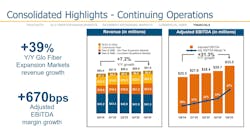
Driven by another quarter of strong Glo Fiber expansion market revenue growth of $6.5 million or 39%, Shentel’s fourth quarter revenues grew 7.2% to $91.6 million.
Within the Glo Fiber unit, Shentel saw a 37% increase in data subscribers and a 2% increase in data ARPU.
Shentel saw mixed results across its various segments:
· Residential & SMB - Glo Fiber Expansion Markets: Revenue rose $24.7 million, or 42.7%. Shentel recognized $0.7 million in revenue from the acquired Horizon markets in the first quarter of 2025. The remaining increase of $24.0 million was primarily due to a 42.0% increase in data RGUs and a 16.3% increase in video RGUs, associated with the company’s investment in expanded geographies for Glo Fiber.
· Commercial Fiber: Shentel’s commercial fiber revenue increased $2.0 million or 10.8%.
· Residential & SMB - Incumbent Broadband Markets: This segment’s revenue decreased $5.1 million, or 2.9%. Shentel recognized $1.7 million in revenue from the acquired Horizon markets in the first quarter of 2025. The remaining decrease of $6.8 million was primarily due to lower video and data revenues, a 14.5% decline in video RGUs, lower Universal Service Fund revenues, and a 1.6% decline in data ARPU.
· RLEC & other: Revenue increased $1.0 million, or 3.9%. Shentel recognized $2.9 million in revenue from the acquired Horizon markets in the first quarter of 2025. The remaining decrease of $1.9 million was primarily due to lower DSL revenue from a 19.8% decline in DSL RGUs, partially due to customers migrating to its broadband data service in the recently constructed passings supported by government grants.
As Shentel moves to complete its fiber build, the service provider will wind down capital spending. In 2025, Shentel invested $359 million in capital expenditures and collected $63 million in government grants, resulting in net CapEx of $296 million. The service provider has completed 84% of the Target Glo Fiber passings and 94% of the target passings for the incumbent government grant in unserved areas.
McKay said, “We are well on our way to substantially completing construction for these capital-intensive expansion projects by the end of 2026.”
During the quarter, Shentel also took action to reduce its headcount by laying off about 10% of its employees to better align its staffing levels with the planned completion of the construction phase of Glo Fiber.
McKay said Shentel expects to incur approximately $3.1 million in restructuring costs and anticipates annual savings of roughly $12.3 million starting in 2027, split evenly between operating expenses and capitalized labor.
Looking toward 2026, Shentel has forecast revenues of $370 million to $377 million, representing 4.4% growth at the midpoint.
For related articles, visit the Business Topic Center.
For more information on high-speed transmission systems and suppliers, visit the Lightwave Buyer’s Guide.
To stay abreast of fiber network deployments, subscribe to Lightwave’s Service Providers and Datacom/Data Center newsletters.
About the Author
 Sean Buckley
Sean Buckley
Sean is the Editor-in-Chief of Lightwave. He establishes and executes Lightwave's editorial strategy across its website, email newsletters, events, and other information products. Before coming to Lightwave in July 2023, he served as editor of Broadband Communities. Earlier, he served as senior editor of FierceTelecom and the editor of the former Telecommunications Magazine. He got his start in the optical industry in 1998 when he became the editor of enterprise and optical networks at Information Gatekeepers. He has a BA in English from the University of Massachusetts, Boston, and lives in Dracut, Mass, with his wife, two sons, and his cat, Dove.