TDS Telecom battles fiber overbuilders in its cable markets by scaling its fiber reach

Keep up to date with Lightwave’s Q2 2026 earnings coverage.
You can check our publication’s key segments:
And
Here are other stories on TDS Telecom:
- TDS Telecom reaches nearly 1.1 million fiber service addresses
- TDS Telecom deepens New Hampshire footprint with Granite State Communications deal
- TDS Telecom will opportunistically use M&A to enhance its fiber reach
- TDS Telecom nears its 1.8M fiber service location target in Q2
·
TDS Telecom’s president and CEO Kenneth Dixon isn’t afraid of fiber broadband overbuilders.
As this new class of provider enters its cable territory, he sees an opportunity to continue expanding its established fiber base.
“What we're seeing from an overbuilder perspective is we've seen some activity in some of our cable markets,” he said during TDS Telecom’s second quarter earnings call. “But what I will tell you about our cable markets is that today, they're 22% fiber already. And as we were going through to look at our edge-out opportunities that we updated the market in the first quarter, we used that same process to run our cable markets through.”
Fiber growth focus
TDS Telecom continues to move forward with its fiber growth plan via a three-pronged plan that includes building fiber addresses, driving fiber sales, and transforming its operations.
During the quarter, TDS delivered approximately 66,000 marketable fiber service addresses, bringing it to approximately 106,000 for the first half of the year.
As of the end of the quarter, TDS Telecom served nearly 1.2 million fiber service addresses, representing 60% of its total footprint with 80% of addresses capable of gigabit speeds.

In its expansion markets, which are new geographies it has entered as a competitor, it is building only fiber. Likewise, in its cable markets, 22% of TDS Telecom's addresses are already served by fiber, and it continues to expand fiber across its footprint where it can get an ROI for the upgrade.
“Our fiber address additions represent the strongest first-half delivery in company history and even exceed what we accomplished in the second half of 2025, which is typically our peak construction period,” Dixon said. “It reflects both strong execution by our teams as well as expanded construction capacity.”
But TDS isn’t stopping there. The telco raised its 2026 guidance for fiber service address delivery to 250,000 to 300,000, increasing its range by 50,000.
“We have a robust pipeline of addresses currently under construction--positioning us well for the remainder of the year,” Dixon said.
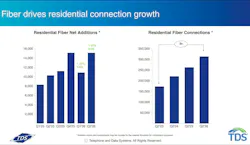
From a customer sales perspective, TDS ended the quarter with about 15,000 fiber net adds, up 47% year-over-year.
To grow its fiber broadband customer base, TDS is building out sales teams across all markets. These sales teams are focused on both prelaunch sales as well as penetrating new open-for-sale addresses and aftermarket delivery.
“As we continue to grow our fiber footprint, we are hyper-focused on converting these new service addresses into customers and improving the overall customer experience,” Dixon said. “We have significantly expanded our door-to-door sales capacity, and we're pleased with the improved performance of our dot-com channel.”
TDS is seeing similar customer trends in its cable markets. “In our cable markets, we're beginning to see the benefit of expanded sales teams and targeted investment, which are now driving increased gross adds,” Dixon said. “As I mentioned last quarter, our cable markets are some of the best in the country, and we see significant opportunity to grow here.”
However, as the fiber base grows, the service provider is focusing on improving customer experience, including how customers purchase service from the telco. By having its technicians use the same platforms across all markets, TDS simplifies its back-office processes and improves the customer experience.
“Our operational transformation is centered on efficiency, improving the customer experience, and simplification,” Dixon said. “We continue to make progress modernizing our systems and remain on track with our transformation roadmap, making it easier for customers to do business with us.”
Dixon added that it has “several additional enhancements underway that are on schedule to be completed in the back half of the year.”
E-ACAM momentum continues
Given the challenges of serving rural areas, including lower density and terrain, TDS Telecom’s fiber build-out pipeline in existing markets is being fueled by leveraging FCC’s Enhanced ACAM (E-ACAM) program funding.
As the largest recipient of E-ACAM, TDS can bring fiber-based broadband to hard-to-reach rural areas where it would otherwise not be economical.
TDS is leveraging E-ACAM support to accelerate its fiber expansion in 22 states, bringing fiber to more than 300,000 addresses in our incumbent footprint. It has already met its 2026 obligations in 3 states and now has the highest crew counts ever in the remaining E-CAM markets to deliver on its 2026 milestones.
“In our incumbent markets, we've already overbuilt 52% of our addresses with fiber,” Dixon said. “With E-ACAM help, we plan to deliver another 300,000 addresses with fiber over the next 2 years, further reducing copper in our network.”
He added that TDS is deploying the “most crews right now to our E-ACAM markets, where that is obviously copper, and along the route getting to those E-ACAM markets, we can deploy fiber.”

Balancing fiber growth with legacy declines
Being a traditional telco, TDS continued to weather the growing pain of revenue challenges as next-gen fiber increases with legacy copper declines.
Total residential revenue declined $6 million compared to the prior year. About $2 million of this decrease reflects divestiture in copper-based markets, such as its Oklahoma network, which it sold to Hillary Communications.
TDS’ Fiber revenue rose 13% or $11 million versus the prior year, helping offset legacy revenue pressures in its ILEC copper and cable markets.
In cable, TDS’ revenues declined roughly 10% versus the second quarter of 2025.
Kristina Bothfeld, VP of Finance and CFO of TDS Telecom, said it is “increasing investment and sales capacity in our cable markets to stem these declines.”
She added that “we are continuing to experience faster declines in copper, so we are deploying fiber across our ILEC footprint at a record pace to help mitigate those headwinds.”
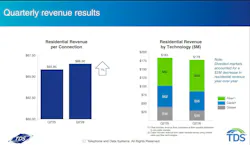
Residential revenue per connection increased 1% year-over-year, reflecting annual price increases offset by ongoing industry-wide declines in video attachment rates.
Total operating revenues declined 6% in the quarter or 4% excluding the impact of divestitures. Discrete adjustments to wholesale revenues that benefited 2025 are driving roughly half of the year-over-year decrease.
“The remaining decline reflects continued legacy revenue stream pressures partially offset by growth in fiber connections and modest improvement in revenue per connection. Cash expenses were flat as savings from ongoing cost management initiatives were offset by costs to support our growing expansion markets and inflationary increases.”
Capital expenditures totaled $179 million in the quarter. This reflects higher construction activity and a robust funnel of addresses under construction.
Looking toward the rest of 2026, TDS has forecast total telecom revenues of $1 billion to $1.03 billion, down from its prior guidance, primarily due to what Bothfeld said: “were headwinds in its copper and cable markets.”
However, TDS is increasing its capex range from $625 million to $675 million to support its move to add 250,000 to 300,000 new fiber service addresses.
He added that “we found there were tremendous opportunities still to fiberize in our cable markets, and I think we're going to continue to see that activity from us over the next couple of quarters.”
For related articles, visit the Broadband Topic Center.
For more information on high-speed transmission systems and suppliers, visit the Lightwave Buyer’s Guide.
To stay abreast of fiber network deployments, subscribe to Lightwave’s Service Providers and Datacom/Data Center newsletters.
About the Author
 Sean Buckley
Sean Buckley
Sean is the Editor-in-Chief of Lightwave. He establishes and executes Lightwave's editorial strategy across its website, email newsletters, events, and other information products. Before coming to Lightwave in July 2023, he served as editor of Broadband Communities. Earlier, he served as senior editor of FierceTelecom and the editor of the former Telecommunications Magazine. He got his start in the optical industry in 1998 when he became the editor of enterprise and optical networks at Information Gatekeepers. He has a BA in English from the University of Massachusetts, Boston, and lives in Dracut, Mass, with his wife, two sons, and his cat, Dove.