Ethernet optical transceiver set to grow 120% in 2026
Key Highlights
- Cloud providers like Oracle, Alibaba, and Tencent are driving record capex spending, fueling optical transceiver demand.
- Market growth in 2024 and 2025 has been exceptional, with projections indicating a moderation starting in 2026.
- Supply chain overreactions are causing rapid sales increases, but may lead to market corrections in the coming years.
- Forecasts suggest a peak growth rate of 120% in 2026, with a decline to 76% in 2027 and 20% by 2031.
- Technological advancements in network architectures and AI clusters are expected to support sustained market growth despite cyclical patterns.

Ethernet optical transceivers continue to enjoy a strong sales cycle.
After doubling in 2024 and rising almost 90% in 2025, LightCounting said it “expected a moderation in the market growth rate for 2026, but the first 9 months of the year derailed those projections.”
The research firm noted that growth is driven by a jump in cloud company capex spending that has not abated since the start of the year.
This thesis is reflected in spending patterns by cloud providers, including Oracle, Alibaba and Tencent.
In the most recent quarter, Oracle spent nearly $30 billion (up 235% year over year) and generated less than $20 billion in revenue (up 30% year over year). LightCounting said this “large established company is turning into a start-up, reinventing itself around AI.”
Likewise, capex at Alibaba and Tencent increased 150-200% year over year in the most recent quarter, but revenue growth was modest at 15-20%.
Supply chain overreaction
Despite near-term growth, the growth trend will face limits.
Some top market forecasters, including Nvidia, predict capex growth will hold steady at 70% in 2027, like 2026 rates.
In its forecast model, LightCounting said it assumes “only” a 50% increase in capex for 2027 because the supply chain often overreacts to capex momentum changes.
The supply chain “is clearly overreacting now: Innolight reported close to 200% y-o-y growth in sales of optical transceivers for the first half of 2026,” the research firm said.
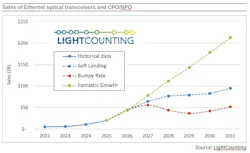
LightCounting has forecast 120% growth in the Ethernet optical transceiver market for 2026. The research firm’s forecast for 2027-2031 is based on what it calls a “Soft Landing” scenario.
Cyclical patterns ahead
Looking ahead to 2027-2031, the outlook is far from certain.
LightCounting notes that cycles will occur during this period.
While LightCounting notes that what it calls “Fantastic Growth” could continue in 2027 and beyond, the forecast assumes the market growth rate will decline from 120% in 2026 to 76% in 2027 and 20% by 2031.
“Historical data on sales of optical transceivers in 2004-2025 shows a cyclical pattern as growth periods of 2-3 years are interrupted by a flat or negative year,” LightCounting said. “Most of the cycles are due to supply chain rebalancing, and we will see a similar situation in 2027-2030.”
The research firm noted that its forecast projects a “Soft Landing,” but the supply chain equilibrium oftentimes is restored by a market correction – or a “Bumpy Ride” scenario.
Also, LightCounting’s “Soft Landing” scenario accounts for more efficient use of optical interconnects in AI clusters, enabled by new network architectures and improved XPU designs.
While TPU-based clusters and multi-plane networks require fewer transceivers per XPU, new high-radix switches will also help flatten networks and make them more efficient.
For related articles, visit the Optical Topic Center.
For more information on high-speed transmission systems and suppliers, visit the Lightwave Buyer’s Guide.
To stay abreast of fiber network deployments, subscribe to Lightwave’s Service Providers and Datacom/Data Center newsletters.
About the Author
 Sean Buckley
Sean Buckley
Sean is the Editor-in-Chief of Lightwave. He establishes and executes Lightwave's editorial strategy across its website, email newsletters, events, and other information products. Before coming to Lightwave in July 2023, he served as editor of Broadband Communities. Earlier, he served as senior editor of FierceTelecom and the editor of the former Telecommunications Magazine. He got his start in the optical industry in 1998 when he became the editor of enterprise and optical networks at Information Gatekeepers. He has a BA in English from the University of Massachusetts, Boston, and lives in Dracut, Mass, with his wife, two sons, and his cat, Dove.