Hittite Microwave releases clock divider supporting 28 GHz serial data transmission
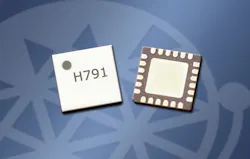
JANUARY 19, 2010 -- Hittite Microwave Corp., a supplier of MMIC-based devices for communication and military markets, has launched a new SMT-packaged, low-noise Divide-by-2, Divide-by-4 designed to support input clock frequencies up to 28 GHz. The HMC791LC4B clock divider is well suited for serial data transmission systems; short, intermediate, and long-haul fiber-optic systems; broadband test and measurement equipment; and 100 GbE applications.
The HMC791LC4B provides simultaneous divide-by-2 and divide-by-4 outputs, and is designed to support clock frequencies up to 28 GHz. Input signals to the HMC791LC4B are terminated with 50 Ohms to ground on-chip, and may be either AC- or DC-coupled. The clock divider outputs support differential and single-ended operation, and are capable of driving up to 600 mV p-p differentially.
Ideal as a high-speed frequency divider, says a company representative, the HMC791LC4B exhibits ultra-low SSB phase noise of -151 dBc/Hz with typical rise and fall times of 12 and 14 ps, respectively. Housed in a compact RoHS-compliant 4x4-mm ceramic SMT package and specified for operation from -40 degrees C to +85 degrees C, the HMC791LC4B draws 200 mA from a single -3.3-V DC supply.
Samples and evaluation PC boards for all SMT packaged products are available from stock and can be ordered via the company’s e-commerce site or via direct purchase order.
Visit Hitite