Co-packaged optics deployments will start in 2026, says Cignal AI

What is co-packaged optics?
Co-packaged optics is a technology that directly integrates optical components into a switch ASIC package to address next-generation bandwidth and power challenges. CPO addresses the problem of overloading the number of optical modules after ultra-high computing power, and the optical engine is moved near the switching chip to reduce the transmission distance and improve the quality of high-speed electrical signal transmission.
Driven by growing demands for AI bandwidth and connectivity, Co-Packaged Optics (CPO) are migrating to actual network deployments.
However, Cignal AI cautioned in its latest Active Insight report that large-scale CPO deployment is not expected for three to five years, but some initial deployments will start in 2026.
Further, the research firm noted that although technical and manufacturing challenges hinder high-volume CPO, its adoption is inevitable for specific applications.
Hyperscalers and Nvidia, which have the scale and vertical integration to test out proprietary concepts, will drive early volume deployments of CPO.
Initial volume deployments will be proprietary and prioritize innovation before standardization. These deployments will originate at large hyperscalers and Nvidia, which has the scale and vertical integration to take on the sizable technical risks.
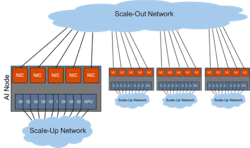
One of the initial applications for CPO is in the scale-up AI networks. In this scenario, CPO will enable higher connectivity and longer distances than copper.
As AI nodes expand, the initial high-volume deployments will start in the scale-up network as an alternative to copper before migrating to the scale-out network. In the scale-up, hyperscalers will struggle to keep up with bandwidth, density, and power demands, but today, copper still has the upper hand in terms of power and cost.
Cignal AI said these factors make it “hard to dislodge” copper in favor of CPO.
CPO’s impact on pluggable optics will be minimal during the copper replacement process. However, once this application is proven in volume, CPO cannibalizes pluggable optics in scale-out applications.
While the scale-out is already optical-based and could be a good place to initiate CPO deployments, the research firm notes that existing solutions working well (pluggable) and improved solutions that can be adopted (LPO/LRO) are available. As a result, there is less immediate need for CPO.
“The industry recognizes CPO’s undeniable benefits, but the technology is still not competitive with pluggable optics which are working well,” says Scott Wilkinson, lead analyst at Cignal AI. “There are positive signs for CPO deployment by 2026, but large-scale deployments will require investment by motivated industry actors like hyperscalers or Nvidia.”
For related articles, visit the Business Topic Center.
For more information on high-speed transmission systems and suppliers, visit the Lightwave Buyer’s Guide.
To stay abreast of fiber network deployments, subscribe to Lightwave’s Service Providers and Datacom/Data Center newsletters.
About the Author
 Sean Buckley
Sean Buckley
Sean is the Editor-in-Chief of Lightwave. He establishes and executes Lightwave's editorial strategy across its website, email newsletters, events, and other information products. Before coming to Lightwave in July 2023, he served as editor of Broadband Communities. Earlier, he served as senior editor of FierceTelecom and the editor of the former Telecommunications Magazine. He got his start in the optical industry in 1998 when he became the editor of enterprise and optical networks at Information Gatekeepers. He has a BA in English from the University of Massachusetts, Boston, and lives in Dracut, Mass, with his wife, two sons, and his cat, Dove.