Corning’s CEO says there’s enough fiber in the world to meet demand
Key Highlights
- Corning is expanding manufacturing capacity in North Carolina to address fiber shortages impacting U.S. data center and broadband projects.
- The company has secured a multi-year, up-to-$6 billion agreement with Meta to support AI and data center infrastructure growth.
- Corning’s optical communications sales increased by 24% in Q4, driven by enterprise and hyperscale data center demand.
- Long-term agreements with major clients demonstrate Corning’s commitment to supporting next-generation connectivity solutions.
- Despite supply chain challenges, Corning emphasizes innovation in high-density fiber and connectivity products to improve performance and reduce costs.
Keep up to date with Lightwave’s earnings coverage.
You can check our publication’s key segments:
And
Here are other stories on Corning:
- Corning sees growth opportunities in the hyperscaler data center’s scale-up segment
- Corning’s CEO: Data Center Interconnection will be a $1B opportunity
- Corning’s Q1 Optical Communications results signal service providers' inventory glut ending
- Corning’s AI push bolsters fourth-quarter Optical Communications results
Corning has addressed concerns about a fiber shortage head-on by ramping up its manufacturing facilities and emphasizing the potential of its connectivity and next-gen connectivity platforms for data centers and broadband operators.
This comes as a series of reports indicates an ongoing shortage of fiber cable in the United States, driven by data center expansions for AI and federal broadband (BEAD) funding, resulting in significant project delays and extended lead times into 2026.
As of early 2026, lead times for ribbon fiber are over 60 weeks, while loose tube fiber for outdoor, rural, and FTTH projects is backordered into the third quarter of this year.
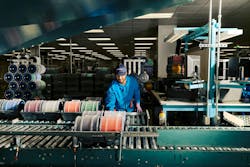
Corning is working with customers to secure funding to expand manufacturing, specifically at its Hickory, North Carolina, plant, to meet the needs of partners like Microsoft and now Meta, which signed a $6 billion fiber deal with the company earlier this week.

Speaking to investors during its fourth-quarter 2025 earnings call, Wendell Weeks, CEO and Chairman of Corning, noted that “there is enough fiber in the world to meet demand.”
Weeks emphasized that the company is seeing demand not only for fiber but also for cabling and connectivity products, such as its GlassWorks AI™ solutions for data centers and co-packaged optics (CPO), which are gaining momentum.
“Our capacity expansions are about our new high-density products in fiber, in cable, and in connectivity,” he said. “And for those, we are experiencing a very, very robust demand. That is why we continue to expand our capacity and improve our productivity for these products.”
He added that “over time, you'll see the mix impact of these more valuable innovations,” which will “enable our customers to have better and more reliable optical performance in about half the space with significantly reduced installation cost.”
Ramping long-term agreements
Regardless of any pending fiber shortage, Corning continues to ink agreements with key customers, including Meta.
On the eve of its fourth-quarter earnings announcement, Corning announced a multi-year up-to-$6 billion agreement to support Meta's apps, technologies, and AI plans using its fiber, cable, and connectivity solutions.
As part of the agreement, Meta will serve as the anchor customer for the expansion and upgrade of our manufacturing and technology capabilities across our North Carolina operations.
“This long-term partnership with Meta reflects our commitment to develop, innovate and manufacture the critical technologies to power next-generation data centers here in the U.S,” Weeks said.
While he did not call out specific customer names, Weeks noted that it is “concluding similar long-term agreements with other major customers to dedicate capacity for them as well.”
Enterprise, Gen AI drive optical growth
The ongoing adoption of our new Gen AI products led to Corning’s fourth-quarter Optical Communications results.
The fiber manufacturer’s Optical Communications fourth quarter sales were $1.7 billion, up 24% year-over-year. Net income was $305 million, up 57% year-over-year, and the net income margin was 18%.
For the full year of 2025, sales were $6.3 billion, up 35% year-over-year. Net income was $1 billion, up 71% year-over-year.

Edward Schlensinger, CFO of Corning, said an uptick in enterprise business sales drove the growth of 2025 full-year Optical Communications earnings.
“For the full year, our enterprise business, where we capture sales inside the data center, grew 61% year-over-year,” he said. “And the hyperscale data center portion of our business grew significantly faster.”
Likewise, Corning’s carrier networks business grew 15% year-over-year. Schlesinger said sales primarily drove this “growth to interconnect data centers.”
Schlesinger added that we expect the [data center] segment to continue to drive significant growth,” and that “our recent Meta announcement is a great proof point.”
Looking ahead, Corning expects year-over-year sales growth to accelerate, with sales approximately 15% higher, in the range of $4.2 billion to $4.3 billion for data center interconnection and fiber-to-the-home (FTTH).
For related articles, visit the Business Topic Center.
For more information on high-speed transmission systems and suppliers, visit the Lightwave Buyer’s Guide.
To stay abreast of fiber network deployments, subscribe to Lightwave’s Service Providers and Datacom/Data Center newsletters.
About the Author
 Sean Buckley
Sean Buckley
Sean is the Editor-in-Chief of Lightwave. He establishes and executes Lightwave's editorial strategy across its website, email newsletters, events, and other information products. Before coming to Lightwave in July 2023, he served as editor of Broadband Communities. Earlier, he served as senior editor of FierceTelecom and the editor of the former Telecommunications Magazine. He got his start in the optical industry in 1998 when he became the editor of enterprise and optical networks at Information Gatekeepers. He has a BA in English from the University of Massachusetts, Boston, and lives in Dracut, Mass, with his wife, two sons, and his cat, Dove.