Charter, Verizon and Zayo acquisitions to shake up 2026 Ethernet rankings
Key Highlights
- Major acquisitions by Verizon, Charter, and Zayo are expected to significantly alter the U.S. Ethernet market share landscape in 2026.
- AT&T and Comcast continued to grow in 2025, driven by fiber expansion and enterprise solutions, maintaining their leadership positions.
- Ethernet DIA remains the top service, with double-digit growth forecasted, due to its reliability and SLA guarantees for business applications.
- The market is shifting towards larger providers with enhanced fiber and service capabilities, increasing competition and market complexity.
- Consolidation and fiber investments are expected to drive rapid growth and innovation in Ethernet services for enterprise customers.

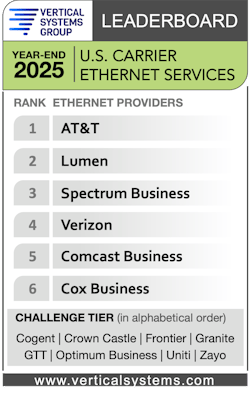
Driven by aggressive fiber and service rollouts, the U.S. Ethernet market remains dominated by AT&T and five other companies, even as the market transitions.
Vertical Systems Group noted that six companies secured a position on the year-end 2025 U.S. Carrier Ethernet LEADERBOARD: AT&T, Lumen, Spectrum Business, Verizon, Comcast Business, and Cox Business.
Each of these network providers has four percent (4%) or more of the U.S. retail Ethernet services market to qualify for a LEADERBOARD rank.
However, change is on the horizon.
As these providers complete their pending acquisitions of Cox, Frontier and Crown Castle, it could alter the market share in the Ethernet services market.
M&A deals will alter the Ethernet market
In 2026, the Ethernet market will see a shift as a group of key acquisitions is completed. AT&T, Charter, Verizon and Zayo all purchased assets that will advance their network reach and service capabilities with an expanded set of fiber assets.
Here’s a quick roundup of the key deals announced in 2025:
· AT&T sets path to reach 60M fiber locations by 2030 with Lumen fiber business acquisition
· Charter and Cox $34B merger creates a broadband and business service powerhouse
· Verizon snaps up Frontier for $20B in bid to bolster fiber broadband base
· Zayo deepens metro fiber scale with $4.25B Crown Castle’s fiber solutions acquisition
Verizon’s now-completed acquisition of Frontier, Zayo’s pending acquisition of Crown Castle’s fiber business, and Charter’s move to complete its acquisition of Cox will create three larger competitors in the Ethernet race, each with a larger war chest of network and service capabilities to serve business customers.
Crown Castle, Frontier, and Zayo have been ranked in VSG’s Challenge Tier, which includes providers with a 1%-4% share of the U.S. retail Ethernet market.
The U.S. Ethernet market rankings will see significant change this year due to a trio of large acquisitions that have been completed or are in progress.
“While the U.S. Ethernet Leaderboard remained unchanged through 2025, we expect major reshuffling in 2026,” said Rick Malone, principal of Vertical Systems Group. “Top provider rankings will shake up this year due in part to Verizon’s now-completed acquisition of Frontier, Zayo’s impending acquisition of Crown Castle’s fiber business, and by mid-2026, Charter is expected to complete its acquisition of Cox.”

AT&T, Comcast make gains
As the Ethernet market braces for the impact of new acquisitions, 2025 once again showed that AT&T and Comcast Business made the largest strides.
AT&T and Comcast Business were the only LEADERBOARD companies with Ethernet port share gains in 2025.
While AT&T saw the typical TDM legacy decline in the fourth quarter, it also continued to contend with the ongoing growth of fiber, wireless, and IP services. AT&T’s Business Wireline revenues declined 7.5% year-over-year due to what the company noted was continued declines in legacy and other transitional services of 17.5%, partially offset by 6.8% growth in fiber and advanced connectivity services.
John Stankey, CEO of AT&T, told investors during its fourth quarter earnings call that it plans to reach approximately 5 million locations annually through the end of the decade with fiber, which would “drive rapid expansion of our opportunity to sell fiber and 5G together, to both households and businesses at unmatched scale.”

Rosemary Cochran, principal of Vertical Systems Group, said AT&T’s aggressive fiber build and service efforts have enabled it to maintain the top spot on the Ethernet LEADERBOARD.
“AT&T ranks first on the 2025 U.S. Ethernet Leaderboard, driven by DIA port growth, expansion of gigabit Ethernet services, advanced fiber deployments, and secure AI-powered connectivity offerings,” she said.
AT&T could also further its Ethernet and overall business services reach when it completes its acquisition of Lumen’s fiber assets
Likewise, Comcast Business continued to make gains in the fourth quarter and throughout 2025. Driven by an increase in revenue from enterprise solutions offerings, including the results from a recent acquisition, Comcast Business's revenues rose 5.8% year-over-year and 3% quarterly to $2.59 billion.
The cable MSO announced in 2025 a plan to expand DIA services to 1 million locations as part of an $80 billion network investment.
“Comcast Business gained Ethernet port share in 2025 as the company expanded its DIA services and high-speed Ethernet capabilities, in addition to broadening its U.S. fiber footprint,” Cochran said.
Dedicated Internet Access (DIA) dominates
In the Ethernet services market, Dedicated Internet Access (DIA) remains the top-selling service.
The growth of DIA comes as other services, such as EPL, EVPL, Metro LAN, E-Access to VPN, and WAN VPLS, all show flat or declining port growth.
VSG forecasts that Ethernet DIA will grow at a double-digit CAGR between 2024 and 2029.
What’s compelling about DIA is that, unlike shared broadband platforms, it provides consistent, reliable speeds during peak hours with strict Service Level Agreements (SLAs), making it ideal for cloud apps, VoIP, and data-intensive operations.
“The major dynamic for the 2025 U.S. Carrier Ethernet market is that while Ethernet DIA ports increased by double digits, this growth was offset by a flat or eroding port outlook for all other service segments - EPL, EVPL, Metro LAN, E-Access to VPN and WAN VPLS,” Cochran said.
For related articles, visit the Business Topic Center.
For more information on high-speed transmission systems and suppliers, visit the Lightwave Buyer’s Guide.
To stay abreast of fiber network deployments, subscribe to Lightwave’s Service Providers and Datacom/Data Center newsletters.
About the Author
 Sean Buckley
Sean Buckley
Sean is the Editor-in-Chief of Lightwave. He establishes and executes Lightwave's editorial strategy across its website, email newsletters, events, and other information products. Before coming to Lightwave in July 2023, he served as editor of Broadband Communities. Earlier, he served as senior editor of FierceTelecom and the editor of the former Telecommunications Magazine. He got his start in the optical industry in 1998 when he became the editor of enterprise and optical networks at Information Gatekeepers. He has a BA in English from the University of Massachusetts, Boston, and lives in Dracut, Mass, with his wife, two sons, and his cat, Dove.