AT&T’s Lumen fiber deal could boost its converged business services outlook
Key Highlights
- AT&T’s acquisition of Lumen’s fiber assets aims to reach over 40 million customer locations by the end of this year, up from 32 million in 2025.
- The company plans to expand its fiber reach by approximately 5 million locations annually through 2030, enabling more bundled wireless and wireline services.
- Fiber availability correlates with higher postpaid subscriber share, with areas offering fiber showing a 10 percentage point increase in postpaid phone subscriptions.
- Converged service packages have led to top rankings in brand love and Net Promoter Scores among consumers and small businesses, highlighting customer loyalty.
- Despite growth in fiber and advanced connectivity, legacy business lines continue to decline, but future revenues from wireless, fiber, and fixed wireless are expected to offset these losses.

Keep up to date with Lightwave’s earnings coverage.
You can check our publication’s key segments:
And
Here are other stories on AT&T:
· AT&T’s CEO says convergence is part of the structural realignment of the telecom industry
· AT&T Business offers businesses a 30-day trial program for fiber and wireless services
· AT&T’s CEO says its scalability enables agility in its fiber build
· AT&T sets path to reach 60M fiber locations by 2030 with Lumen fiber business acquisition
· AT&T’s CFO sees business revenue potential in fiber and broadband wireless
AT&T’s completion of its acquisition of Lumen’s fiber assets is not only about scaling its consumer fiber segment, but it could also have potential implications for its business services segment, in that it gives the provider more opportunities to sell bundled wireless and wireline services to local businesses in the new markets it will enter.
Already, AT&T is the dominant provider of fiber-lit business buildings, reflecting the service provider’s gain in new business fiber installations.
The service provider retained the #1 position on Vertical Systems Group’s U.S. Business Fiber LEADERBOARD for a ninth consecutive year. This factor will likely continue when the research firm releases its next report later this year.
A key element of the Lumen acquisition is scale.
Given its GigaPower venture and Lumen fiber assets, AT&T expects to reach more than 40 million customer locations with its fiber services by the end of this year, up from 32 million at the end of 2025.

Speaking to investors during its fourth-quarter earnings call, John Stankey, CEO of AT&T, said the company will increase its annual fiber build, enabling it to deliver wireless and wireline bundles to more consumers and businesses.
“Beyond 2026, we plan to expand our fiber reach by approximately 5 million locations annually through the end of this decade,” he said. “We expect this to drive rapid expansion of our opportunity to sell fiber and 5G together, to both households and businesses at unmatched scale.”
Capitalizing on convergence
AT&T’s fiber network has become a catalyst for its wireless and wireline convergence strategy, which focuses on providing bundled service packages for consumers and businesses.
In markets where AT&T has fiber, the service provider estimates its share of postpaid phone subscribers is 10 percentage points higher in areas where it offers fiber.
“We estimate that our share of postpaid phone subscribers is 10 percentage points higher in areas where we offer fiber and in areas where we don't,” Stankey said. “The power of our converged offers is evident across our business. In areas where we offer converged services, we rank #1 in brand love and #1 in Net Promoter Score with consumers and small businesses in both wireless and Internet connectivity.”
He added that “we're #1 or #2 with medium-sized businesses and enterprises. Scores for our converged offers are not simply better than our stand-alone services; they're improving in most categories.”
Legacy to next-gen tangles
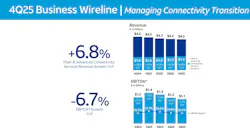
As in earlier quarters, AT&T continued to contend with the growth of fiber, wireless, and IP services, while its legacy business lines continued to erode.
AT&T’s Business Wireline revenues declined 7.5% year-over-year due to what the company noted was continued declines in legacy and other transitional services of 17.5%, partially offset by 6.8% growth in fiber and advanced connectivity services.
Operating expenses were down 8.2% year over year, driven by lower personnel costs, savings from transformation initiatives, and lower network costs.

Pascal Desroches, CFO of AT&T, said its business customers are leveraging a range of wireline and wireless services, including Internet Air.
“Our business customers continue to use a range of fixed connectivity services across different stages of their life cycles,” he said. “Over the past few years, growth in our business fiber and advanced connectivity services, which include fixed wireless, has been more than offset by declines in business transitional and other services, which include mature product categories such as VPN.”
Looking forward, Desroches expects business service revenues from wireless, fiber, and fixed wireless to surpass legacy losses.
“Our outlook anticipates that service revenues from business customers across wireless, fiber, and fixed wireless will accelerate over the next several years and more than offset expected continued declines in transitional and other services,” he said. “Altogether, we expect that total business service revenues within the Advanced Connectivity segment will grow at a low single-digit CAGR through 2028.”
For related articles, visit the Business Topic Center.
For more information on high-speed transmission systems and suppliers, visit the Lightwave Buyer’s Guide.
To stay abreast of fiber network deployments, subscribe to Lightwave’s Service Providers and Datacom/Data Center newsletters.
About the Author
 Sean Buckley
Sean Buckley
Sean is the Editor-in-Chief of Lightwave. He establishes and executes Lightwave's editorial strategy across its website, email newsletters, events, and other information products. Before coming to Lightwave in July 2023, he served as editor of Broadband Communities. Earlier, he served as senior editor of FierceTelecom and the editor of the former Telecommunications Magazine. He got his start in the optical industry in 1998 when he became the editor of enterprise and optical networks at Information Gatekeepers. He has a BA in English from the University of Massachusetts, Boston, and lives in Dracut, Mass, with his wife, two sons, and his cat, Dove.