Shentel’s CEO says Starlink only impacts its rural incumbent broadband markets
Key Highlights
- Shentel is responding to Starlink's rural expansion by increasing broadband speeds to retain customers and reduce churn.
- The company’s fiber network now spans over 19,000 miles with more than 700,000 passings across 8 states, aiming to reach 510,000 passings by 2026.
- In Q1, Shentel added approximately 6,000 new customers and grew its revenue by 4.8%, driven by Glo Fiber expansion and increased passings.
- Despite some ARPU decline, 82% of new residential customers opted for speeds of 1 Gbps or higher, indicating strong demand for high-speed broadband.
- Shentel plans to complete 1,800 additional government-subsidized passings in 2026, primarily in West Virginia, supporting its growth strategy.

Keep up to date with Lightwave’s Q1 2026 earnings coverage.
You can check our publication’s key segments:
And
Here are other stories on Shentel:
- Shentel sees incremental revenue potential with the rural data center movement
- Shentel’s CEO says it would be interested in acquiring a pure-play fiber player
- Shentel’s CEO says it is on track to complete its fiber broadband build by the end of 2026
- Shentel's CEO: Residential Glo Fiber and commercial fiber to surpass incumbent revenues next year
Shentel isn’t afraid of Starlink’s movement into its rural territories since it can respond with a competitively priced fiber broadband service. Still, the churn it saw in these markets during the first quarter shows how new broadband players do affect incumbent markets.
Ed McKay, CEO of Shentel, told investors during its first-quarter earnings call that Starlink’s presence affected only parts of its rural incumbent area. “We only saw the impact in the most rural areas of our incumbent broadband market,” he said. “We saw really no impact in Glo Fiber and no impact in the majority of our incumbent passings.”
Starlink, whose parent SpaceX is preparing to go public later this year, began offering not only a promotional $15 discount, but also free equipment that typically costs $350.
However, McKay noted that the one weapon it can use to battle customer churn in these markets affected by Starlink is its ability to raise broadband speeds.
“We can increase speeds,” he said. “So, we've done that. Late in the first quarter, we increased speed significantly in our rural incumbent areas. Most of those customers who left were on legacy rate cards. So, we've given those customers more value for the same price, and we think that will help mitigate.”

Glo Fiber on track
Now that it has launched all its planned Glo Fiber markets, Shentel has shifted its focus to adding passings in its existing Virginia, Pennsylvania, Maryland and Ohio markets.
The service provider’s integrated broadband network spans more than 19,000 fiber route miles across 8 states, with over 700,000 total broadband passings.
“We remain on track to complete our Glo Fiber expansion in 2026, reaching 510,000 passings,” McKay said. “Our sales and marketing team continues to drive strong growth across our Glo Fiber expansion markets.”
Shentel also saw growth in video, voice and data. During the first quarter, Shentel added approximately 6,000 new customers and nearly 7,000 revenue-generating units across video, voice, and data, a 9% improvement over the prior year, and now serves a total of 94,000 customers.
Over the past 12 months, it added more than 23,000 new data customers and more than 26,000 total RGUs. Total Glo Fiber revenue-generating units surpassed 110,000 in the first quarter, up 31% compared to the prior year.
The first quarter was also a time of growing fiber passings. In the first quarter, Shentel added 22,000 passings, bringing the total to more than 449,000.
“Coupled with the continued increase in homes passed, penetration rose to 20.9%, a 30-basis-point increase over the fourth quarter and a 150-basis-point increase year-over-year,” McKay said. “Penetration trends across our Glo Fiber cohorts reflect blended penetration rates for both residential and small and medium business passings.”
ARPU challenges, opportunities
As Shentel faces growing competition from satellite broadband and fixed wireless, it is taking steps to mitigate churn with new speed offerings.
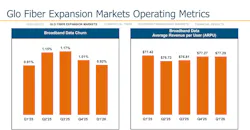
Shentel’s broadband data churn overall was stable sequentially and up “modestly year-over-year” at 1.46% for the first quarter. Broadband data average revenue per user for the first quarter was stable sequentially and year over year at more than $77.
The service provider noted a slight uptick in churn due to promotional activity from satellite competition in some of its most rural markets without a fixed wireline competitor. In these markets, it implemented a speed increase late in the first quarter, providing customers with higher speeds at the same price to better differentiate its service from satellite offerings.
Also, in about one-third of its passings against another fixed broadband competitor, its strategy of offering higher speeds at the same price continues to be effective at mitigating churn.
Shentel is having success selling higher speeds, with 82% of its new residential customers in the first quarter selecting 1 Gbps or higher, including 18% choosing 2 Gbps and 5% choosing 5 Gbps.
However, McKay noted that “broadband data ARPU declined 1.6% from a year ago to $82, driven by the addition of new customers with more aggressive pricing in our competitive markets.”
Shentel’s Q1 revenue breakdown
Shentel saw varying results across its segments:
- Residential & SMB - Glo Fiber Expansion Markets: Due to a 33.7% increase in data revenue-generating units (RGUs), revenue (26.9% of total) increased $6.4 million, or 34.6%.
- Residential & SMB - Incumbent Broadband Markets: Revenue declined $2.2 million, or 5.1%, due to a 14.6% decline in video RGUs, and a 1.6% decline in data average revenue per user (ARPU).
- Commercial Fiber: Due to an increase in recurring revenue resulting from additional circuit services sold to existing customers, Commercial Fiber revenue rose $0.9 million, or 4.7%.
- RLEC & Other: Due to a 28.0% decrease in Digital Subscriber Line RGUs and a $0.3 million decrease in government support revenue, revenue decreased $0.8 million, or 13.0%.
Glo Fiber drives Q1 growth
Shentel’s first-quarter revenues reflected its aggressive Glo Fiber build out strategy.
Driven by strong Glo Fiber expansion, market revenue growth of $6.4 million, or 34.6%, due to a 33.7% increase in data subscribers and stable data ARPU, first-quarter revenue grew 4.8% to $92.2 million.
Commercial Fiber revenue grew $900,000 or 4.7% year-over-year, driven primarily by growth among existing customers in the enterprise and carrier verticals.
Meanwhile, Shentel’s incumbent broadband markets revenue declined $2.2 million, mainly due to lower video revenue from a 14.6% decline in video RGUs as customers switched to streaming video services and, to a lesser extent, lower data revenues due to a 1.6% decline in data ARPU from a more aggressive rate card in competitive markets.
While experiencing some declines due to losses in traditional video, Shentel’s incumbent markets are on track to grow through publicly funded broadband projects.
At the end of the first quarter, Shentel served over 111,000 broadband data customers. Data, voice, and video RGUs were over 156,000 at the end of 2025, down 4% year-over-year, primarily due to video customers moving to online streaming services.
McKay said that “total broadband passings in our incumbent markets stayed steady compared to the fourth quarter, and we expect to complete 1,800 additional government-subsidized incumbent grant passings in 2026, primarily in West Virginia.”
RLEC revenues declined $800,000, primarily due to lower DSL revenue from a 28% decline in DSL RGUs and lower government grant support revenues.
Jim Volk, CFO of Shentel, said: “Half of the decline in DSL RGUs was due to customer upgrades to our broadband service.”
Looking toward full-year 2026, Shentel has forecast revenue of $370 million to $377 million and CapEx, net of grant reimbursements, of $220 million to $250 million.
For related articles, visit the Business Topic Center.
For more information on high-speed transmission systems and suppliers, visit the Lightwave Buyer’s Guide.
To stay abreast of fiber network deployments, subscribe to Lightwave’s Service Providers and Datacom/Data Center newsletters
About the Author
 Sean Buckley
Sean Buckley
Sean is the Editor-in-Chief of Lightwave. He establishes and executes Lightwave's editorial strategy across its website, email newsletters, events, and other information products. Before coming to Lightwave in July 2023, he served as editor of Broadband Communities. Earlier, he served as senior editor of FierceTelecom and the editor of the former Telecommunications Magazine. He got his start in the optical industry in 1998 when he became the editor of enterprise and optical networks at Information Gatekeepers. He has a BA in English from the University of Massachusetts, Boston, and lives in Dracut, Mass, with his wife, two sons, and his cat, Dove.